Search This Blog

Tuesday, March 1, 2022

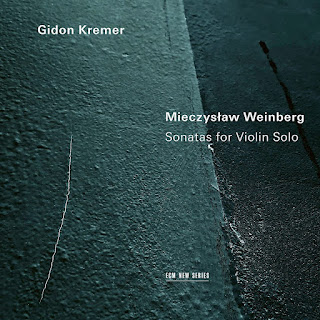
Mieczyslaw Weinberg, Sonatas for Violin Solo, Gidon Kremer


When done well, there is something about a modern work for a solo stringed instrument, or for that matter earlier, equally focused ones, like some heartening Bach for violin or cello. In recent years the music of Polish-Russian master Mieczyslaw Weinberg (1919-1996) has been getting at last the attention it deserves as exemplifying an original and compelling compositional voice that extends the legacy of the local brilliances of Prokofiev, Shostakovich, etc. And there is a realization the more we hear it all that he was a real influence, not just somebody who was influenced.

The remarkable Sonatas for Violin Solo (ECM New Series 2705) as played with a brilliant dedication by Gidon Kremer, manages to be a great set of examples of Weinberg's chamber excellence as well as some of the real gems of Modern solo string music. The three sonatas (written in 1964, 1967 and 1979,  respectively) combine in Weinberg's special way the simultaneous recurrence of slavic diatonics with interrelated edgy chromatic stridency and tension, all of which ratchets up or down according to the compositional flow..

The release comes to mark Maestro Kremer's 75th birthday and some 40 years collaborating with ECM Records. The care with which Kremer brings this to us in every way helps us celebrate the milestone occasion with the Master.

Kremer gives us highly focused, loving, highly articulated attention to the myriad details and levels of development that the music exhibits so creative-poetically throughout. Kremer in turn expresses an emphatic dynamic and at times a tender playfulness that breaks the music up into contrasting dialogics.

This is extraordinary music in extraordinary performance/ Molto bravo!

Monday, February 21, 2022

Kate Soper Featuring Sam Pluta, The Understanding of All Things


Potentially every release in New Music could be something truly in its own world. One needs to take such things seriously because we are talking about somebody's long-term grappling with self-expression. A review may have some bearing on that life, at least ideally, so that it behooves us to approach it all earnestly and attentively.

So today it is such a thing, an album put together with a lot of care and creative thrust. It consists of three compositions of Kate Soper and two improvisations by Kate Soper and Sam Pluta. The album is entitled The Understanding of All Things (New Focus Recordings FCR 322), which is in fact also the title of the first work we encounter in the program's sequence.

The title work, "The Fragments of Parmenides," and "So Dawn Chromatically Descends to Day" are Soper compositions that feature Kate on piano and vocals along with Sam Pluta on live electronics. Then there are two works ("Dialogue I" and "Dialogue II"). They are improvisations by Soper and Pluta with the same lineup as the compositions. more specifically it features text by George Berkeley and Kate Soper, which Kate presents while Pluta creates a live electronics backdrop. The second Dialogues features wordless vocals and piano by Kate and live electronics by Sam.

The Soper-composed works feature absorbing texts--"The Understanding of All Things" (2013-15) by Kafka with deliberate fragmentation initially by Kate and a vital ultra-Modern expressivity of piano and electronics. Kate is her own impressive self on vocals--these are decidedly something more than "composer vocals"--she has an excellent voice that she uses not so much with typical operatic training so much as natural unpretentiousness and precise declamation as called for. The vocal parts are generally in the foreground with modernistic sound color complexities from piano and electronics.

The texts are either poetic or philosophical and so justify their existence by presenting thoughts and feelings worthy of our attention, and make a musical centrality that perfectly opens up to the instrumental and electronic movements in spatio-temporal synchronicity and soundscaping, or in the case of Yeats, song weaving. 

It is all distinctive, haunting, dramatic and absorbing, deep and quite sincere. I sometimes dislike recitation in the contemporary music world, because if the words do not work in themselves, the music cannot save them. This is the opposite--everything works together well and originally. And the words are quite worthy in themselves.

I recommend this one highly. Kate Soper is a new brilliance. Bravo!


Thursday, February 17, 2022

Samuel Coleridge-Taylor, Hiawatha Overture, Petite Suite, RTE Concert Orchestra, Adrian Leper


Samuel Coleridge-Taylor (1875-1912)? It is a name so distinctive you feel as if you already know him. Well I've heard a work or two but do not really, until now and an orchestral anthology that includes Hiawatha Overture, Petite Suite (Naxos 8.556191). It is a considerable sampling that embraces some six works, performed ably and spiritedly by the RTE Concert Orchestra under Adrian Leaper.

Coleridge-Taylor was British, born of mixed descent. Wikipedia tells us he was best known for three  Cantatas based upon the poem "The Song of Hiawatha." They also mention that, thanks to his tours of the USA, he was sometimes known there  as "The African Mahler." If all that doesn't get your attention, it should.

The news on my end is that this Naxos disk gives us a thorough introduction to his music, Late Romantic certainly, but not really sounding like Mahler or anyone else for the most part. His thematic development sometimes seems less of a long-winded later melodist than a more succinct lyricist. His orchestrations sound rather fully expansive in that later mode, but he remains his own person stylistically. All that serves to distinguish him on this program, such that one feels in a rather different world, not all that far from Elgar as much as Mahler. perhaps somewhere in between or just not entirely or easily compared. Every so often, one remembers Delius and his lyric thrust. So all that is a good thing of course.

So coming out of multiple listens here I must say this is music well worth hearing and having. This is one of those programs that to me benefits most from its actual hearing. I could describe things about all six works but you are better off giving it your own set of ears, I think.

So for the record we get to hear the Overture from "The Song of Hiawatha" (1899), the "Petite Suite de Concert" (1910), the "4 Characteristic Waltzes" (1898), the "Gipsy Suite" as arranged by Artock (1927), the "Romance of the Prarie Lillies" as arranged by Fletcher (1931) and finally the "Othello Suite" (1909).

Something that is decidedly "something different" is a good thing. In terms of compositions and performance that is true in every way. I recommend it.


Thursday, February 10, 2022

Simone Dinnerstein, Undersong, Works for Solo Piano


An album of more or less well known piano music needs to have something about it or why go to the trouble? In today's example that is the case. It is pianist Simone Dinnerstein and her album entitled Undersong (Orange Mountain Music 0156). The main thing, the prime mover for hearing this one is that Simone has her way with all the works; she has a very animated expressivity that makes the whole program come alive in an appealing way. And there is more to ponder when you read her liner notes.

First off is the world in which this music took performance shape. This was in fact the third album Simone recorded during the Pandemic, and that isolated ponderousness surely influenced what she chose and how she approached it all. (Type her name in the search box for reviews of the other two companion volumes.) And then too note the title Undersong. This, Ms. Dinnerstein tells us, is a somewhat archaic term referring to songs that have a refrain, that return to a theme continuously. Another way to say it is that the music has a return, a repetition that molds our perception of how we hear it in time and aural space.

Simone's poetic demeanor is apparent in how she describes the project. Each of the composers returns repeatedly to the central thematic material and by so doing transforms the music--harmonically differing, rhythmically transformed, etc., each pass-through varying in some significant way. And out of that Simone recalls a key part of the life as she lived it in lockdown. As she worked with these pieces in the fall of 2020 she also took daily afternoon walks through Green-Wood Cemetery, with each heading outwards and then returning like a different treatment of her existential refrain. And truly, I listened to this album a few times before reading the notes, and once I did I  understood her own meditations behind the music and her life and it made sense to me.

As you listen and gradually understand how Simone was feeling through the music and her daily walks you start feeling the connectivity of the works--which are widely selected from a worthy gathering from a number of periods. Each work is given a very reflective interpretively poetic reading that sets all this apart. 

So we have as bookebnds at the beginning and end Couperin's lovely "Les Barricades Mysterieuses" and in the middle Couperin's :"Tic Toc Choc." Then on either end towards the middle are two by Schumann--the "Arabesque" and his "Kreisleriana" (the latter of which is totally ravishing here, deeply introspected, then explosive in turn.). Phillip Glass's "Mad Rush" takes flight in Simone's hands, bringing it together in a very skillfully poetic way. Finally there is Satie's gorgeous "Gnossienne No. 3." 

Each one of these works gets reflected and refracted in Ms. Dinnerstein's deepest musical wells, so that after a few listens you understand that Simone is gifting us with a kind of focus all her own. So for me anyway the program keeps on getting better, for there are nuances you start picking up on the more you give it all your attention.

Hearing this I am moved. It is a set of performances that reflect and transcend the horror of what we have been through, consoling us that if nothing else the true artists will give us a reason to get through..

Dinnerstein reaches far into the center of this music. Highly recommended.


Wednesday, February 9, 2022

Solomiya Ivakhiv, Poems and Rhapsodies, National Symphony Orchestra of Ukraine, Volodymyr Sirenko


Now pretty many years ago when I worked in a publishing house the Art Director had a radio tuned to a local classical station. Every so often he would call me into his office (mine was next door) and ask, "What is this music!?" Interestingly it was nearly always Vaughan Williams' "The Lark Ascending." He was right to ask. It is exceedingly haunting music, wonderful, and reminds us that Ralph studied with Ravel, but also that his Impressionism contained a large portion of his "musical DNA." The results were very much his. My friend and colleague was right on the money to pay note to that music. 

All this I scrawl to bring us up to today's album, Poems and Rhapsodies (Centaur CRC 3799) which showcases the rather ravishing violin expressions of Solomiya Ivakhiv, along with the National Symphony Orchestra of Ukraine under Volodymyr Sirenko. Joining the proceedings for one piece is US native Sophie Shao as cello soloist.

I bring up Vaughan Williams and "The Lark Ascending" as it is a part of the program, very nicely done, an excellent version with all the special wistfulness of the score on display. 

Throughout the program focuses quite happily on Ms. Ivakhiv's wonderful violin play, sweet enough to carry the feeling this program needs, not sticky sweet, and beautifully poised in her concentrated lyricism. The National Symphony Orchestra of Ukraine with Volodymyr Sirenko at the podium provides us with both the detailed sound staging that this music demands and a sympathetic centrifugal irradiation of lyric fullness.

The key to the music resides in part clearly in the title of the album, Poems and Rhapsodies. The six work program centers on an expression of impassioned sweeps of dramatic sounds, from the Late-Romantic French budding of a dimensional proto-Impressionism in Saint-Saen's "Le Muse et le poete" that features Ms. Ivakhiv along with the cello of Sophie Shao as dual soloists in a rhapsodic introspection that opens further into the present on Chausson's "Poem symphonique," which projects a wonderfully suspended reflectiveness and gives Solomiya a  glowing set of responses to the orchestral ruminations, which she takes in stride and makes of it all something personal.

And then out of the rhapsodic mist there emerges at the most opportune point the wonderful "Lark Ascending" with a very fine absorption of the solo part, deeply thoughtful-wistful and the orchestra laying down a gentle carpet of aural pine needles. Nice job! And like my art directing friend of years back asked, "What is this?" is still relevant, for the music is wonderfully itself and as timeless as it ever has been. 

From there we have a threefold second half of the program with some very Ukranian melodic and rhythmic fine tuning and folk recalling in the works by Anatoly Kos-Anatolsky and Myroslav Skoryk. The two works as presented here give the ultimate argument of why we need to hear and appreciate the works thanks to the considerable beauty and dynamics of the performances. The Kos-Anatolsky "Poem for Violin and Orchestra" was composed in 1962 and lost. Ms. Ivakhiv commissioned Bohdan Kryvopust to reconstruct the work from a recoded source. It is some beautifully intriguing music with Ivakhiv sounding every bit as expressive as you could ask for. And in the process we get the chance to hear this work in near ideal circumstances. It calls forth with a beautifully rhapsodic and then beautifully folk-dance-like. Bravo.

The Myroslav Skoryk "Carpathain Rhapsody" also has wonderful local dance-folk components that the composer skillfully sets up for soloist and orchestra in ways that intrigue and beguile.

To more or less tie things together we are treated to a Modern blockbuster with Kenneth Fuch's "American Rhapsody." It has a furtherance of the beautiful mystery than these works often carry to us in this recording. The Fuchs work has a wonderfully colorful and luminescent quality. It is worth the price of entry alone. 

But of course you get a considerable amount of lovely music here, played with the kind of attention each of these works deserve. Solomiya Ivakhiv has just the right temperament to make each of these works shine with a fabulous tone and virtuoso panache that feels just right. And bravo to the National Orchestra for the care and brilliance with which the music comes to us here.

This one gives you a great deal to appreciate. Do not hesitate!


.
Tuesday, February 8, 2022

Davide Ficco, Asymmetric Thought, Italian Music for Guitar and Electronics


There are some musical releases that are so rich in content that it takes some time to absorb. That is certainly true of guitarist Davide Ficco's Asymmetric Thought: Italian Music for Guitar and Electronics (Davinci Classics C00318 2-cds 1-dvd). It is a set of two CDs and one DVD, covering the music of some 18 Italian Contemporary composers, names you might not recognize unless you are very well versed in the Italian New Music scene today.

The names unfamiliar (to me) do not mean uninteresting, surely. And as you think about it, the asymmetric is a stylistic center-periphery in Modernism music and art, so an important consideration. The music decenters in all kinds of ways. That is a good thing of course. Davide Ficco is an impressive artist in the Modern mode, coming through with articulate and virtuoso insights on the many shifting stylistic nuances, from High Modernist expression to the many tone color and melodic brilliances that are to be had in the set.

The electronics range from a full electronics sound color orchestration  to a transformation of guitar sounds to various possibilities and things in between. It is a rather astonishing wealth of state-of-the-art New Music stylistic niches and in the end a tribute to Davide's open facility and flexibility as well as some pretty remarkable composer contributions taken as a whole. A few add additional instruments--percussion, trumpet, and there are some that have a Jazz-stylistic element.

Note: The DVD gives you multichannel versions of selected tracks from the CDs.

Anyone who loves Modern Classical guitar and/or electronic and acoustic transformations will have a great deal to explore and appreciate. Recommended highly to those who think they might like it from my description.

Monday, February 7, 2022

Douglas Knehans, Cloud Ossuary, Brno Philharmonic Orchestra, Mikel Toms


Living and thriving composer Douglas Knehans exemplifies a certain aspect of New Music today. That is, he does not attempt to occupy a genre so much as to create the music inside him. His latest album gives us that in all its finery, Cloud Ossuary (Ablaze Records ar-00062).

It is a program very well played by the Brno Philharmonic Orchestra under Mikel Toms, Pavel Wallinger nicely appearing on solo violin, with a beautifully wrought soprano performance by Judith Weusten for the single movement that calls for the vocal part.

The album contains two vibrant and essential works, A brief but mysterious "Mist Waves" for solo violin (Pavel Wallinger) and Douglas' "Cloud Ossuary--Symphony No. 4" which is a major work of our present-day to my ears.

When I listen to Douglas Knehans' music (type his name in search box for more reviews) I come away with the feeling that the music coming out of him has a kind of organic singular inevitability--that he has a full-blown melodic-harmonic-orchestrational personality that is eloquent and original, that speaks directly to one's listening muse in ways that keep you focused on the flow of lyric and dynamic articulateness.

So the symphony builds in the three movements very beautifully contrasting sound evocations of clouds. Each fulfills a will to form, so to speak, a sincere expression of the experience of cloud-dom. And too in the best ways the music is lucidly a commentary on itself, on its self-presencing service of looking out upon the world as a musical human. Maybe that seems obvious but this music succeeds in expressing the musical self in a complete and satisfying way and, perhaps, not all that many composers you can say that of. A key is the sureness of orchestration, almost a kind of second nature of one who has explored the inner realms of sonic possibility in considerable depth.

So the contemplative continuance of "Mist Waves" works within itself as a complete being, as does the rhythmic unfolding of the first movement of the 4th, "The Ossean Cage." Then we get transported to the gorgeously hovering sustains of "Breathe Clouded" And then the longer final centers upon the beautifully apposite soprano floating above a singular series of orchestrational aural poems. It is a rich and complex tapestry of a movement, something to sink into with absorption.  For a moment you may call to mind the gargantuan enormity of a Mahler, the orchestrational sensuality of a Ravel, but then no, this is music of the present, music of the present as fertilly imagined by Douglas Knehans, not quite Modern in the typical way, nor a backward leaning in a reverse mirror on it all. It is K-n-e-h-a-n-s.

And that is a wonderful thing to me. Dive into this one of you will. There is much to live with, to grow into. Bravo!