Search This Blog

Thursday, July 28, 2022

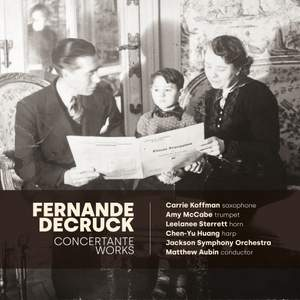
Fernande Decruck, Concertante Works, World Premiere Recordings

If you asked me before I went to the mailbox the other day who was Fernande Decruck, I would have said I had no idea. But here we are a few days later and I have been listening to the album of her Concertante Works  (Claves SO-3056) some in premier recordings, some in premiere performances. She is a she, first off, which explains in part why maybe you've never heard of her? Women and Jews, according to some in the earlier days, supposedly did not make good composers. Well that turned out to be utter nonsense, of course. So to further debunk that myth here is the music of Ms. Decruck, who was French, born auspiciously enough on a December 25th, 1896 and leaving this earth on August 6, 1954. 

The album is one that takes a bit of patience to start with. After a while it begins to get through to your ears, to have a cogency, a definite French evocative sense of melodic form. She is not quite Ravel or Debussy-esque. But then she has her own lyrical sense. It is a happy discovery if you give it a chance-- well played by soloists and the Jackson Symphony Orchestra conducted by Matthew Aubin.

The album has three concerted-like works for solo instruments and orchestra. She apparently wrote quite a few works for saxophone, including the opening "Sonate et un diese pour saxophone (ou alto) et orchestre."  Also well worth your ear time is the "Poem Heroique" for trumpet and orchestra and finally the (to me) especially charming "Concerto pour harpe et orchestre."

Strongly recommended. Give it a listen by all means!   

String Orchestra of Brooklyn, Enfolding, The Music of Scott Wollschleger and Anne Leilehua Lanzillotti

Every day is a new day. And every day out there there is new music to be heard, things you may not know from people you may not know. I feel I should cover as much as I can, so I do. Of course that is a problem because when nobody knows an artist they may not respond to the article and I perhaps am doing myself in? Well I cannot help that.

So today I've got another for you, something worth checking out, something local for me, not far from where I am so I feel the need to cover it even if you do not know it. It is by the String Orchestra of Brooklyn, who sound very good here.  The album is entitled Enfolding (New Focus Recordings FCR 331).

It is a gathering of new and worthy works that you might know nothing about until now. That was the case for me. It features Scott Wollschleger and his 15 minute "Outside Only Sound," and then Anne Leilehua Lanzilotti's Pulitzer Prize nominated work "With eyes the color of time."
Now both works are in a kind of PostModern, not quite Minimalist mode. Both works have something distinct and original to impart and the String Orchestra of Brooklyn give us a sincere, committed and very together reading of both works.  "Outside Only Sound" has a fascinatingly hypnotic wall-of-sound quality about it. "with open eyes the color of time"  gives us a wonderful title and the nine part work itself takes us for a ride with slowly unfolding drone-sustain-melodies in stop time and then, well, listen!

Now if you are not really in the mood to explore the very new, you might not want to venture here. But if you are ready for a real musical adventure, this is one to add to your listening pile! Very happily recommended!

Tuesday, July 12, 2022

Elaine Greenfield, Ravel Compared, Solo Piano Works on Two Period Instruments


As I write these lines it is peak summer outside, a sunny morning surely made for Ravel's piano music. So I feel all is well as I listen to the two-CD set at hand, Ravel Compared (Navona NV6401) as played with real artistic vibrancy by Elaine Greenfield. I might argue that Ravel was at the very top of 20th century composers for the piano. It is not like I would be saying something not already generally felt out there. And as times goes on I still feel that way, not surprisingly.

What is especially nice about this compilation is that each of the two CDs features the same repertoire, only Ms. Greenfield plays each set on a different period instrument. CD 1 features an 1893 Erard from Paris; CD 2 features an 1917 Ivers & Pond from Boston. MS. Greenfield responds to each piano as she feels it. The Erard has a great kind of mirrored liquidity, the Ivers & Pond has a sunshiny woodiness equally charming. As you listen to each you feel you are closer to the music the way Ravel himself may well have heard it. But at the same time you hear Elaine's unwavering sympathy to the works and her open nd poetic readings, more about the warmth and lucidity of the music than some technical self-aggrandizement.

So the works chosen sound great in slightly varying ways each outing."Pavane Pour Une Infante Defunte" reminds us how wonderful his melodic-harmonic gifts were. Then we get to appreciate Ms, Greenfield's well varying readings of the "Sonatine," a couple of movements from "Miroirs," his "Valses Nobles et Sentimentales," "Gaspard de la Nuit," and :"Le Tombeau de Couperin."

Anyone who has communed in the Ravel pianistic approach will have plenty to appreciate in Elaine Greenfield's supreme artistry. A newcomer to the music would benefit from hearing both piano-based versions and their heightened lyrical dynamics. Strongly recommended!

Thursday, July 7, 2022

Gene Pritsker, Cloud Atlas Symphony, MDR Leipzig Radio Symphony, Kristjan Jarvi


I've appreciated composer Gene Pritsker since I first started listening to his album releases. Nothing has changed and I am always glad to hear more whenever I can. The new one is especially special because it gives us a wonderful reading of the Cloud Atlas Symphony (NEscapes Records), a compelling thing to hear indeed. This album fulfills the Pritsker promise of an assumption of all that has come before but then something only Gene might create as the furtherance, the comeback, the rejoiner and the return volley? Well yes, yes it does.

I am perfectly serious about all that above. It is ever an adventure when Gene gets a project going. And here with the Cloud Atlas Symphony we get an excellent performance and a high quality recording of the work. As Gene expresses it on the promo sheet, there is the original world of Cloud Atlas the novel, there is the film made on the basis of the story, there is the movie soundtrack Gene adapted for it, and then there is the symphony as it is an extension, expansion, and an abstraction of all of the above.

And as I listen a bunch of times I feel the story theme obliquely but I hear the symphonic presence of it all as a beautifully descriptive set of passages that somehow channel Brahms and everybody after yet make of it all something new!

Now the full symphony comes at us in six dynamic movements, and then there are three additional segments written by Tom Tykwer. Johnny Klimek and Reinhold Heil, all masterfully orchestrated by Gene. I am not sure how they relate to the symphony but it does not entirely matter because they are intriguing and hypnotic and add something definite to the program. Well, OK I get it I just realized that underneath the Symphony notes it says "based on the music from the film Cloud Atlas written by" the three composers mentioned above. OK, right.

What we have in the end is one cohesive sequence of powerfully constructed and deeply expressed musical fare and another beautifully wrought feather in the Gene Pritsker compositional cap. Bravo! Very strongly recommended.


Wednesday, July 6, 2022

Steven Ricks, Assemblage Chamber


There is much, ever so much New Music still, and the day we take it for granted is the day we must renew our love of being here with the music in the present-tense.. So, good readers, I come to you today with a kind of bubbling under excitement of a new disk of chamber works by Steven Ricks, in an album named after one of the compositions, Assemblage Chamber (New Focus FCR328). 

There are Baroque elements, both musically and in instrumentation, at times and the overall impression I get is of a highly singular Neo-Classical Modernism of today. Liners author Michael Hicks instructs us to remember the Baroque as channeled by Ricks not "as a kind of stone-tablet monument to the intellect or dexterity," but rather something "sown with adventure, defiance, mannerism, improvisation, eclecticism and spectacle." The second cautionary assertion is not to "Take 'baroque" and attach a 'neo-' to it" which to Hicks entails imitating "seventeenth or eighteenth century style with a few token dissonances or syncopations" to make it Modern. Well that of course is not to be desired, but what does that have to do with the prefix "neo-," except perhaps as abused in the must facile of Neo attempts? If so, I agree. But then I might wonder, does Stravinsky qualify as Neo-Classical in some of his middle period music? And is it not completely and utterly Stravinsky-esque? Of course. And Hicks is right to caution us away from some mechanical vision of the period as it speaks to us, and truly Steven Ricks gives us nothing at all mechanical here, instead a living, breathing New Music that draws inspiration from the past but then transforms it into his own compositional matrix, just as he does the "Modernist" element as he claims it as his own. 

There is nothing borrowed in this music as much as it is explored in transformation. And if "neo" still means "new" then Neo-Classical would only mean New Music in a Classical mode, which may then refer to elements of earluer periods incorporated but not necessarily to imply a servile copyist's vision, for surely Steven Ricks is a visionary as much as anything! I actually agree with Hicks, just not his abandonment of "neo" as a descriptor. But of course what matters is the music. And that is something to appreciate for sure.

So for example the "Reconstructing the Lost Impressions of Aldo Pilestri (1683-1727)" from 2018 includes transformed quotations from Vivaldi's "Seasons" but a great deal more elsewise to the naked ear, nicely scored for prepared guitar, violin, viola, cello, and bass clarinet. The end-experience of the music is simultaneously appropriation-transformation of the earlier musical world yet also completely immersed in the this-world of Modernity. 

"Heavy with Sonata" (2021) takes the violin, viola and harpsichord medium and parallels the Baroque chamber sonata as rejuvenated and re-created to Ricks' own vision of musical unfolding.

The remaining "Piece of Mixed Quartet" (2011) and the electroacoustic cut and reassembled, ravishing "Assemblage Chamber" (2022) have more of the patented Ricks original novel appropriations and re-placements that are so striking in all of these works.

In the end this is some of the most original and inspired contemporary chamber music I have heard in years! The performances are right on it and the music gets better with every hearing. Hail Steven Ricks. Very recommended.
Thursday, June 30, 2022

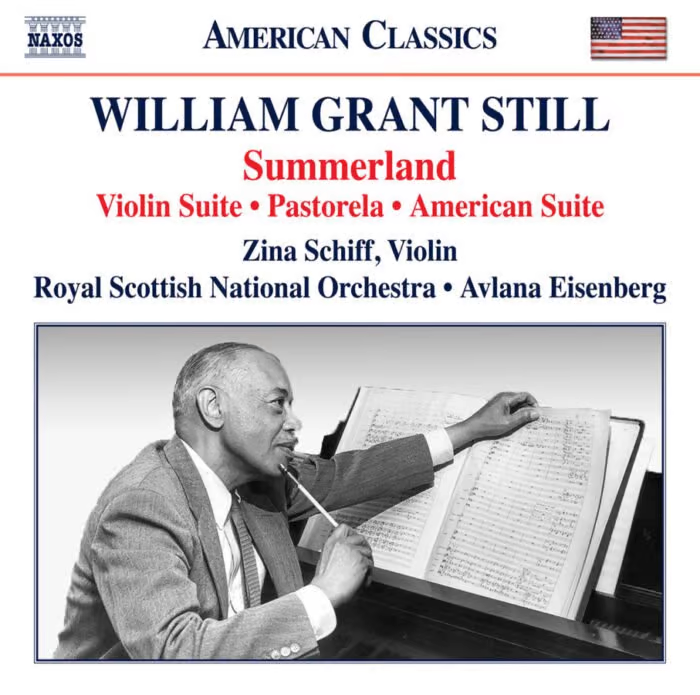
William Grant Still, Summerland and Other Works, Zina Schiff, Royal Scottish National Orchestra, Avlana Eisenberg


Maybe as we live we look at how there is a month for this and a month for that, and the rest of the year we hope people will still honor the importance of this and that? As I write these words it is Black Music Month. Well I approve. And happily because of the existence of such a month, we might get to hear music that otherwise we might not? Well the point is to appreciate whatever such things can spawn. For example today I am most happy to extol the virtues of a recent release celebrating the music of William Grant Still, one of the most worthy of 20th century Afro-American Classical composers.

So as I write these words this morning I continue to listen to this Still anthology of some four works, Summerland, Violin Suite, Pastorela, American Suite (Naxos 8.559867). It is competently and inspiringly brought to us here by the Royal Scottish National Orchestra conducted by Avlana Eisenberg. Violinist Zina Schiff handles beautifully well the solo violin parts for the two works that call for the instrument in the spotlight.

And you listen perhaps as I did with a gradually growing appreciation for the inventive brilliance of the composer. This is not "Modernism" with a capital /M/. And it is not without some references to Afro-American music in the larger world of national music, but in many ways it is not overflowing with such things either. 

And in the end we do well if we do not insist someone like Still, clearly a truly talented composer in his day, if we do not insist he create music in some mold we would create for him. No, that will not do. Listen to this music, Listen a few times if you will. And if you expect nothing particular, you will doubtless come to appreciate this music. That is the way of our last 200 years. Expect nothing "ordinary," get everything! Heartily recommended.


Tuesday, June 28, 2022

Margaret Brouwer, Reactions, Songs and Chamber Music


We roll into the end of the month and I am happy to grapple with a disk by a living composer I have as yet missed. She is very musical, kind of Neo-Classically Modern in her attention to unfolding form and open harmonic and progressive sonance. I speak of Margaret Brouwer and her album of Songs and Chamber Music entitled Reactions (Naxos 559804).These are compositions penned recently, between 2005 and 2020--world premier recordings in fact.

It is music that occupies its own space, neither retrograde nor highly, overtly modernistic. It is music of some care and quality, some fine invention, responding to the musical world we occupy today without being enslaved to anything referentially. Ms. Brouwer goes her own way and we do not miss what she choses to leave out. We appreciate conversely what she gives to us in each instance;

The "Rhapsodie Sonata" from 2011, revised 2016, has a wonderfully alive viola part nicely handled by Eliesha Nelson and an equally, nicely  complexly conjugated piano part realized with grace and musicality by Shuai Wang. It is serious music, brimming over with crackling electricity and turbulence but post-Romantically rhapsodic, which is something rather rare in my listening experience. I find it very fetching and absorbing. Its 20 minutes makes the album worthy just for its happy presence, but there is more.

The more consists of two song cycles for mezzo-soprano or tenor and piano, complexly expressive and something to grow into surely as you listen. There is also a nicely evocative summer meditation for violin and piano, then there is a rather humorous encounter with the ever-present telephone robot menus one encounters all too often today--crafted partwise nicely in this work for narrator-violinist. All goes by and you feel the presence of musical eloquence that sounds thoroughly contemporary yet self-contained in its alternate dialogic invention. The performances are all one might hope for and help us to feel the music enter our listening selves.

I find I would love to hear more of her music, which is what of course I should be feeling if a new composer gets my positive attention. Listen to this one a bunch of times and I think you will understand how I feel and why.