Search This Blog

Tuesday, February 28, 2023

Catalyst Quartet, Uncovered, Volume 3, Coleridge Taylor Perkinson, William Grant Still, George Walker


The Catalyst Quartet shows itself to be a first class, ultra-musical outfit with their third volume of Uncovered (Azica ACD-71357 download digital only), a well-conceived compilation of historically and artistically important Black composers and their String Quartets. The Third Volume looks at three quartets written between 1895 and 2018, by George Walker, Coleridge Taylor Perkinson and William Grant Still. All three works contain Afro-American rooted materials that undergo various transformation in constructing a Classical or Modern Classical chamber work in more or less recognizably mainstream form.


All that is the case and what ultimately unfolds is nearly an hour of state-of-the-art string quartet music played with spirited brilliance and well balanced expression throughout. The music fills in an important gap in Black chamber music by some of the most important of all US exponents. This is every bit as good as expectations would have it. Highly recommended.

Monday, February 27, 2023

Steven Christopher Sacco, Parables and Meditations, A Concerto for Piano and Fixed Media


Steven Christopher Sacco has given us a worthy Sonata for Clarinet and Piano on these pages (see entry of February 12, 2021). Now he returns with Parables and Meditations, A Concerto for Piano and Fixed Media (The Hill Studio CD 198004 702331).  The work was written especially for pianist David Oei, and the music in many ways functions as a kind of portrait of the artist-pianist.

David plays the five solo piano movements unaccompanied. Directly following each are five "Meditations" responding to the piano through digital signal processing conversions of piano sounds via speech sounding of clusters, diphthongs and fricatives as filters for the piano soundings transformed. So five piano-based sorts of neo-orchestral electronics as meditations on each piano movement follows each upon the other piano movements that start each section.

The music is uncanny, lyrical in the best ways, like perhaps a post-Satian landscape, gorgeous and brilliant. The solo piano and the solo electronics each have their profound leaning say in turns unaccompanied, that is to say pure of itself in timbre.The results are magical, some of the most ravishing music of our time I would say happily. Do not miss this! It is a towering achievement and ever worthy of many listens. My strongest recommendations!

Thursday, February 23, 2023

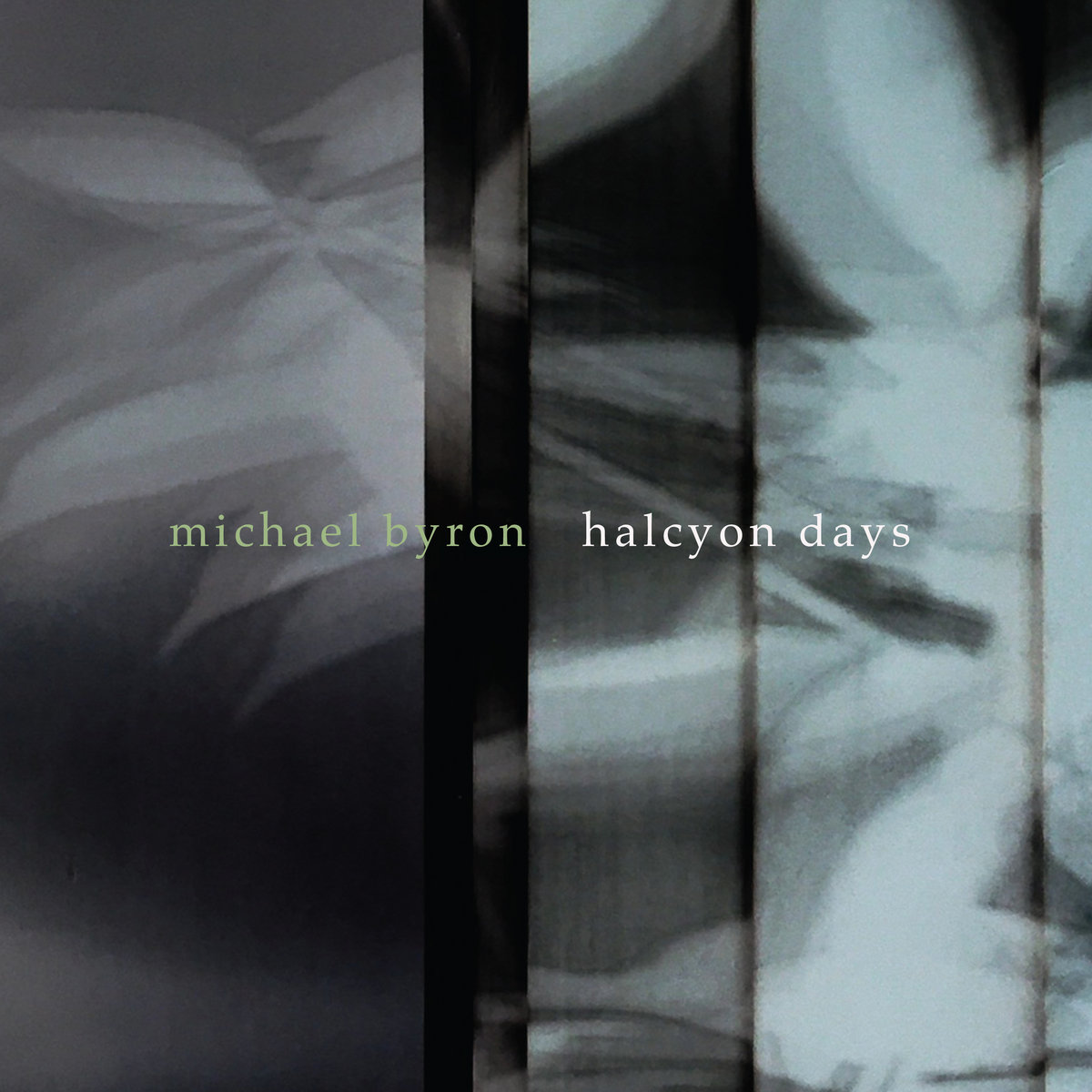
Michael Byron, Halcyon Days


Michael Byron is a composer who innovates in the Neo-Minimal, Radical Tonality zone in ways that sometimes suggest, and nicely so, a cross affiliation with Avant Jazz in its spiritual aspects, such as we have heard from mature Cecil Taylor and later John Coltrane, and then from the Minimal school later Terry Riley also, in its hypnotic quality. In this manner the new album of some five lively chamber works steps forward boldly and appealingly. It is a new one on Cold Blue Records, named Halcyon Days, Music for Marimbas, Xylophones, Vibraphones, Glockenspiels, Maracas and Pianos (Cold Blue Music CB0065).

The volume adds to the strong batch of works by Byron that gradually found their way into aural publication (type his name in the search box above for my reviews of recent albums) and we are all the better for it since Byron has his own special voice yet draws upon roots music and tonal lyricism in gratifying resonances.


Performances are championed with flair by William Winant and the William Winant Percussion Group, the Ray-Kallay Duo of four-hand piano performances and Lisa Moore on piano. Getting this music right takes persistence and spirit, and that  is just what they do.

The first part of the program highlights some special music for mallets from the '70s, with clusterings of notefulness in dense testificatory energetics rather than pulse, and nicely hovering over our listening selves. We hear with interest the two solo percussion works, from 1972 the tubular bells of "Drifting Music," and the maracas and marimbas of the 1974 "Music of Every Night."

The three movement "Music of Steady Light" (1978) gives us a spacious soundscape of twittering  and expressive multimallet configurations. You should let this music wash over you while noting how it passes over like a virtual series of celestial weather forays, with a enchantingly expressive way about it.

"Starfields"  (1974) creates a another hovering superstructure via four hand piano configurations. It bears scruitiny and repeated hearings.

Finally "Tender, Infinitely Tender" brings us to 2016 and a solo piano work that enchants wonderfully for a time again and then is gone like all music, stays in the air and then nowhere to be found as Eric Dolphy noted some time ago. It has that endless melody of a cosmic Coltranesque aura to my ears and I myself love to bask in it all throughout.

I recommend you give this one your ears if you respond to the sort of contemplative zone that Radical Tonality excels at. Listen, do. A milestone in the genre.


Tuesday, February 21, 2023

Kenneth Newby, spectral (golden) lyric


Kenneth Newby has gotten my ears before in the course of this site (see May 30, 2018 review) and for good reason. Today he comes forth with a recent one I am reconsidering after having missed a concentrated listen, namely spectral (golden lyric) (Emergence Trilogy, Volume Three) (Flicker Art Collaboratory FAC 201703), works for string quartet, solo piano and small ensemble. This one comes from 2017 but still very much speaks to us, There are 20 interrelated  works for chamber assemblages, performed nicely by Flicker Ensemble.

This is a brace of rather haunting ambient soundscapes in a mysteriously hypnotic, ritually alive kind of Neo-Minimal manner, spatially open yet coiled round itself like a cosmic folkloric snake eating its tale and its tail all at once.

Every piece is an element in the overall puzzle and the whole thrives as the together thing all 20 parts have become.

Kenneth Newby needs to be heard and this album brings him to us in all its flourishing best. Please listen by all means! Highly recommended. Worth resurrecting!~

Monday, February 20, 2023

Milton Babbitt, Music for Treble Voice and Piano


When you live through a period of music history, which of course we all do, it is not always clear how things will shake out when the years pass and it is the futurel. Like some fellow oldsters I bore witness as a listening self to some of the peaks of High Modernism and now get the chance to go back again to it in retrospect. For that I am happy to report in on an album that helps us further gauge and indeed affirm the stature of a leading light of US High Modern musical art.

Milton Babbitt (1916-2011) when I was coming up was mostly known as a brilliant pioneer of Electronic and Computer music in the USA, primarily via his long association with the Columbia Princeton Electronic Music Studio and the iconic RCA Synthesizer. Perhaps only in later times do we truly value his brilliance as a Serialist and instrumental composer of equal stature.

And accordingly on today's recent release we get a lot of exhilaratingly advanced Babbitt music, well performed. I allude to the CD Music for Treble Voice and Piano (New Focus Records FCR 369), with soprano Nina Berman and pianist Steve Beck plus Eric Huebner on the two-piano works.

The CD covers a broad swatch of time from 1951 to 2002. Each composition is a little gem, with voice and piano parts diverging widely in terms of space and time, Vocals tend at times to utilize longer held notes while the piano(s) is a spicy clamor of brilliance, with the bifurcated  soprano-piano sounding making for an enormously complex array in space. If you recall the many fine works Webern put across to us for voice and instruments, this Babbitt seems like a fine rejoinder and an artistic triumph in his own right,

It is hard to imagine better performances than these, though given the hugely detailed music scape it is easy to imagine equally interesting but somewhat different readings.

Anyone wanting to grasp the very high points of the Serialist US school should hear this and no doubt check out some choice Elliot Carter as well, like the String Quartets. This album today scores high for Serialist excellence in the later period. Do not miss it! Bravo!


Beethoven, The Late Quartets, Calidore String Quartet


If you know about chamber music in general you probably know that Beethoven's last String Quartets are considered among the most sublime and intensely personal chamber works of all time. There of course have been many recordings of them over the years. Here is a new version (Signum Classics SIGCD733 3CDs) by the  Calidore String Quartets and it has a freshness to it that helps it all rival the most acclaimed versions, to my mind.

The music is astounding fare, strength-after strength from the 12th Quartet through the 16th and the grippingly profound Grosse Fugue. It is all here and each is given the sort of loving care each deserves. What is most remarkable about the Calidore Quartet's extended focus through it all is how they manage to express all the deep introspection that Beethoven put into these quartets. And they do so without an ounce of excess expression, no heart-on-sleeve desperation so much as a transcendance of human hubris, a springing through vast canopies of structural presence with extraordinary gravitas and panache.

But more than that ever, as you listen, does it all come to you with impeccable spirit. Sometimes Beethoven's last String Quartets will break your heart as at times you feel he is saying goodbye and he was. Yet nobody took leave of life with such beauty and grace as he. The classic bio claimed that there was thunder sounding all around him when he passed. It probably did, for he was more than mortal.

These performances do as much as any to convince you of the depth of his last music. Bravo.

Thursday, February 16, 2023

Lei Liang, Hearing Landscapes, Hearing Icescapes


As we travel through the seasonal cycle we experience the natural and cultural elements tied to each. It is a part of our birthright to recognize each element in conjunction with its multi-complemental whole. Major living Modernist composer Lei Liang gives us two major electroacoustic soundscapes that span seasonal and culturo-natural zones of timeliness conjoining multidisciplinary gestalts in two multipart works of importance, Hearing Landscapes, Hearing Icescapes (New Focus Recordings FCR 360). 

The idea is that through a combining of musico-artistic and scientific knowledges we can appreciate a kind of vibrant soundscape inside a broad episteme, or that at least is my take on it all. The granular methodologies include oceanography, Chinese landscape painting and Folk Song, software development, earth science and underwater acoustics. The electroacoustic soundscapes vary between earthy and resonant, or electro-acoustically noisy, or birdcall filled natural landscapes. They combine at times with  instruments in blends uncanny, adding trumpet, flute and/or violin.

Hearing Landscapes perhaps has the more vivid and absorbing sound sequence, but both stand out as poetic, intelligent and evocative. It is a music of impressive strength and lingering profundity if you meet it all halfway, or that is my take on it at least. This is one of the landmark efforts on the New Music scene today.  Take time for this music and it will pay off. Strongly recommended.

You can preorder now at Bandcamp. Official release date is March 10, 2023.