Search This Blog

Saturday, July 5, 2025

Gustav Mahler, Symphony No. 9, David Bernard, Park Avenue Symphony


Of all the composers I've had the pleasure to listen to and live with over the years, perhaps Gustav Mahler has grown most inside me over time, the Ten Symphonies being the most varied and challenging of the lot. It certainly helped to read most of  the extensive biography by De La Grange, but constant review of performances by conductors who have contributed their key interpretations was instrumental, and my own increasing maturity has helped a good deal. So I came to appreciate the Viennese element, the Jewish, the Romantic, and now something else again.


Here today we have a brand new recording of his Ninth Symphony (Recursive Classics rc3691873) by  David Bernard conducting the very capable ensemble Park Avenue Symphony. It has taken me a while to appreciate fully the ninth, in part because it does relate to Mahler's increasing age then, which Bernstein saw as a multiple farewell to everything, ultimately life. But as Bernard succinctly notes it is also a matter of an increasing contrapuntal prowess, and of course a full mastery of the orchestrational palette of the later nineteenth-early twentieth centuries.


There is a virtually unmatched lyrical sadness and playfulness to the reading, and a real Modern presence to the poetic side here that is something to appreciate. The performance will get you rehearing the work virtually anew and give you a new understanding of his latter approach in key ways. Do not miss this!

Thursday, July 25, 2024

Charles Ives, Sonata No. 2, "Concord Mass, 1840-1860," Donald Berman


I have, after a long period of listening intently to virtually all available recorded versions, come to the conclusion that Charles Ives Sonata No. 2 "Concord Mass, 1840-1860" is one of Ives very most important works and a hugely influential force on contemporary Modern Classical piano style as well as Avant Jazz key approaches today.

The work was initially completed in the early days of Ives' post-educational tenure: he begin it in 1904-1914 and first completed and published it in 1920. He revised it a number of times and definitively published it as a Second Edition in 1947. It was with the first complete recording 
by John Kirkpatrick as an early LP on Columbia around that time that its reputation was fully secured. All these years later it has gradually and definitively outpaced.competing sonatas to become a true watershed work of the past century.

I find that every recording I have heard of the Concord, which by now totals a significant number, has something definite to offer. The deeply probing chromatics, dissonances and rubato oriented chordal melodic attacks, the cascades of advanced harmonic lining, the clusters of notes, the quotation and collaging of Americana motifs, the entire thrust of the work over time, its transcendental musicality, all make it as important a sonata of the last century as we can have and an important  milestone for Modernism as we see it today. Interestingly enough we can still draw parallels with the more important tone poem piano works of the later Romantic Era. Yet Ives carved a distinctive language that set it apart from those foreshadows, so it was similar only in having a literal subject matter.

It was not entirely disseminated until the first recorded release in 1948. After that, eventually, there have been scores of recordings and though I am sure I missed a few I cannot say I did not gain something from every version I have heard. There are those with the optional flute and viola parts, frenetic ones, more deeply stoic and/or philosophical channelings and so forth. All versions I have heard express Ives in convincing ways, some of course perhaps more than others.

Today we have a new version by pianist Donald Berman (Avie CD 2678) and it is a good one. Berman handles Ives in ways that make us realize even further how seminal this music is.  Berman is somberly meditative at times, as a kind of musical philosophicality, then nicely jagged and expressionist as Ives imagined it. The arpeggiated dissonances are rubato drenched and markedly Modernist as Ives virtually invented for himself. The quotations and the first theme from the Alcotts movement are played with a literal care mostly and that seems right. Sometimes he varies in those passages from marching rhythm just a tad and I understand it but I also like versions with the melodic contours a little more even keeled, In the end it is his touch and it all comes across as personal and committed, which no doubt Ives would have liked. Some of the quotations are articulated with a tenderness for, say, things long past but highly regarded, recollections of a poetic demeanor. All that understandably works well.. 

The addition of the short but exciting  and advanced Ives composition "The St. Gaudens 'Black March'" is a decided plus and nicely played to boot.

In all, the pianist is virtually fearless, and plays with a healthy confidence in the place of all this today which was not always the case with earlier readings--before we came completely to accept and understand the mystical historicism, and that is of course for the best. The rubato clusters of notes are marvelously poetic here. and to me they sound perfect, though of course there are other ways of articulating them as we hear in other versions. Still this is a superb sympathy and we are all the better for it.Bravo.

Listen to a free stream of the album on YouTube:

Friday, June 21, 2024

Lewis Gill, Parochial Chamber Works, Music Inspired by Warrington, Volume One


I have been friends with UK composer Lewis Gill for some time now, having the pleasure of hearing about his music on social media and exploring mutual musical frontiers by sharing music and thoughts over the years. I originally liked what he was doing in Prog Rock and have followed his forays into Modern Concert Music for some time without  hearing a lot of musical examples until lately. I am especially glad that I have gotten the chance to hear his latest, Parochial Chamber Works Inspired by Warrington, Volume One (Self Released, Bandcamp).

The album covers some eight shorter works all centered around the feeling of place, most specifically of the town of Warrington, England.

The works are all chamber and chamber orchestral configurations, well orchestrated and apparently articulated via synthetic sound modulators such as you might hear in composition software like Sibelius. Gill skillfully builds and articulates the music while wisely avoiding a lot of string writing as this kind of software can be less convincing in this wise.

The works are mostly squarely of a High Modernist ambition, with edgy harmonies, slippery quagmires of repeating cycles of melodic ambiguity that recalls nicely traces of later Feldman and non-formulaic others. We are not talking about vulgarly imitative as we are original fare. Each piece is singular and memorable, though one is also a humorous foray into melodic ironies like Happy Birthday, Way Down South in Dixies and another uses Shave and and A Haircut as a cadence marker!..

It is first rate and well worth repeated listens. Bravo buddy!

Check out a full stream of the album on SoundCloud: https://on.soundcloud.com/V3neX To order a copy get in touch with Lewis Gill on his Facebook page: https://www.facebook.com/profile.php?id=61558178737272


Monday, June 10, 2024

Nova Pon, Symphonies of Mother and Child, Turning Point Ensemble


When listening to unfamiliar New Music it may on occasion suggest  some better known composer without sounding like a direct imitation. Sometimes the style revives itself under this new creator and stands on its own two feet in a way we may appreciate. And in the end one might suggest that nothing or almost nothing new sounds like absolutely nothing we have appreciated in the past, and the nature of that new-out-of-old form of flattery can be its own innovation at the same time.

That might be said enthusiastically for Canadian composer Nova Pon and her Symphonies of Mother and Child (Red Shift TK546). It puts together nicely an opening ten minute "World Within" with the five movements of the title work.

The chamber orchestra Turning Point Ensemble under conductor Owen Underhill transports us to a finely lyrical state of mind, redolent of some of the lyrical sides of Early Modernists such as Stravinsky, Milhaud, Ravel and such. As you listen however that similarity of expression morphs towards a music of a singular personality. And the music in time stands out as exceptionally memorable, at least to me.

"World Within"starts things off dramatically with a kind of endless modulation sequence between instruments with especially the trombone and trumpet heading a series of musical tag relay teams that articulate Neo-Classical roots and a very satisfying interplay, all with a processual development that thickens and increases complexities in the textural mapping of the score.

The four movement sequence comprising Symphonies of Mother and Child follows with a mysterious opening and a good deal of brilliant interplay. There are moments of movingly cyclical Minimal motifs yet they do not dominate as much as provide a kind of launching vehicle for tone-color variations that break free of the circular turnstyles typical of classic Minimal fare. As the music unfolds, we hear the major mode tonality emerging more and more with a kind of modal folksiness that gives it all a more contemporary feel--and it works very well as you follow the development throughout.

This is very intelligently wrought  music by a true illuminati of total modernism. Bravo.

Highly recommended. A kind of milestone.

To hear a complete stream and find out how to order go to  https://redshiftmusicsociety.bandcamp.com/album/symphonies-of-mother-and-child


Thursday, May 23, 2024

Johan Helmich Roman, Assaggi per Violino Solo, Fabio Bondi


If you are a Baroque fanatic you may know the name of Swedish composer Johan Helmich Roman (1694-1758), or perhaps you do not. He is new to me. The recent recording of his  Assaggi Per Violino Solo (Naive  V 8209) will doubtless show you a composer of real talent if you spend some time with it as I have.

Perhaps the first thing you'll notice is the beautiful performances of violinist Fabio Biondo throughout. He has a beautifully sparking sound and impeccable tone control. The seven groupings of works each gives us a bristling Baroque leaping forth of single-noted implied counterpoint furthered by double stops weaving in and out, somewhat in the manner of Bach and his Suites, yet lyrically more trimmed down-- though still lovely at every turn.

This is a real sleeper, a gem in the solo string realm both for composer and performer. Very recommended.

To stream the album, start with this link https://www.youtube.com/watch?v=xJyAL20HcEE and follow the single links for a wealth of movements.

Thursday, May 9, 2024

Denman Maroney Quintet, The Air Conditioned Nightmare


When Minimalist hypnotic circularity meets Free Jazz oriented geometric Pointillism we have something that makes sense and indeed when in the right hands such as here we have some sensational music. Pianist Denman Maroney has for some time been a thoughtful Free Jazz pianist. See my review of some of his Free Jazz music from my Gapplegate Music Review article of August 21, 2017  https://gapplegatemusicreview.blogspot.com/search?q=denman+maroney.

On this new album The Air Conditioned Nightmare (Neuma CD 204) we feel the open Jazz rootedness that over the years Maroney has so authentically embodied in his previous work. Here however Maroney introduces a deliberate Counterpoint of differentially varied rhythmic cycles between piano left hand and piano right hand (Maroney), that and vocals (Emilie Lesbros), that and tenor and Bb clarinet (Robin Fincker) that and bass (Scott Walker) and finally all that and drums (Samuel Silvant).

We get a deliberately composed set of differentials presumably laid out by Maroney and allowed to expand and contract as they play out, within at time Jazz Swing, Rock, and New Music performance feels. We get a great deal to explore and appreciate on the 18 works that comprise the two CD set, including a skewed Monkian Stuffy Turkey.

The complexity and organic heft of the skewed works offers us much to experience and appreciate. And in the end, we come away with a strong feeling of the newness of the music as well as its rootedness, with real musicianship by all concerned. It repeats in a roughly Minimalist way but stands out as a new way to lay out the cyclic material.

This one satisfies the discerning ear in musically substantial ways.

Go to BandCamp to listen to a free stream, and if you like order a downlo0ad or a CD copy. https://denmanfmaroney.bandcamp.com/album/the-air-conditioned-nightmare-2

Monday, April 15, 2024

Rodney Sharman, Rachel Kiyo Iwaasa, Known and Unknown, New Music for Solo Piano


Not everything can be grasped in a single setting as we all have learned over time. For New Music these days it has never been more true. It used to be at times that you more or less knew what you were getting by gazing at an album cover, the art, the label, the liners and giving it a single listen but that is rare today in some settings. So with the one for today, distinguished Canadian composer Rodney Sharman and pianist Rachel Kiyo Iwaasa bring to us a stunning series of works based imaginatively on opera transcriptions, 18 works under the rubric Known and Unknown (Redshift TK539 CD). This is music not obvious, with true originality and unexpected brilliance.

For me this one was a natural, the combination of vivid sound color, a modern yet a distinct melodic-harmonic foundation, ambient brilliance and a sort of eloquent expressionist pianism, a kind of moody, haunting thoughtfulness and a refreshing bit of text narrative and singing by the pianist in her enchanting performative role.

The eighteen short and longer works each hold their own in ultra-musical and inventive ways. That there is a Non-binary element in the thematics is the case thought for me it all works together as a poetic, lyrical whole so that I embrace  it all as ART, which for me is what especially matters in the end.

Though the transcriptions are based on well known operas the end product stands out again as more in its finality of brilliance than as source inspiration.

This is piano music that thrives in its wonderful pianism, both in composition and  performance. It stands out is a high point of the music I have heard thus far in the current year! Do not miss it.

Listen to a full stream on Bandcamp: https://redshiftmusicsociety.bandcamp.com/album/known-and-unknown-solo-piano-works-by-rodney-sharman

Wednesday, March 20, 2024

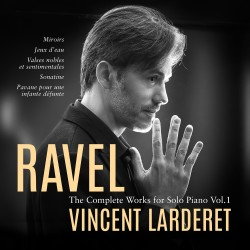
Vincent Larderet, Ravel, The Complete Works for Solo Piano, Vol. One

Maurice Ravel (1875-1937), as many readers will ,know. was one of the 20th centuries most original and poetic of composers for the piano. His was a voice of great color and poise. He gives the contemporary pianist a manifold challenge for realizing great expression and symphonic dimensions, along with a great intimacy of voice that broke new grounds continually. Pianist Vincent Larderet appears with the first of several volumes devoted to The Complete Works for Solo Piano  (Avie AV2623).

In this inaugural volume Larderet tackles five remarkably articulate and brilliant compositional sets, allowing the pianist to hold forth with novel and appealing interpretations that give us pause and move us along into Ravel's special aural world.

The set opens with Ravel's five movement Miroirs (1904-05) a breakthrough world of great sound color impressions and clangorous tonal brilliance. Larderet brings his own personally inventive aesthetics to each movement. 

The 1903-05 Sonatine forms another high water mark of pianistic dazzle with effective stretching of rubato singularity that stands out among classic renditions since the advent of the LP Ravel's ravishing Pavane pour une infante defunte (1899) chimes in as another outstanding reading, a hovering liquidity of great beauty one should not miss in this reading. The Jeux d'eau (1901) and the Valses noble et sentimentales (1911) are not in any way lagging and benefit from a thorough immersion in the periodicity of Ravel's and so bring forth a period charm here. Larderet shines thoughtfully regardless. which work on this set

Whether you are familiar with this music or are a newcomer you will doubtless benefit greatly by the pianist's genuine feeling for the music. Bravo. Catch a free stream of the music here: https://orcd.co/av2623

Monday, March 18, 2024

Plinio Fernandes, Bacheando, Works for Solo Classical Guitar


Brazilian born classical guitar virtuoso Plinio Fernandes returns with more sparkling fare for solo classical guitar, this time flourishing within the Bachian strain with works initially written for  lute by Bach, followed by Paulinho Noguera's Bachianinha Nos 1 and 3 plus other gems by Assaf, Villa Lobos and Mario Albanese on the album Bacheando (Decca Gold B0038-493-02). The eleven works here presented are substantial, the performances do not distract with a lot of rubato so much as they move nicely forward with a kind of infectiously rocking presence.

It all does not attempt to overwhelm so much as it gives you a compact brilliance that speaks to our contemporary sensibilities. It convinces by staying close to the original spirit of the music and in so doing Fernandes distinguishes himself as one of the very best today.

Listen to a stream at https://music.youtube.com/playlist?list=OLAK5uy_k-F-aqCp9tUppdMyMuAGUsiHYSLnDoqQc

Bravo, Plinio. A  fine effort.

Wednesday, March 13, 2024

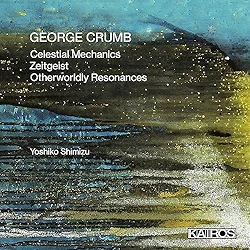
George Crumb, Music For Amplified Piano, (1979-2012), Yoshiko Shimizu, Celestial Mechanics, Zeitgeist, Otherworldly Resonances


If you are like me you sometimes think of various lists of favorite artists and/or perhaps composers... like for example what about the more important and innovative High Modern composers for the piano, like Ives, OK, then perhaps Cage, Messaien, Stockhausen, and George Crumb? I suspect many aficionados would include Crumb, surely. His open, sometimes sparse, spooky style with sustains and various inside the piano trademarks, such as pluck, strum, slide, sustained echoes, then centering folk-like motives or High Modern tattoos on the piano keys, etc. have justly gained a lot of attention and appreciation over the years.

With Crumb it all started with various early works featuring piano voice and other instruments, leading to the various volumes of his celebrated Mikrokosmos. It all culminates in his last works, which happily are well represented in this new volume of Music for Amplified Piano (Kairos 0022012KAI) as beautifully realized by Yoshiko Shimizu.

So to begin we get Makrokosmos IV, or in other words Celestial Mechanics (1979/2021), the Cosmic Dances for Amplified Piano, Four and Six hands, then Zeitgeist (1988), and finally Otherworldly Resonances (2005), the final two for Two Amplified Pianos. 

Yoshiko Shimizu heroically creates the immersive piano worlds for each piece with dramatic distinction and convincing thrust. It is an ideal hearing of these wonderful end works that fully deserve our repeated attention. Bravo. Highly recommended.

Monday, January 8, 2024

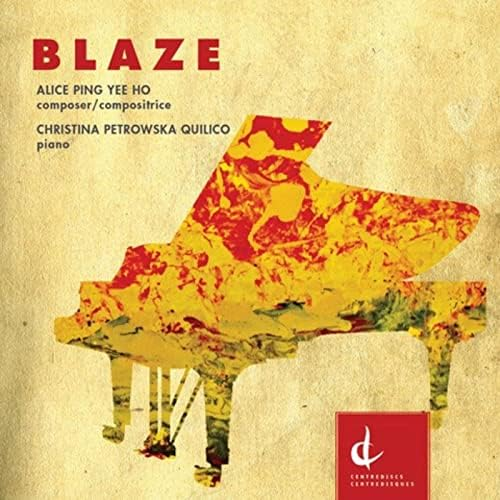
Alice Ping Ye Ho, Blaze, Christina Petrowska Quilico, Contemporary Works for Piano


The state-of-the-art when it comes to Modern virtuoso music for the piano today can be had nicely in the recent album of piano works by Canadian-Chinese composer Alice Ping Yee Ho as played with insightful concentration by the formidable Christina Petrowska Quilico. This on Blaze (Centrediscs CMCCD 31323).

In all some eight compositions flow with dramatic High Modern intensity in the course of the program. It is a nice example of High Modernism today and how the more advanced sorts of musical contours thrive in dedicated hands. 

"Erupting Skies" (2022) is doubtless the most sonically spectacular of the eight works, with bracingly elaborated interplay between the piano part and equally so the full bore counterpart of the electroacoustic construction, all pinned down by the central narrative of natural danger and eventual triumph.

Thanks to Ms, Quilico's finely granular, precision and poetic readings, all of these pieces come alive in the most enthralling ways as sprawling and highly absorbing masterworks that sacrifice nothing to easy listening sorts but instead carve each a twistingly elaborate excitement. Kudos to all concerned. This is a monumental breakthrough that all New Music aficionados should doubtless find as interesting as I have.

Hear samples and some insightful thoughts on the album https://www.youtube.com/watch?v=z4TamhwA4UM

Monday, December 18, 2023

Susan Alcorn, Jose Lencastre, Hernani Faustino, Manifesto


Today we roll into the modified Space Age and that robotic vision of Hal in 2001 is closer to our experience than certainly it was when the movie was made. And the music we hear now, is that any closer to the swirls of mad blips, bloops  and barongs that formed part of the score in 2001? Well sure and you might argue that most of 2001 was already present in some form in the culture for which it was made, maybe inevitably we are what we are when we make things. It just was not perhaps as central as the movie made it. So then Ligeti's avant work "Atmospheres" graces the score and of course it was made for initial hearing in a neutral concert venue situation. Well now that we are well past the "New Millennium" these days has our music taken a decisive turn into an all prevailing Space Age? Maybe not entirely as yet.

On the other hand the Modern in Modernism can be said to be a constant in New Music Avant circles. There are of course purely Electronic essays in the Modern Music world, there too are Orchestral and Chamber Classical related musics that can be readily heard out there. On the other end of the spectrum too there is the world of Avant Post-Classic Jazz as we hear it.

A very good example of the latter today we can contemplate on aa a new release from the Cleanfeed Label, an intrepid concern with a substantial monthly release schedule of more advanced Improvisation being played today, with natives from Europe especially Portugal but the rest of Europe very much as well as the East and the US West, sometimes a conglomeration of all, or two of the three or so possibilities. On today's release we have two regions well represented--for the USA steel pedal guitarist Susan Alcorn, a very-much-in-the-limelight artist these days, doing important work, and here also two fellow travelers from Europe involved in such heroic endeavors as well. So making the rest of the trio are Jose Lencastre on alto and tenor sax and Hernani Faustini on acoustic double bass.

Six probing and adventurous pieces make up the whole, all in a free improvisatory style so often a fixture of the Clean Feed way. Susan Alcorn has pioneered an avant style using the conventional steel pedal guitar and she is very much in her element here with the full spectrum of the instrument's note possibilities to vitiate advanced figures that glide like conventional playing of the instrument but then stand out with a good deal of imaginative note spinning and some advanced technique propelling us along as well.

Alcorn is given two especially well healed avant artists with Jose Lencastre wielding an aggressive and exciting stridency making a statement about the ethnicity and forward loving nastiness and then the all-over intensity of the stellar sorts of jazz dates that define where it all is as a modernism should go. Hernani Faustino does all the right things to help enflame and engulf caustic kindling.

Give a listen to the entire album at Bandcamp https://cleanfeedrecords.bandcamp.com/album/manifesto

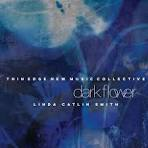
Linda Catlin Smith, Dark Flower, The Thin Edge New Music Collective


Linda Catlin Smith is a composer getting attention in good ways with her work in recent years including especially her new album Dark Flower (Red Shift CD). The Thin Edge Music Collective commissioned the works and play them here with just the right (deep) level of understanding and participation. Six interrelated compositions follow a special, long form elevation of tone color and lyrical unfolding, from the larger chamber quintet of clarinet, violin, cello, piano, violin and percussion (wanderer), to dual cello, then cello, piano, violin and viola (dark flower) thereafter subtracting instruments until the finale, a solo piano presence of unbroken dramatic girth.

The music haunts in gripping ways that get you involved the more you listen.  There is a logical unfolding that has some relation to Morton Feldman's Oriental-rug-like opening out, only somewhat less abstract. It is always convincing and poised.  In the end Ms, Smith comes off nicely as a major New Music narrative voice. 

As much as any New Music composer today Linda Catlin Smith here shows us a completely affirming sense of musical discourse, a natural elegance and inventiveness that flows with inevitable charm and poise, in the process creating a tone world that is very original and compelling. Highly recommended.

Stream the whole album at Bandcamp https://redshiftmusicsociety.bandcamp.com/album/dark-flower


Wednesday, December 6, 2023

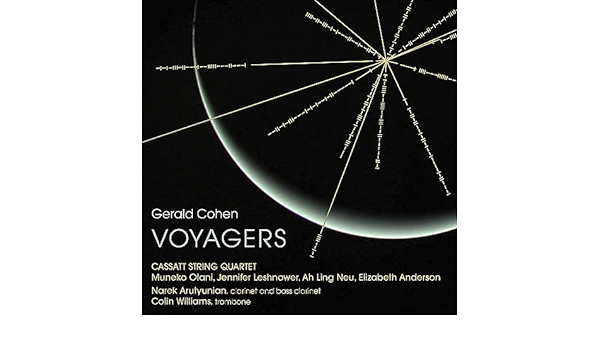
Gerald Cohen, Voyagers, New Music for String Quartet, Clarinet and Trombone


Ah, great, somebody I've never heard of has works I've never heard," some reader I've never heard of either might be saying as she confronts this article. OK, so I ain't gonna get rich covering the super new and in fact in the internet focus on immediate and continuous readership, I might be consigning myself to a kind of internet Siberia? Nonetheless I cover things I listen to closely, critically and actually like so you have nothing to lose in the reading of this, I believe. Today I cover another you might not know about, though I might also cover something famous now and again. 

With the exception of a nicely wrought chamber offering of music for clarinet and chamber ensemble, entitled Sea of Reeds, that I covered on these pages on December 17, 2014,  I've not delved into much of the music of Gerald Cohen in my listening over time. But this recording of  Voyagers (Innova 090) confirms my initial impression with a revelation, for his is a distinct and authentic voice in the New Music today. 

The album brings to our ears three substantial works for string quartet, as is as performed by the Cassatt String Quartet on the "Playing for Our Lives" work, with the addition of the clarinet and bass clarinet of Narek Arutyunian on "Voyagers," and with the addition of the trombone of Colin Williams on "Preludes and Debka."

None of these three works are especially Avant Garde in approach. Rather they dwell in a Modernity where there is a wide harmonic spectrum of possibility and a rugged tone color palette and also a healthy dose of the eclecticity of folk and ethnic elements, sometimes what sound like Semitic elements that injects a timeless quality to it all.

What matters in the end is the authentic and dedicated performativity of it all, the highly crafted and careful building of a particular work from the ground up with great care, skill, and eloquently inventive qualities.

Anyone who wants a good example of what is happening in the chamber realms of New Music would do well to check this one out. Take a listen and decide for yourself, but keep in mind that several listens will be necessary to hear these works as they actually reveal themselves. Check this link:  https://music.youtube.com/playlist?list=OLAK5uy_lIIy5IuFPJelqOZJrKecpoiz6aU5wR2s4


Thursday, November 16, 2023

Stanley Grill, The Bridge


US composer Stanley Grill takes inspiration from Hart Crane's epic poem on his recent World Premiere recorded orchestral work The Bridge (self released digital) featuring Brett Deubner on viola and the Czech Chamber Philharmonic Orchestra Pardubice conducted by Marek Stilec.

This is a long flowing. multi-movement work which has musical roots in the tone-poem world of classic Americana of the most descriptively evocative orchestral works by the likes of Ives, Copland and a select few others, yet it has such roots without exposing them in obvious ways. Rather there is sincere lyrical attachment to the subject matter from the Hart Crane epic, which as the composer suggests uses the bridge idea as a unifier of disparate US cultural-geographical diversity. Slow moving and feelingfully encompassing from the matter-of-fact yet evocative dawn on the harbor to the murky quagmires of mythic Atlantis, but then tempo pacing and presumably flow of water steps up on The River and expands and flows again more slowly with advancing worlds of sorts, resuming and re-attaining stately passage through a landscape musi-scape of Indiana, the steady wind for Cutty Sark, and then Cape Hatteras and its special presence brings back the expectant mysticism and the tolling of a fateful bell.

National Wintergarden has an altered jazzy feel and gives you a good example how originally inventive Grill can be. It goes from there. Suffice to say each movement has a distinct character rolling through an overall feeling of immediacy as experienced in rhapsodic lyricism and descriptive poignancy. Grill is a gifted symphonic narrator here and the more you listen the more you grasp of it all. Enthusiastically recommended

Stream the work in full at the following link: https://stanleygrill.bandcamp.com/track/to-brooklyn-bridge

Sunday, November 5, 2023

Marc Ponthus Plays Beethoven Hammerklavier sonata opus 106 and Stockhausen Klavierstuck X


It is not precisely usual to experience an album sequence that pairs Beethoven with Stockhausen, excepting perhaps an old album of Stockhausen's that dealt with Beethoven themes on a 1970  Stockhausen recording marking the 200th birthday of the 19th century composer. But here we have the two together in a pairing by lucid and articulate pianist Marc Ponthus (Bridge 9584).

We get to hear Ponthus's take on Beethoven's long-formed Hammerklavier Sonata opus 106 and Stockhausen's monumentally expressive but somewhat more terse Klavierstuck X. In pure statistical terms, there are far fewer recordings out there of Kavierstuck X than there are of Hammerklavier op 106, so that doubtless we should be especially grateful for the Stockhausen if it be good. In truth, these are worthy versions of both. Happily the Beethoven is undeniably symphonic in its consistently surcharged and continuously dramatic thrust as interpreted by Ponthus.

The Stockhausen likewise hangs together in a continuous unity that gives it a readily communicative power and visceral  accessibility it may not have quite as readily in some earlier versions.

Stream the album at the following links. https://www.youtube.com/watch?v=nlbrhunWJ7k for the Stockhausen, then the Beethoven  https://www.youtube.com/watch?v=dRT9zW0S-IA and follow the movement sequence from there in the You Tube listings.

An important pianistic event, a nice stocking stuffer.

Wednesday, November 1, 2023

Sonic Alchemy, YuEun Kim, Mina Gajic, Coleman Itzkof Play Arvo Part, Peteris Vasks, Mozart


Sonic Alchemy (Sono Luminus DSL92261) gathers together the considerable interpretive and sonically advanced gifts of violinist YuEun Kim, pianist Mina Gajic, and cellist Coleman Itzkoff for a rather magical program of chamber gems by Arvo Part, Peteris Vasks and Wolfgang Amadeus Mozart. When you have a trio of the musical sensitivity you hear readily on this album, of primary importance perhaps are the commonalities one might sense between the composers and works covered in the seven dramatic and lyrically probing works heard here.

In many ways the central section of this program gives you a kind of remarkable kismet between the Mozart's Fantasias, in C minor and D minor, and the Part "Mozart Adagio." All have the motion of Mozart Classicism and the exploratory lyricism we especially appreciate in Part, but perhaps do not always underscore in a Mozart movement but of nevertheless can be touchingly present.

As bookended there is much to appreciate even in that movement from the outer, melodically immediate yet exotic quality of the Vasks and the Part of whirring summer "Fratres" and then in the end the Vasks lyric pulsation of "Castle Interior" and Part's classic "Spiegel im Spiegel." In the end you might as I do revel in the superior expressive excellence of the ideal in many ways for these works, as heard here. Bravo.

Listen to a free stream of the entire album at this link: https://sonoluminuslabel.bandcamp.com/album/sonic-alchemy


Friday, October 27, 2023

Leonard Bernstein, Music for String Quartet, Aaron Copland, Elegies for Violin and Viola


In music you might spend a lifetime with some composers and still not know some of the works. That is the case for me to date with Leonard Bernstein and Aaron Copland and their respective Music for String Quartet (1936) and Elegies for Violin and Viola (1932). The former by Bernstein is in its world premiere recording here, and the Copland in any event is not especially well known. I do not believe I've heard either previously. So here we have both (Navona NV6557), as played very capably by Lucia Lin, Natalie Rose Kress, Danny Kim, and Ronald Feldman. For the duo it is Kress and Kim.

What is amazing in part is how good the Bernstein is, considering we had to wait 77 years to hear it in recorded version. The Copland is also heartening in its probing Modernistic stance.

The Bernstein is very motile, dense, rhythmic and at times thick harmonically. The Copland makes a case for something somewhat more sparse but is equally serious in its contemporary ultra-musical stance.
All-in-all this is superior, no-nonsense art-for-art's sake and shows you the early brilliance present in both, wow!

Stream a telling excerpt of the Bernstein: https://www.youtube.com/watch?v=URcGWPVKqj8


Wednesday, October 25, 2023

Justin Dello Joio, Oceans Apart, Boston Symphony Orchestra, Garrick Ohlsson, Alan Gilbert


You live your life day-to-day and for me anyway the new music I hear marks time as a constant and an inspiration to me. There is no different a situation today except perhaps the offering stands out aore captivating than the average. Namely Justin Dello Joio, son of Norman Dello Joio, and his title-bearing Concerto Oceans Apart (Bridge 9583) along with two chamber works that provide contrast--namely "Due Per Due" for cello and piano and "Blue and Gold Music" for brass quintet and organ. 

The "Oceans Apart" Concerto runs for around 20 minutes of the 40 minute CD, but in terms of the emphasis it is much more the dominant work.It is a piece that commanded my immediate attention and kept on. It has the full force of the Boston Symphony Orchestra under Alan Gilbert, with Garrick Ohlsson on piano, even with numerous replays. It is a stunningly dynamic and enthralling work, like an after-Scriabin modernity in the sensibility of the new Millennium.

"Due for Due" gives us piano and cello in an Expressionist firebrand of a score that keeps the momentum of the concerto. 

"Blue and Gold Music in turn nicely parses out the brass and organ parts with some haunting music for the finale, At timesit all recalls earlier periods where the music was more widespread in the churches and cathedrals of Europe yet show a modern sensibility which connects it with today.

All in all we have a vibrant program that speaks to us with musical details worth you time. This one is a goodie. Stream the concerto in full https://www.youtube.com/watch?v=LW4l-CDNwB8


Tuesday, October 24, 2023

Vivian Fung, Insects & Machines, Quartets, Jasper String Quartet


Vivian Fung steps forward  thanks to a rewarding new album covering her four string quartets on the recent CD Insects & Machines (Sono Luminus DSL-92270), played with a beautiful sense of color and SUBSTANCE by the Jasper String Quartet. These four quartets were written between 2001 and 2019, and show each a special sonarity and musical ethos.

The Quartet says "Vivian's String Quartets Nos. 1-4 reflect a remarkable journey of absorbing, integrating and synthesizing a unique spectrum of influences into her compositional voice. Unwavering in all of the works is a fierce heart, instrumental fearlessness, and an amazing instinct for texture."

And the synergy between composer and quartet is palpable and deep to my mind. Each of the four quartets has its say in Modernist, Expressionist terms that convince, especially after a number of listens. There is a belonging to a rewarding set of aesthetic principals and an original, authentic sounding that one does not come across every day. Very recommended.

The composer's Asian heritage is never far from the consideration in her music. Quartet No.3 for example is in part based on Chinese folk themes. As you would expect of any good composer the influences are not the primary reason to hear the music.There is much more, in terms of what is actually done to those influences.

The fourth quartet has the title used on the overall album and is based on Ms. Fung's time spent in  Cambodia and the singular insect buzz she found so fascinating there.