Search This Blog

Thursday, July 9, 2015

Franz Schubert, Andras Schiff

The singular beauty of Franz Schubert's solo piano music hit me dramatically sometime around age 18. It changed my idea of what could be said musically without an overemphasis on pyrotechnics or high drama. It was a music without pretensions. Long unfolding and enfolding melodic-harmonic brilliance without end, music so lyrically strong it spoke directly through the ages to your inmost musical being. I never went back. Schubert has been a part of me ever since.

So even though I have had some favorite performances of most all the Schubert solo works (mostly on vinyl), I was pleased to receive a new two-CD set of gems by the remarkable modern pianist Andras Schiff. The set is simply called Franz Schubert (ECM New Series 2425/26 4811572).

The first thing you notice: this is Schubert in vivid period performance, played on a very sonically alive Franz Brodman fortepiano manufactured in Vienna around 1820. I have never had trouble with the best readings of Schubert on a modern instrument, but nonetheless the piano featured here is more in line with the balance of timbres and dynamics as Schubert himself experienced them, not to mention the intimate friends-listeners in a Schubertiade evening.

Add to that Schiff's careful selection of some of the most brilliantly unpretentious works for performance. The glorious "Moments musicaux, op. 17," the Sonatas D894 and D960, the "Vier Impromptus D93," etc. These are some of the finest of the Schubert piano works, not necessarily the most overtly difficult to play on the surface, but those that demand an artist's poetic touch, lyrical, unendingly melodic masterpieces.

Schiff most certainly is a pianist who totally immerses himself in the magic of this music. He is not out to impress with showmanship, but rather to get deeply inside the music and the subtlety of phrasing. He does that so well here. And the sound of the 1820 Brodman is a revelation. Each register has its own special sound, which is typical of the early pianos, so that the colors of the music and the original balance in passagework comes through strikingly, thanks of course to Maestro Schiff's careful attention to the phrasing as it sounds on the old instruments.

The result is a set of interpretations that brings out even more strongly the melodic beauty of the music. The parts are transparently singular, which a great period piano performance by a master allows you to hear as never before. The modern piano versions can be wonderful, of course, but you do get a different balance, as registers that tend to ring out more sonorously may take a larger sonic space than Schubert intended.

Schiff allows you to hear the music all over again. It takes someone of the extraordinary musical caliber of Andras Schiff to make it work in the highest poetic way. He does it throughout the set. It is marvelous Schubert to begin with. And Schiff makes it all the more stunning.

If you don't have much Schubert piano music, here is a place to start. If you have been all over Schubert's music, here is a place to return to and hear the music in a new revelatory light. Fabulous!

Wednesday, July 8, 2015

Kai Schumacher, Insomnia, Piano Music by Gershwin/Cage/Crumb/Belet/Stark

The thematic program can create a long-lived mood that perhaps no one work can do as well. That assumes that the music is well chosen and works together to bring to the theme a multi-faceted musical landscape.

That surely is the case with pianist Kai Schumacher and his suite of modern works all having something to do with Insomnia (Hanssler Classic 93-334). The album covers five pieces in multiple modern dimensions, showcasing the solo pianistic gamut of possibilities and a wide historical time frame.

The sequence is well considered and gives us an aural workout on the themes of night, sleep and the lack of it. So we begin with George Gershwin's little gem "Sleepless Night (Prelude)" played on a slightly out-of-tune saloon piano to give us that "last call" atmospheric feel. From there we go to John Cage's mesmeric "Dream" and its magic.

Perhaps the centerpiece is the George Crumb opus, "A Little Midnight Music," his inside-and-outside the piano meditations on Thelonious Monk's "Round Midnight." It is especially well done, though Schumacher treats all the works with special attention to sound staging and a dramatic sensitivity to mood.

Brian Belet's "Summer Phantoms: Nocturne" delves even more deeply into the evocative inside-outside the piano night ruminations, with electronics joined closely with the live piano part to create a deep-night atmosphere.

We end with Bruce Stark's more down-to-earth "Urban Nocturnes," in a sense coming full-circle from the immediacy of Gershwin to the more atmospheric night sounds of the three middle pieces and then back again to a matter-of-fact suchness.

Kai Schumacher gives us performances of both subtlety and power, making each work stand out as very much within its own world, thanks to the creative interpretive touch of his masterful approach.

The album breathes life into the night-sleepless theme in ways that strike the careful listener, map out a dramatic trajectory, stay in the mind as a landmark program that exposes us to a wide range of modern piano music and makes it all accessible by nature of the thematic unity of the program.

An impressive outing and a joy of poetic pianism. Bravo, Maestro Schumacher!

Tuesday, July 7, 2015

James M. Stephenson, The Devil's Tale

Something today rather unusual, a kind of sequel to Stravinsky's chamber-and-narrative classic "L'Histoire du Soldat," namely James M. Stephenson and his The Devil's Tale (Ravello 7906). It essentially gives us Stravinsky's "Soldat" in reverse, as far as plot goes. There is no fiddle, instead the main character is a musician in a Las Vegas show band, his girlfriend a Vegas dancer, the devil a blackjack dealer. We get a plot where the devil loses, in a kind of symmetrical reversal of the Stravinsky.

I've said my peace about works with extensive non-sung narratives. I generally dislike the approach. Here the dialog tells the story effectively enough. Narrator Matt Bean is called upon to play all three characters. He is no Laurence Olivier doing "Hamlet," but let me just bracket all that. It is fundamental to a reverse "Soldat" and so it is there. But it is not the strength of the work.

What captures my fancy about the piece is the music. Stephenson manages to convey the period essence, the early Jazz-ish strains of the Stravinsky, the neo-classic elegance and brilliance of the original piece, and make a modern-day analogue that fascinates and enthralls. The seven-member Western Illinois University Faculty Chamber Players under Mike Fansler do an excellent job realizing the score.

Stephenson not only understands the essence of the Stravinsky, he recaptures it and creates a vivid rejoiner. If the music reminds a bit of period Weill as well, so much the better.

The rhymed narrative-play has of course an essential role in the totality. I have followed along in my listens and must say it is quite adequate, though again perhaps a Laurence Olivier would put it all together in a more convincing way. But the music is quite nice and well performed. So we get a good idea of Stephenson's gestalt. And the music triumphs!

If you love "L'Histoire du Soldat" this will give you pleasure. Even without knowing the original there is much to please. Something different!

Monday, July 6, 2015

Keller Quartett, Cantante e tranquillo

When I was a graduate student years ago it was finals week when must of us were up all night trying to get the papers written for the deadlines. One of my fellow students, who happened to be Amish, remarked the next day how he liked to listen to Haydn Quartets when writing, but only the slow movements. He wished there was a compilation of such things. I thought the idea fascinating, but left it at that and promptly stopped thinking about it.

Though nothing like that to my knowledge has come out, we do have the Keller Quartet doing a wider range of quiet movements on the recent Cantante e tranquillo (ECM New Series 2324 B0021591-02). The performances and the selections stand out in a program that puts you in a profoundly tranquil frame of mind, reflective, inward.

The late Beethoven Quartets are here in slow movements from Quartets Nos. 16 and 13, we have string quartet arrangements of segments of Bach's "The Art of the Fugue," and then we have a number of modern works, a movement from Alfred Schnittke's "Piano Quintet," and excerpts from works by Ligeti, Kurtag, and Alexander Knaifel. Not all are quartets (there are also duos, trios, quintets) but all are deeply probing, meditative, absorbing, moody in the best ways.

The Keller Quartet has an exquisite sensitivity towards the music. That and the quality of the works make us take pause, listen, drift along with it all. It is an extraordinary program and I cannot recommend it strongly enough for when you are in a mood for reflection.

Friday, July 3, 2015

Bang On A Can All-Stars, Field Recordings

The premise behind the Bang On A Can All-Stars album Field Recording (Cantaloupe CD & DVD) was simple. Each composer commissioned for the project was asked to select a pre-existing recording or create one anew and utilize it as a sort of found object to compose music around. The original tape and its permutations are played back and performed against by the Bang on a Can chamber ensemble according to the respective score the composer created.

The premises are simple but the music is far-ranging and very inventive. Source sounds vary widely, from traditional Irish folk singing to street singing, from John Cage reading from his diaries to gospel preaching, electro-acoustic sounds and much else as well. Each in its own way is a gem.

So we get works by Julia Wolfe, Florent Ghys, Michael Gordon, Christian Marclay, David Lang, Tyondal Braxton, Johann Johannsson, Todd Reynolds, Steve Reich, Bryce Dessner, Mira Calix and Anna Clyne.

The music draws from modern and postmodern, quasi-rock and folk modes with the panache and elan you expect from Bang On A Can adventures. A good deal of funding from listeners and institutions went into making this project a reality, and a good thing it is. There is an accompanying DVD with several of the compositions and visual elements. I was not able to watch it but I imagine it enhances the package.

Either way this is music of differences, inspired and played with grace and thrust by the All Stars.

Very highly recommended.

Thursday, July 2, 2015

Wolfgang Rihm, Et Lux

There are composers out there today who get your attention ever so gradually over a period of time. Through the accident of place and convergence you only come to appreciate their stature after an ongoing period of exposure. Such a composer for me has been Wolfgang Rihm (b. 1952). I've listened to and appreciated selected works but now with the release of Et Lux (ECM New Series 2404 4811585) I am fully illuminated.

The 2009 work is for vocal quartet (Huelgas Ensemble) and string quartet (Minguet Quartet) under the direction of Paul Van Nevel. The sung text consists of fragmented excerpts of the traditional Roman Requiem. The string quartet plays pianissimo, with mutes, the upper-ranged instruments bowed close to the fingerboard to create the sound of an ancient consort of viols.

The vocal parts combine early music styles with ultra-modern harmonic densities. The strings similarly give way at times to eruptions of the very contemporary both with and against the vocal group.

The hour-long work is a masterfully original example of the early-in-the-late aspect of contemporary music, not following Arvo Part in sound and substance, but creating a mysteriously engaging parallel soundscape that reflects Rihm's own sensibilities.

Rihm makes use of old church harmonic part writing as well as the fully dissonant and open possibilities of the modernism we still find central to the world we live in today.

The result is a music of remembrance and a sort of confrontation of the weight of our cultural heritage with the real totalities of the present.

In the end we are treated to a haunting work that brings us squarely to Rihm's brilliance. The performance is everything one would hope it to be. The recording has the ECM resonance one expects, which seems especially right for a work of this sort.

Thrilling music! This one is a must for those who follow the trends in new music and an enthralling listening experience as well. Wolfgang Rihm enchants our ears with a masterpiece.

Wednesday, July 1, 2015

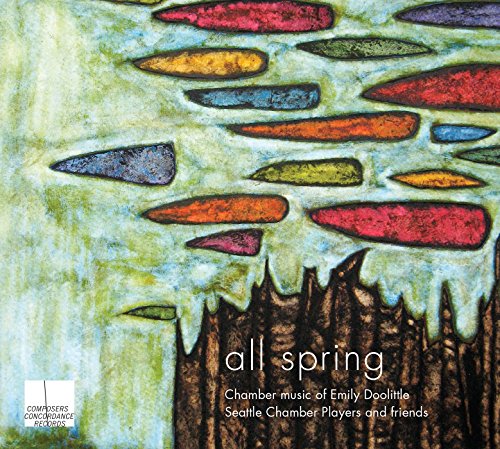
Emily Doolittle, All Spring, Chamber Music, Seattle Chamber Players and Friends

Spring may be over here where I sit at my desk outside New York City. But the music of Emily Doolittle, specifically her album All Spring (Composers Concordance 0025) transcends season. Five works in the chamber mode get careful and effective performance by the Seattle Chamber Players and Friends.

I read on the press sheet that the album has an official street date of July 31st, 2015, so I am a bit early.

Nonetheless this is music worth waiting for, a set of works that all have a disarming charm, an organic, almost rustic sort of modern feel. She hails originally from Nova Scotia but now divides her time between Seattle and Glasgow. Her music has been performed to acclaim over North America and England.

All five works have the personal Doolittle stamp upon them. The music often has a whimsical quality, well paced, organically modern tonal, spun out with a cohesively inventive narrative sequentiality. Each work has a distinct identity.

The 2004 "All Spring" song cycle based on the poetry of Rae Crossman has an open poeticism which soprano Maria Mannisto brings out nicely. The duo "Col" (2002/2014) for marimba and violin has a diatonic matter-of-factness and charm. "Why the Parrot Repeats Human Words" (2005) is a narrative based on a Thai folktale with chamber accompaniment. Though I generally do not respond to extensive narrative works I found the chamber music surrounding it compelling.

"Four Songs About Water" (2000) portrays water in four different states with corresponding descriptive music for a nine-member chamber ensemble. So we get effectively contrasting movements depicting "Running Water," "Salt Water," "Frozen Water" and "Rain Water." It is fascinating, nicely crafted and innovative.

"Falling Still" (2001/2009) has as its inspiration the song of a blackbird singing in the early morning rain. The music has a gentle pastoral quality, lyrical and flowing.

If you were to try and pin the ancestry of this music to the influence of forebears you might as I did think of the chamber neo-classic phase of Igor Stravinsky, but that mostly in the pacing, not the tones themselves. Nonetheless Emily Doolittle stands on her own ground, rather delightfully so.

Recommended listening.