Search This Blog

Wednesday, December 15, 2021

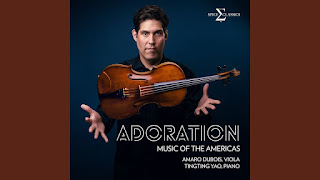
Amaro Dubois, Adoration, Music of the Americas, Viola-Piano Works by Price, Clarke, Coleridge-Taylor, Piazzolla, Villa-Lobos, Guerra-Peixe, Fanny Mendelssohn, with Tingting Yao


I cannot always tell day-to-day what new musical treasures will await my ears, but there are ever good things. Today there is a fine and adventurous album by violist Amaro Dubois with pianist Tingting Yao, entitled Adoration: Music of the Americas (Spice Classics SR-101-56). 

The most apparent thing you notice is the very adventurous program of works, things that if you have not heard you are glad to or even if you have, it is a nice gathering of unexpected juxtapositions and very solid viola fare. It happens that I became quite enamored with the viola in my early listening years thanks to Walter Trampler. I still feel the same way so always glad to hear an excellent player unknown to me. Like you might come to expect from a violist of stature there is a woody, burnished deepness to Amaro's tone, and given the expressive qualities of much of the music there is an emotive sweetness that is not overblown but just right, a trim tautness coupled with a projective richness that makes the music sing out nicely. 

Dubois and Yao give poetically focused attention to works that are neglected treasures, many of them, and/or illuminating to our understanding of composers, regions. periods.

We get to hear a couple of gems by the now emergent Afro-American woman composer Florence Price, plus worthy but neglected works by Rebecca Clarke, Samuel Coleridge-Taylor, Astor Piazzolla, Cesar Guerra-Piexe and Fanny Mendelssohn. And then to remind us that there is a treasure trove of possible rearrangements of other works and composers  more well known, we hear a ravishing viola-piano version of Villa-Lobos's "Bachianas Brasileiras No. 6."

In the end it is a pleasure to hear the brilliant musicianship of Dubois and Yao, as much as it is heartening to hear some wonderful music we are fortunate to experience today. Bravo!           

Gyorgy Kurtag, Six moments musicaux, Officium breve, Antonin Dvorak, String Quintet, Parker Quartet, Kim Kashkashian


Some of the best recordings in the New Music world combine brilliant compositions with special performances, vivid readings. Such things are in store for you on the recent CD by the Parker Quartet and Kim Kashkashian on viola, performing Gyorgy Kurtag's "Offiicium breve" and "Six moments musicaux" along with Dvorak's "String Quintet, op. 97" (ECM New Series 2649).

The wonderfully Bohemian Dvorak "Sextet" as a great deal of sublime energy and the performance here has all the brio you might hope for, along with the lyric articulateness Dvorak often expects of a performance. This is a wonderful work and it never sounded better than here! If this was the lone item on this CD it would be a happy (if short) thing. But of course we get much more, two nicely contrasting High Modern forays by Gyorgy Kurtag, a composer to savor all the more as one hears his opus bit-by-bit.

His "Officium breve"" has deeply moodful ruminations that stand out as strikingly fashioned the more one listens. Like Berg before him, he can be on the cutting-edge as he is here, yet also extraordinarily expressive of mood and feeling. The all-but-hushed unfoldings give one a kind of eerie spaciousness, a feeling of journeying to a rare place of beauty and strangitude combined.

Kurtag's "Six moments musicaux" have more abstract expressive edges to them. They are in fact Modern with a capital /M/. You feel his mastery and complex forward momentum. This one doubtless is possibly one of the unsung high points in the chamber music of our times. In the very least it is essential listening, a sterling performance of a special work.

The Parker Quartet with Kashkashian seize the day and shine with luminescence and musicality. This is a triumph, and one of the finest chamber music releases of the year. Be sure and check it out if you can. Bravo.

Tuesday, December 14, 2021

Jerome Kitzke, The Redness of Blood


I do not suppose I need to remind readers how the integration of text-voices in all kinds of Modernist works can be an iffy proposition. It is a combination of course of composer and artist(s) and when it does not work it can even be a little painful. But then there are the good results and hurrah for them.

A very nice example just hitting the release stacks is an album of Jerome Kitzke music entitled The Redness of Blood (New World Records 80834-2). There are four chamber works to be heard on the program, two for a pianist who also sings, makes specific vocal sounds and recites text--starring nicely Lisa Moore and Sarah Cahill. Then there are two with six or seven artists who play and/or have vocal parts.

The music is a series of "Post-Modern," openly imaginative forays that show the composer can put together such things with a disarming good humor, an unpretentious idea of how these things can present themselves, sometimes even in a quasi-traditional Asian unity of expression and/or otherwise resourcefully Contemporary in outlook. The artists respond with a kind of natural expressiveness that puts everything together in nicely listenable ways. One thinks of how Crumb and perhaps how Stockhausen and Cage  have  done such things as precedent, though Kitzke remains consistently original in all of this. The voices can be percussive, articulated, wide-ranging in use of available speech sounds, and well integrated into the instrumental parts so that one feels like all this makes a special kind of sense reserved for inspired peaks in New Music of this kind. Oh and the press sheet mentions Harry Partch as well. Yes, I hear that, too. All in good, forward moving ways.

So who is Kitzke? He was born in 1955, which makes him roughly my age. He makes a music that again in the materials that came with the CD can be noted falls into a somewhat more simple expression than typical High Modernist works in this realm, yet too more transformative and mutable than typical Minimalism. And that betweenness embraces an invigorating vitality and continual possibility of transformation. 

Each work has its own momentum, its own trajectory and aural-semantic space. The two piano-voice works have a more directly presentative vibe about them. Kudos to Lisa Moore for her fine musico-dramatic wholeness on "Bringing Roses with Her Words" (2009) and Sarah Cahill for "There is A Field" (2008) with texts by Whitman and Rumi. Both handle the multi-faceted demands with a fabulous steady-state inspiration. Bravo. 

And the small ensemble works take that same down-to-earth idea of the voice in the ensemble and expand upon it, with some more intricate ensemble interactions by all with a goodly vocalization idea and lots of good instrumental parts. So I end up quite impressed with that too--"For Pte Tokabewin Ska" (2015) with text by Native American Charlotte Black Elk. And then the climax of it all, there is the title work "The Redness of Blood" (1994-95) and its full 26 minute unfolding. with five instrumentalists and simultaneous vocal parts in addition, and then another three vocalists. It is complicated and rewarding to hear, with a pronounced Native American feeling at times. It is very good listening as is the whole of this.

New World Records continues to offer an exemplary program of Modern Americana and this is a great example of how it works. Kitzke is it turns out an essential voice and this then is essential fare. It is born out of expressive need more so than a sort of formalist rigor. It works and it works very well indeed. Highly recommended.
Tuesday, December 7, 2021

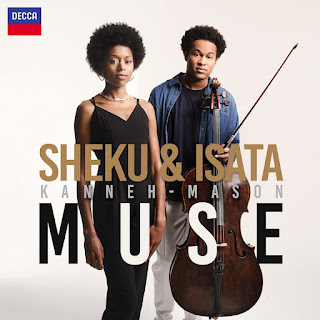
Sheku & Isata Kanneh-Mason, Muse, Barber and Rachmaninoff for Cello and Piano


Some music and artists seem promising straight off. That is what I felt opening up the mailer that contained cellist Sheku Kanneh-Mason and pianist Isata Kanneh-Mason's album Muse (Decca B0034635-02), It is an interesting assortment of short songs--with the cello taking the vocal parts--and a Cello Sonata each, all by two Late Romantic composers from two edges of the Western world, namely Samuel Barber and Sergei Rachmaninoff, from the USA and from Russia, two composers I have long appreciated, both entering my music experience beginning with the earlier days of my exploration of Classical 20th Century music.

The artists are brother and sister and they have had the good fortune to be playing the two Sonatas repeatedly on tour during the Fall of 2019, The pandemic cut short any continuation of the tour but by then they had grown into the works by a kind of concerted osmosis. So indeed these works plus the selected songs seemed like the perfect material for their recorded debut. And here we have it!

Both composers have in common an Expressionist emotive quality and a wayward insistence that their music go its way with an intensely personal originality, each of course in different ways, partially because of the way their music worlds contrast as heritages.

Not surprisingly both composers give the duo carefully conceived and personal yet idiomatic expressions for cello and piano. And the songs come through too as wholly appropriate in the cello-piano adoptions.

I have already come to know and love the Rachmaninoff Sonata so I got to hear how their interpretation differs from ones I have heard. I must say the flow and feelingful poise is in all ways worthy and first-rate. Though unfamiliar up until now with the Barber sonata it too convinces in its whole-cloth grasp of what is lurking inside every note.

There is nothing but good things to say about this program and the beautifully poetic presence of the Kanneh-Mason siblings. This is one to savor, in solitude or with some good people. This is Modern music that seeks a beauty we sometimes leave behind in our Space Age of being. Regain some of it here. Highly recommended!

Thursday, December 2, 2021

Jose Antonio Bottiroli, Complete Piano Works 2, Nocturnes, Fabio Banegas


Who? Jose Antonio Bottiroli (1920-1990) an Argentinian native, composer of piano music with an exploratory gentleness that we hear most vividly in the recent CD Complete Piano Works 2: Nocturnes (Grand Piano GP871) world premiere recordings nicely played by Fabio Banegas, the composer's protégé. They reflect in part Bottiroli's sun soaked holiday home in Los Cocos, Cordoba Province, Argentina. It is lyrical, Impressionistic in its own way, an Argentinian Satie, Grieg or Chopin with his own special originality and incisive expression.

In all the program contains 16 Nocturne miniatures stemming from 1974-1984, and then "Cinco Replicas Para Piano "1974-80, which consists of six probing poems by the composer as recited by Star Trek's George Takei, followed in each case by a piano movement in response.

It is all good, Refreshingly unpretentious, disarming, it comes off as sincere and carefully inventive. The more you listen, the more you find it all rather enchanting, or I do anyway. I recommend it to all 20th Century Moderns who love a well turned solo piano piece, and of course those who want to get a handle on what was going on in South America last century. Either way you will find music to savor and appreciate.

Tuesday, November 30, 2021

The Knights, The Knights Before Christmas


Those of you who are musically sensitive like I am go through the Winter Holidays with an undiminished need for stimulating musical experiences, yet of course the many Christmas carols, some better than others, are subjected to innumerable arrangements for better or ill, and then too of course our musical memories draw sometimes rich associations with particular songs and versions, not to mention the Classical staples of the season, by Handel and Bach among others.

Since I am sent various things of a seasonal sort I try and listen to them and if any stand out write something about them on my blog pages. And so today a CD someone kindly sent that strikes me as being ultra-musical and so quite welcome.

It is by a musical outfit dubbed the Knights and the album is called The Knights Before Christmas (Bright Shining Things BSTC-0159), 

In some ways the impetus for more recordings of Christmas music in your life is a means to connect present with the holiday experience while more or less reconnecting the past with the present. While the songs are often enough old and familiar, the version are new and ideally regenerating.

I cannot say that is not the case with this one, for each is freshly arranged for a chamber orchestra and at tines one or more female vocalists. The arrangements are full throated without being overly sentimental. I post it on the "Classical" blog because the orchestral approach will no doubt appeal to classicists. So Vince Guaraldi's Peanuts classic "Christmas Time is Here" sounds rejuvenated in this female vocalist and orchestral rendition, as does "Deep in Bleak Midwinter" and the Asian sounding arrangement of "Do You Hear What I Hear?"

There are a few things I do not recognize and good for that since we need something new every year we hope. If you need some names attached to this music, what about Krystie Warren, Anthony Roth Costanzo, Magos Herrera, Gaby Moreno, Wu Man and the folk trio I'm with Her? 

"Another Lonely Christmas" has a sort of Joni Mitchell flavor to it, though rather dark and filled with feelings of loss. It is good music nonetheless. 

In the end the nicely apportioned arrangements give us music with something of a new life. The version of "Christmas Time is Here" alone is worth the price of admission, for it reminds us (or me anyway) that the song can travel far from its Peanuts origin and sound great all by itself. As a whole the album stands apart from the typical as music of a special sort.


Monday, November 29, 2021

Dai Fujikura, Glorious Clouds


If you are alert to what is going on these days you might know something of the music of Dai Fujikura. I reviewed his Zawazawa on these pages last September 25, 2019 (see index for that one). And now I am happy to be listening to his new two-CD set Glorious Clouds (Sony Music Labels SICX 10012-3). Like Takamitsu before him, he can incorporate traditional Japanese elements into his music while transforming them completely into his own New Music vision. And he extends the Modern vocabulary in ways both personal and brilliant.

The new music set is bracingly varied and diverse in combinations and expressions. Sandwiched between the orchestral gems "Glorious Clouds" and "Ghost of Christmas" is a wealth of musical worlds: the electric guitar of Prog meets New Music via Danlel Lippel performing "Sparkling Orbit," solo recorder on "Serene," solo horn on "Uniuni," then the koto and voice of Muyo Kumera, a Shamisen Concerto, New Music for five Shakuhachi, solo violin with motion sensor, chamber music with two clarinets, song form for soprano and piano, solo marimba, solo double bass, solo viola and solo contrabass clarinet.

What is perhaps the most remarkable about all this is how the music manages to sound idiomatic for the instruments at hand and yet refreshingly free of formula or predictability.

The twenty minute title cut for orchestra gives you a wonderful place to start with dramatic atmospherics and a sense of mystery and wonder.

All performances are first-rate and in the end you can only feel like you have been in the presence of a musical mind that seems literally endlessly inventive. Hurrah for all this. Listen all you who want a bead on what is NEW in New Music. Strongly recommended.