Search This Blog

Monday, January 17, 2022

Robert Schumann, The Roots and the Flower, Counterpoint in Bloom, Opus 56 & 60 Organ Music, Jens E. Christensen


The Classical label Our Recordings celebrated its 15th anniversary recently, and I must say they have done some wonderful things in the years I have been reviewing Classical and Modern music (type their name in the index to see my reviews). A recent album of theirs that gives me another reason to rejoice  is called The Roots & The Flower: Counterpoint in Bloom (Our Recordings 6.220675), which in fact is Schumann's organ music Op. 56 & 60 as played with gravitas and heroic liveliness by Jens E. Christensen.

We may sometimes forget that 19th Century composers ordinarily had a good deal of Counterpoint as part of a well-rounded education. No surprise then when we remember Beethoven's Scherzo as the second movement of his 9th. Then of course there was his Grosse Fugue, which is also an amazing achievement regardless of what era we might compare with it.

If these examples readily come to mind, it is less known that Robert Schumann's organ music opus 56 & 60 are master examples of counterpoint as Schumann addressed it. So the 12 deeply ornate examples as we can hear them on this album will no doubt please you who appreciate masterful counterpoint as it sometimes existed happily in the Romantic period.

After a fair number of listens you feel (if you are like me) that Schumann gave us his best here, even if not in any typical way for him. It is the closest thing you'll come to imagine Schumann had he composed in the Baroque era! It is a fascinating and a very rewarding listen, Strongly recommended.

 

Monday, January 3, 2022

Susanne Kessel, 250 Piano Pieces for Beethoven, Compilation 2


Pianist Susanne Kessel has come up with a wonderful idea to mark Beethoven's 250th birthday. She has sent out the call for living composers of a like mind each to write a short piece for solo piano to celebrate and commemorate this milestone date and in appreciation of the Master. The result is the multi-CD offering 250 Piano Pieces for Beethoven. I covered the first compilation on my March 28, 2017 review post here. It got my attention in all the good ways to do so--lots of interesting homage pieces brilliantly played.

So happily I've been hearing the Compilation 2 (Kessel Sonic Projects ppfB2 2-cds) and also Compilation 3 (review forthcoming).

Compilation 2 is a treasure  trove of some 44 miniatures spanning a hearty 2 hours and 39 minutes. The 44 composers involved in this volume may not be familiar to you. What matters us that each of them give us a Modern creative response to the place of Beethoven in our musical world. 

Some pieces rework and re-situate some well known Beethoven piano works, others paraphrase or resituate an orchestral moment or two. And so in this way each strikes out into its own territory. Some others do so without directly referencing Beethoven but quite positively following Beethoven's expressive muse. There is a wide range of Modern genre affiliations--so a prepared piano work for example, or extended techniques beyond the hands-on-keys standard--some work inside the piano, etc. There is also a Minimalist cast to the odd piece or two, with hypnotic fanfares. They spice up the program and expand its grasp to the virtual whole of our current musical world. Much of the music retains the general tonal framework that of course Beethoven worked within over his composing life. But even s there is no mistaking this music for anything but current-day.

All have in common a very pianistic demeanor and a Beethoven-meets-the-modern world outlook It is a testament to Susanne Kessel's musical-poetic pianism, an extraordinary thing and no doubt something that will very much appeal to the piano centric listener, the Beethoven aficionado and the new music enthusiast. It is a most absorbing program, a great listen, and a real piano tour de force! Bravo!


Thursday, December 23, 2021

Benedict Sheehan, Vespers, Eastern Orthodox Choral Music, The St. Tikhon Choir


This time of year always seems right for choral music--for obvious reasons. And so I am listening to something nicely turned and somewhat unexpected. That is Eastern Orthodox a cappella music for Vespers (Cappella Records CR423SACD) sung quite nicely by the Saint Tikhon Choir. It is the World Premiere recording of the 2021 full settings of Psalms composed by Benedict Sheehan. They are in the tradition of Rachmaninoff's All Night Vigil.

What that means is that Eastern Orthodox chant elements are adapted to a melodic-harmonic later day earful. It is in the tradition and nice to hear.

If you like Eastern Orthodox liturgical vocals you will find this a nice addition. Or even if you do not! Recommended.

Monday, December 20, 2021

Dave Flynn, Irish Minimalism


On some level the Minimalist turn at times has been consonant with hypnotic repetitions in Folk music the world round. With composer Dave Flynn's recent release Irish Minimalism (FHR FHR116) we experience a chamber music that explicitly ties with traditional Irish Folk music and thereby injects a feel and form that both embraces and transcends conventional Minimalism. Of course Irish dance music and song have created a music universe that continues to thrive and was a wide-world influence way long before Minimalism came into the New Music scene.

Dave Flynn manages in this lively CD program to capture the energy, lyrical heft and compelling presence of traditional Irish music at the same time as he injects classical instrumentation and Minimalist flow into the sequencing. There can be a bagpipe like drone and phrasing that straddles folk and classical at times in ways that grab your attention and draw you into its orbit. Some sections are more firmly in Folk territory, some more solidly into a Minimalist sound, but it is nicely shifting, ever shifting.

The music makes use of Classical chamber ensembles (ConTempo Quartet, IMO Quartet, the uilleann pipes of Mick O'Brien and the folk-like vocals of Breanndan Begley. There is variety, variation and freshenings in the four works, variously titled "The Cranning" (String Quartet No. 1) "The Cutting" (Quintet No. 1 for Uilleann Pipes and String Quartet),  "The Keening" (String Quartet No. 3), and "Stories from the Old World" (for Voice, Pipes and Quartet).

In the end if you are like me you welcome the rightness and musicality of the hybrid and are glad for Dave Flynn's imaginative music. Recommended if the title intrigues you, for that is exactly what you get in nice ways. It all works together happily. Bravo!

Sunday, December 19, 2021

John Harbison, Diotima, Dawn Upshaw, Boston Modern Orchestra Project, Gil Rose


I was happy to discover the music of John Harbison at the very beginning of my serious interest in New Music, thanks to some of the more adventurous releases  from labels like Nonesuch in their "golden age." I've managed to keep pace with many of the recordings that followed. Type his name in the search box above for my reviews of some of the gems that have come out in the last decade.

And as time marches on there is another new one and it is definitely good listening, another worthy release from the Boston Modern Orchestra Project directed by Gil Rose. The program consists of three especially expressive works, the first forming the title of the CD, Diotima (BMOP Sound  1083), the title work being Harbison's very first orchestral work (1976) followed by "Milosz Songs for Soprano and Orchestra" (2006) and "Symphony No.6," (2011) which the composer believes will be the last in his lengthy series of such pieces. The latter two works feature the exceptional soprano gifts of Dawn Upshaw.

In all three cases BMOP under Gil Rose devote great care and enthusiasm in bringing each work to life faithfully, revealing consistently Harbison's special High Modernist lucidity--in ways both advanced and lyrical, effectively sprawling in inventive beauty and imaginative orchestration girth.

The pure orchestral girth of the 1976 "Diotime" reminds us just how lucid he has been from the very beginning. The bookended recent works then give us the full flowering of the brilliance of Harbison's settings for soprano and orchestra, with the brilliancy of the "Milosz Songs" (2006) and the happily unexpected opening soprano and orchestral movement of the "Symphony No. 6" (2011).

This is music of a finely honed complexity that holds its own as a rare and masterful set of sonic adventures, beautiful New Music we can savor and grow with as we hear it the more.

This is music that forms a sonic paperweight to hold down the artistic fort, music worthy of a lifetime of consideration, a central conduit for the Modern possibilities in our current world. Molto bravo!

Richard Carr, Over the Ridge, String Quartet Music Out of the Pandemic and Beyond


, 
With no doubt a certain amount of determination we face each week nowadays and look to the good things as we come across them. Today that certainly includes a recent album by composer-violinist Richard Carr, namely a set of interrelated movements for string quartet entitled Over the Ridge (Neuma Records 146). It all came about as Richard found himself in 2020 in COVID lockdown with a lot of time on his hands to make use of. He took advantage and created this set of twelve composed-notated works that stand together as a kind of counter reaction of something hopeful in the face of great uncertainty.

The music that comes to us in this program has a Contemporary tonal quality that is neither precisely pre-Modern nor High Modern nor even exactly Post-Modern--which is only to say that it feels like a very lyrical and folksy music of place, locality, of something we might have called in the pre-Pandemic the music of "home," only home is what remains when Not-home shrinks to a tiny fragment of its ordinary place.

So what does that sound like? Well it sounds like Richard Carr music that has folksy originality which in some way reminds me of Lou Harrison if Lou had never "gone World," so to speak, It is kind of primal modal in its own way, neither primarily repetitive though it has sections that open out of ostinato--but in a sort of open ethnicity of our present cosmopolis, how the local spans who we are right now.

All this so much so that I am not sure exactly what else to say except it seems like important music, delightful music well performed, and it is something you probably do not want to miss, even if it does not come careening out of some cyberspace in a far avant sort of way. By a refusal to follow any but its own dictates it gives us an alternative to the lockdown misery! Bravo.


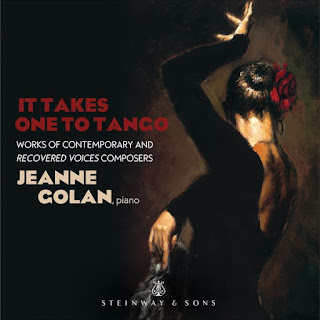
Jeanne Golan, It Takes One to Tango, Works of Contemporary and Recovered Voices Composers, Solo Piano


The most valuable musicians and music people to me these days are those with the courage and insightful instincts when it comes to music we may have missed or not yet heard. In spite of periods in the last century or so where some felt it was a matter of recycling through the same, say 500 works, we now perhaps understand that the job of sifting through the many yet unheard works out there is never finished, for the reason that history is never about the exact same things endlessly repeating themselves, though sometimes it may feel like that!

And on that note we have today an excellent example of how an artist can weed through the many obscure items of past and present and come up with an unexpected and worthwhile blend of things we can grow into, grow with. I allude to a new CD by pianist Jeanne Golan entitled It Takes One to Tango: Works of Contemporary and Recovered Voices Composers (Steinway & Sons 30164).

It is piano music of character, more personally insistent than doctrinairely Modern, as personal as a signature or a special laugh maybe? At any rate it is a fine example of music we are glad to hear, played with a kind of devotion to the inner spectacle and special way of being that marks it all out.

Important to keep in mind that "Recovered Voices" according to the liners refers to "composers who were persecuted and often murdered as a consequence of the Nazi Regime." And in keeping with the title of the album all the pieces have direct or indirect reference to the Tango in its musical specialty, its rhythmic breadth and melodic-harmonic girth.

There is nothing superfluous, no space wasted, much music to come to know and appreciate, composers we may have far too little appreciation of, and in spite of what we think we know, there are surprises, happy ones contained within the 70-plus minutes playing time. Wanda Landowska, the "mother" of the modern harpsichord revival, gives us a short work that tantalizes, Toby Twining's "An American in Buenos Aires" appeals in a Golan arrangement for piano and toy piano, enchants in a bluesy directness. We get a goodly assortment of rediscovered casualties of the fascist refusal in the lively music of Wilhelm Grosz and Erwin Schulhoff, the latter in the substantial "Etudes de Jazz" of 1927. Then there are three captivating miniatures by Pablo Ortiz. All that is a good sample of the totality.

Ms. Golan shows how brightly, brilliantly musical and pianistic she is by virtually selflessly devoting all her focus to this endlessly interesting program. Viva her beautiful interpretive skills and her wonderful sense of discovery as she presents us with a delightful batch of things we might not have discovered were it not for her careful ear and critical soundness of judgement.

A topper of a program. There is every reason to like this one. Do not fail to give it your attention.