Search This Blog

Wednesday, February 9, 2022

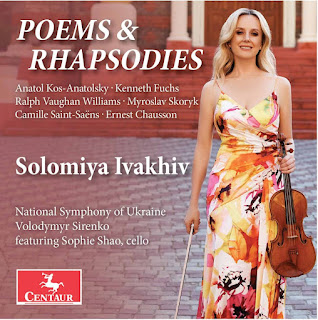
Solomiya Ivakhiv, Poems and Rhapsodies, National Symphony Orchestra of Ukraine, Volodymyr Sirenko


Now pretty many years ago when I worked in a publishing house the Art Director had a radio tuned to a local classical station. Every so often he would call me into his office (mine was next door) and ask, "What is this music!?" Interestingly it was nearly always Vaughan Williams' "The Lark Ascending." He was right to ask. It is exceedingly haunting music, wonderful, and reminds us that Ralph studied with Ravel, but also that his Impressionism contained a large portion of his "musical DNA." The results were very much his. My friend and colleague was right on the money to pay note to that music. 

All this I scrawl to bring us up to today's album, Poems and Rhapsodies (Centaur CRC 3799) which showcases the rather ravishing violin expressions of Solomiya Ivakhiv, along with the National Symphony Orchestra of Ukraine under Volodymyr Sirenko. Joining the proceedings for one piece is US native Sophie Shao as cello soloist.

I bring up Vaughan Williams and "The Lark Ascending" as it is a part of the program, very nicely done, an excellent version with all the special wistfulness of the score on display. 

Throughout the program focuses quite happily on Ms. Ivakhiv's wonderful violin play, sweet enough to carry the feeling this program needs, not sticky sweet, and beautifully poised in her concentrated lyricism. The National Symphony Orchestra of Ukraine with Volodymyr Sirenko at the podium provides us with both the detailed sound staging that this music demands and a sympathetic centrifugal irradiation of lyric fullness.

The key to the music resides in part clearly in the title of the album, Poems and Rhapsodies. The six work program centers on an expression of impassioned sweeps of dramatic sounds, from the Late-Romantic French budding of a dimensional proto-Impressionism in Saint-Saen's "Le Muse et le poete" that features Ms. Ivakhiv along with the cello of Sophie Shao as dual soloists in a rhapsodic introspection that opens further into the present on Chausson's "Poem symphonique," which projects a wonderfully suspended reflectiveness and gives Solomiya a  glowing set of responses to the orchestral ruminations, which she takes in stride and makes of it all something personal.

And then out of the rhapsodic mist there emerges at the most opportune point the wonderful "Lark Ascending" with a very fine absorption of the solo part, deeply thoughtful-wistful and the orchestra laying down a gentle carpet of aural pine needles. Nice job! And like my art directing friend of years back asked, "What is this?" is still relevant, for the music is wonderfully itself and as timeless as it ever has been. 

From there we have a threefold second half of the program with some very Ukranian melodic and rhythmic fine tuning and folk recalling in the works by Anatoly Kos-Anatolsky and Myroslav Skoryk. The two works as presented here give the ultimate argument of why we need to hear and appreciate the works thanks to the considerable beauty and dynamics of the performances. The Kos-Anatolsky "Poem for Violin and Orchestra" was composed in 1962 and lost. Ms. Ivakhiv commissioned Bohdan Kryvopust to reconstruct the work from a recoded source. It is some beautifully intriguing music with Ivakhiv sounding every bit as expressive as you could ask for. And in the process we get the chance to hear this work in near ideal circumstances. It calls forth with a beautifully rhapsodic and then beautifully folk-dance-like. Bravo.

The Myroslav Skoryk "Carpathain Rhapsody" also has wonderful local dance-folk components that the composer skillfully sets up for soloist and orchestra in ways that intrigue and beguile.

To more or less tie things together we are treated to a Modern blockbuster with Kenneth Fuch's "American Rhapsody." It has a furtherance of the beautiful mystery than these works often carry to us in this recording. The Fuchs work has a wonderfully colorful and luminescent quality. It is worth the price of entry alone. 

But of course you get a considerable amount of lovely music here, played with the kind of attention each of these works deserve. Solomiya Ivakhiv has just the right temperament to make each of these works shine with a fabulous tone and virtuoso panache that feels just right. And bravo to the National Orchestra for the care and brilliance with which the music comes to us here.

This one gives you a great deal to appreciate. Do not hesitate!


.

Tuesday, February 8, 2022

Davide Ficco, Asymmetric Thought, Italian Music for Guitar and Electronics


There are some musical releases that are so rich in content that it takes some time to absorb. That is certainly true of guitarist Davide Ficco's Asymmetric Thought: Italian Music for Guitar and Electronics (Davinci Classics C00318 2-cds 1-dvd). It is a set of two CDs and one DVD, covering the music of some 18 Italian Contemporary composers, names you might not recognize unless you are very well versed in the Italian New Music scene today.

The names unfamiliar (to me) do not mean uninteresting, surely. And as you think about it, the asymmetric is a stylistic center-periphery in Modernism music and art, so an important consideration. The music decenters in all kinds of ways. That is a good thing of course. Davide Ficco is an impressive artist in the Modern mode, coming through with articulate and virtuoso insights on the many shifting stylistic nuances, from High Modernist expression to the many tone color and melodic brilliances that are to be had in the set.

The electronics range from a full electronics sound color orchestration  to a transformation of guitar sounds to various possibilities and things in between. It is a rather astonishing wealth of state-of-the-art New Music stylistic niches and in the end a tribute to Davide's open facility and flexibility as well as some pretty remarkable composer contributions taken as a whole. A few add additional instruments--percussion, trumpet, and there are some that have a Jazz-stylistic element.

Note: The DVD gives you multichannel versions of selected tracks from the CDs.

Anyone who loves Modern Classical guitar and/or electronic and acoustic transformations will have a great deal to explore and appreciate. Recommended highly to those who think they might like it from my description.

Monday, February 7, 2022

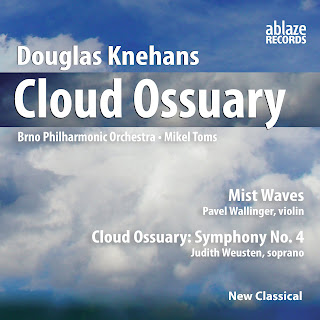
Douglas Knehans, Cloud Ossuary, Brno Philharmonic Orchestra, Mikel Toms


Living and thriving composer Douglas Knehans exemplifies a certain aspect of New Music today. That is, he does not attempt to occupy a genre so much as to create the music inside him. His latest album gives us that in all its finery, Cloud Ossuary (Ablaze Records ar-00062).

It is a program very well played by the Brno Philharmonic Orchestra under Mikel Toms, Pavel Wallinger nicely appearing on solo violin, with a beautifully wrought soprano performance by Judith Weusten for the single movement that calls for the vocal part.

The album contains two vibrant and essential works, A brief but mysterious "Mist Waves" for solo violin (Pavel Wallinger) and Douglas' "Cloud Ossuary--Symphony No. 4" which is a major work of our present-day to my ears.

When I listen to Douglas Knehans' music (type his name in search box for more reviews) I come away with the feeling that the music coming out of him has a kind of organic singular inevitability--that he has a full-blown melodic-harmonic-orchestrational personality that is eloquent and original, that speaks directly to one's listening muse in ways that keep you focused on the flow of lyric and dynamic articulateness.

So the symphony builds in the three movements very beautifully contrasting sound evocations of clouds. Each fulfills a will to form, so to speak, a sincere expression of the experience of cloud-dom. And too in the best ways the music is lucidly a commentary on itself, on its self-presencing service of looking out upon the world as a musical human. Maybe that seems obvious but this music succeeds in expressing the musical self in a complete and satisfying way and, perhaps, not all that many composers you can say that of. A key is the sureness of orchestration, almost a kind of second nature of one who has explored the inner realms of sonic possibility in considerable depth.

So the contemplative continuance of "Mist Waves" works within itself as a complete being, as does the rhythmic unfolding of the first movement of the 4th, "The Ossean Cage." Then we get transported to the gorgeously hovering sustains of "Breathe Clouded" And then the longer final centers upon the beautifully apposite soprano floating above a singular series of orchestrational aural poems. It is a rich and complex tapestry of a movement, something to sink into with absorption.  For a moment you may call to mind the gargantuan enormity of a Mahler, the orchestrational sensuality of a Ravel, but then no, this is music of the present, music of the present as fertilly imagined by Douglas Knehans, not quite Modern in the typical way, nor a backward leaning in a reverse mirror on it all. It is K-n-e-h-a-n-s.

And that is a wonderful thing to me. Dive into this one of you will. There is much to live with, to grow into. Bravo!

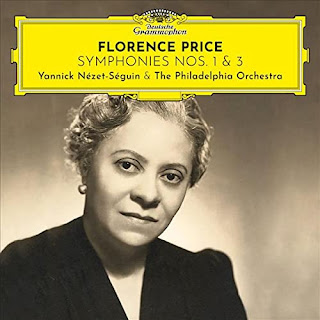
Florence Price, Symphonies Nos. 1 & 3, The Philadelphia Orchestra, Yannick Nezet-Seguin


One of the more rewarding composer revivals recently has been that of Florence Price (1887-1953). whose music underwent a long period of neglect after the Chicago Symphony premiered her First Symphony in 1933.  As an African-American woman she had obstacles to surmount, but thankfully her music is enjoying a re-emergence. I happily reviewed  John Jeter and the Fort Smith Symphony's CD of her first and fourth symphonies (see review of March 12, 2019) . I have a set coming up for review of some of her chamber music, and now I am glad to be hearing and talking about Yannick Nezet-Seguin performances of her Symphonies Nos. 1 & 3 with the Philadelphia Orchestra (Deutsche Grammophon 80034879-02).

The first thing that stood out as I first listened was the quality of the performances and the recorded sound. Both are first-rate. And thanks to the careful yet feelingful readings we get the full-fledged orchestrational  impact--densely scored yet varying in the leading melodic voices changing from instrument group to instrument group over time.

Both symphonies weigh in with alternating pastoral and turbulent Neo-Romantic expression, with a fair amount of Afro-Americana with Spiritual, Ragtime, Jazzy elements exuberantly transformed into a well thought-out symphonic matrix.

Even if you have the Fort Smith Orchestral version of the First and Fourth, you will be I suspect glad to hear the Third, which is equally interesting compared to the others--plus this version of the First is different enough that you will experience it anew.

I am glad we can at last hear Florence Price in some depth. I look forward to more. Grab this one in the meantime. It is fully worth it! Bravo!


Thursday, February 3, 2022

David T. Little & Royce Vavrek, Am I Born, Mellissa Hughes, The Choir of Trinity Wall Street, Novus NY


As I put in the living time of someone with a lifespan longer than some others, I increasingly am filled with some awe and respect for the historicity of given locales, so in the last few years I have pondered the long spans of history for Hackensack and now Cape May. There is a new, ambitious and rather stunning work recently recorded and released that I am appreciating. It relates to my thoughts in the last decade or so, in that it is about the long transform of history, in this case the patch of land in Brooklyn eventually to be torn down to make way for the Brooklyn Bridge. The music was written by David T. Little, the words by Royce Vavrek. It is entitled Was I Born (Bright Shiny Things 0152).

This is diatonic post-Minimalist lyricism beautifully realized by soprano Mellissa Hughes, the always ravishing Trinity Choir of Wall Street and the nicely resonant chamber orchestra Novus NY.

The music teams up with the lyrics to linger with thought and feeling on the uncanniness of time unfolding beneath our very everyday existences.

And with that there is a fragile beauty to it all, a touching introspective ruminating, ultimately on how every moment is in some ways shot through with history.

It is every bit as lovely as your deep memory dreams might be if all is right. Listen to this by all means. It deserves a place among striking Contemporary Modern works of our recent times. Highly recommended. 


Wednesday, February 2, 2022

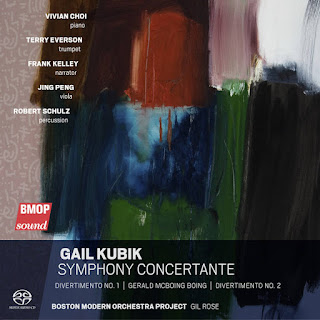
Gail Kubik, Symphony Concertante, Boston Modern Orchestra Project, Gil Rose


Gail Kubik (1914-1984) I've heard something of over the years, but for whatever reason I did not take notice much. And as is the case with many of the Boston Modern Orchestra Project releases, there is a nicely chosen, excellently performed anthology to be had now and it alerted me to what I was missing.

The album features four orchestral works from the '50s: the Divertimento No. 1 and 2 (1959, 1958 respectively),  "Gerald McBoing Boing," narrated by Frank Kelley, percussion by Robert Schulz (1950),  and the titular "Symphony Concertante" for Trumpet, Viola, Piano and Orchestra, with Vivian Choi at the piano, Terry Everson at the Trumpet, Jing Peng at the viola (1951-1953) (BMOP Sound  1085).

It is a kind of happy meld of a Neoclassical Modernism beholden to, but without imitating Stravinsky in that mode, and then the slower middle moment which is lingeringly,  tonally tempered in a poignant feeling of reflectiveness. Listen to the concerted soloists on the "Symphony Concertante" and you will enter an exceptionally inventive world.

The highly puckish, wonderfully orchestrated first Divertimento opens the program with a magnificent textural beauty, some playful Bach quotations and an absolutely charming way about it. Start with this one if you want to sample it and know what to expect

Each work has Kubik's personal stamp. The "Symphony Concertante" provides the deeply accomplished and expressive climax. Perhaps this '50s period may not have afforded him the recognition he deserved because there were several rather unflexible formulas applied to evaluating the Modernism of the day and Kubik did not quite fit either mold. Now we can listen without firm expectations and see how nicely eloquent and original a figure he was.

After lingering with this program a while I am happy to hail it as something special, both from a compositional and a performance point of view. Gail Kubik needs your attention, your consideration, surely. This album stands out as a happy reason to hear him.

Tuesday, February 1, 2022

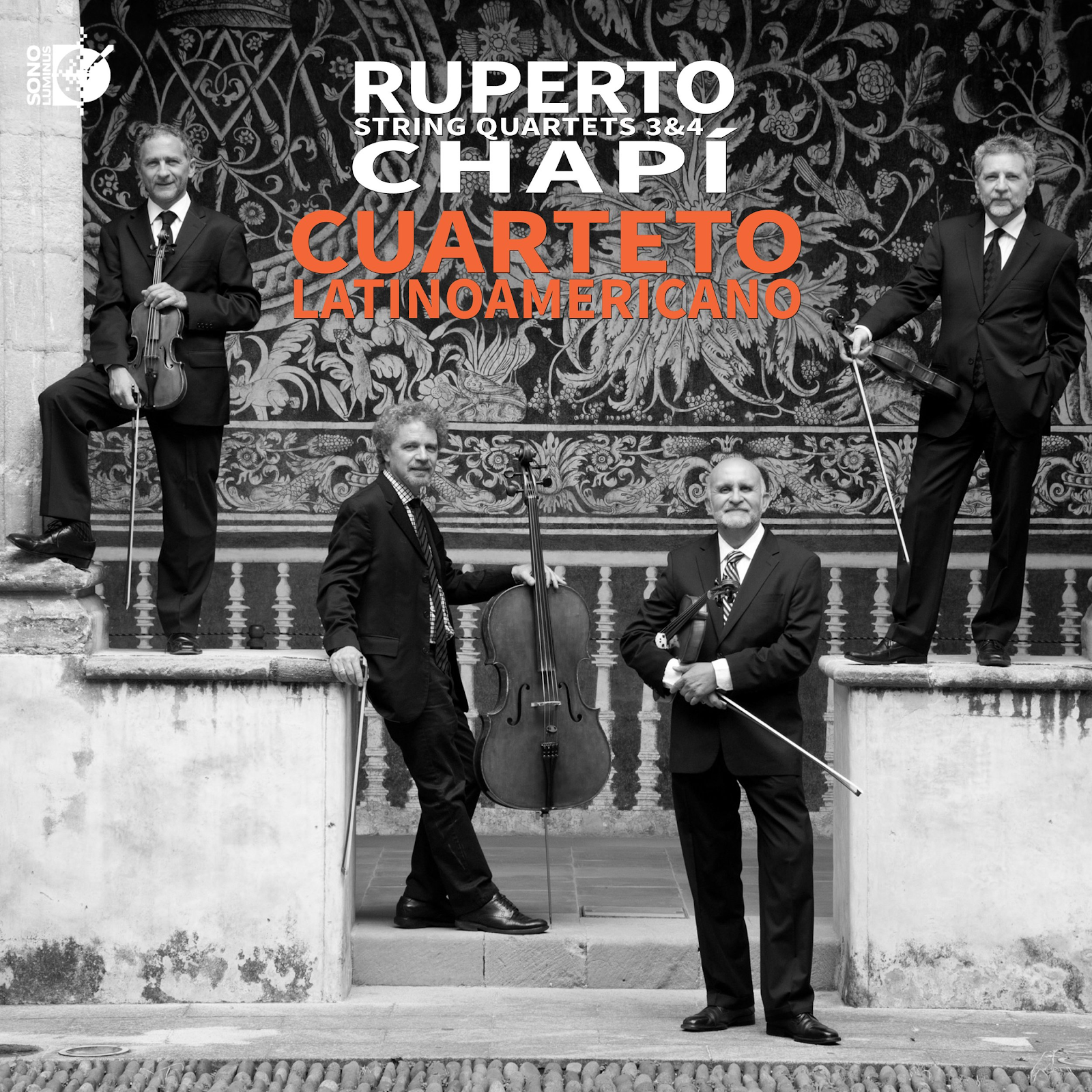
Ruperto Chapi, String Quartets 3 & 4, Cuarteto Latinoamericano


Imagine a comprehensive list of all the composers worthy of the name, all who ever lived whose music survives in one way or another. Would that make a book the size of the old Manhattan phone book? Sure, one way or another. Maybe bigger. And yet music lovers like me wake up every morning assuming they know all that is important in terms of names and schools. But of course there is no true end of knowledge, no matter where you are situated.

So this morning I listen to the music of Ruperto Chapi (1851-1909), specifically his String Quartets 3 & 4 (Sono Luminus DSL-93254) as played with fire and precision by Cuarteto Latinoamericano.

Who was this? Is this?  He was a Spanish national, born in Villena. He established lasting appreciation in Spain for his Zarzuelas, garnering great fame with the 1897 La Revoltosa. He became interested in chamber music towards the end of his life with the advent of his four string quartets beginning in 1903. We have the World Premiere recordings of his third and fourth on today's program and they are substantial and detailed, filled with a post-Romantic Spanish zing perhaps in a kind of Neo-Classical Modernist way, with ,lyrical moments that suggest the kind of dramatics of Zarzuelas without direct reference.

Anyone who like me appreciates the rise of Spanish efflorescence over the last century or so will be quite pleased with these gems, I suspect. By all means give them a listen. Bravo to Cuarteto Latinamericano for bringing us the happy revival of some works that deserve acclaim and renewed attention.