Search This Blog

Wednesday, June 8, 2022

Aznavoorian Duo, Gems from Armenia, Ani and Marta Aznavoorian


Those who know and love Armenian music like I do no doubt have an aural picture in their minds of what to expect. Part of that has to do with the highly developed and special minor or otherwise distinctly diatonic tonality that has prevailed so happily in the music. There is a new anthology of classical music just out entitled Gems from Armenia (Cedille CDR 90000 209), which consists of some 15 Armenian works for cello and piano, played convincingly and sensitively by the Aznavoorian Duo (Ani, cello, Marta, piano).

It all comes to the listener as a kind of cornucopia of possibilities, beginning with the well-known Komitas Vartabed (1869-1955) and four of his beautifully rhapsodic miniatures. Then follows two short but evocative pieces by perhaps the most well known Armenian composer of our modern times, Aram Khachaturian (1903-1978). It includes "Yerevan," which I suspect any avid music lover will recognize. The cello-piano version sings and soars thanks to the Aznavoorian passion and lilt, so to speak.

The program continues on without the least bit of flagging, so we get works by three more Soviet era composers--Arno Babajanian, Avet Terterian, and Alexander Arutiunian, then works by two present-day living Armenian composers, Serouj Kradjian and Vache Sharafyan. The final item is a specially commissioned work by living American composer Peter Boyer, on the iconic Armenian landmark "Mount Ararat."

All of the works feel like a logical sequence going from the rooted to the refreshing of the aural memory with a wealth of music that should appeal to all who love Armenian or for that matter the world of Asian-Indo classical in the recent past and in the present.

The Aznavoorian Duo make their debut appearance recording here auspiciously. It is a lively and lovely program of melodic and harmonic jewels. There are neo-Romantic elements at times and some in a Modern Neo-Classicist vein, but all have elements of Armenian musical tendencies that are realized with a dedicated devotion by the Aznavoorians. 

It is a happy addition to your Armenian collection or for that matter an excellent introduction to Armenian chamber Classical as a Modern whole. Very recommended.


Soul of Brazil, Alma Brasileira, Villa-Lobos Piano Music, Martha Marchena


All, or most all of us who explore Modern Classical have listened to the piano music of Heitor Villa-Lobos at least some over the years, depending in part on how old you are, with age accentuating the probability of such things. I have come away from it with a feeling that the opus has much to appreciate about it but also that the piano music stands virtually alone in that there are lyrical reflections and harmonic-rhythmic stridencies not entirely relatable to the rest of the Villa-Lobos repertoire. With a new volume devoted to selected piano works as played by Martha Machena, we get another opportunity to consider some choice pieces. All this on the CD entitled Soul of Brasil: Alma Brasileira (MSR Classics MS 1764).

Martha Marchena, a pianist of Cuban abstraction, did her doctoral thesis on Villa-Llobos. It is clear from this recording that she is very sympatico with his brilliant musical inventions. As we hear the nicely chosen variety of works presented here, we of course hear moments where the folkloric Brazilian music roots are very much out front. Yet there are reworkings in this music and a stance towards the piano that go a considerable distance into the poetic piano arts for their own sake. So there can be thoughtful expressive rubato and clangorously striking dynamics. Of course no matter the configuration Villa-Lobos nearly always has a musical agenda a good deal more complex at times than a facile sort of Nationalism would suggest.

Still, for example as you hear Ms. Marchena's boldly energetic foray into the "Jungle Festival" movement of his "Ciclo Brasileiro," it is the direct allusion to folk roots that delights the senses as it gives us a most lovely Villa-Lobos approach to folk transformation. And in the end there is ever some perhaps more subtle references to his country's musical ways. Perhaps  it is the way Villa-Lobos applies his brilliance to the piano as a virtuoso and inimitable musical vehicle that stands out in these works.

The five pieces presented here ("Alma Brasileiros," "Rudepoema," "Valso Da Dor," "Bachianas Brasileiras No. 4" and the "Ciclo Brasileiro") stand out in the hands of Martha Marchena as music well worth reconsideration as some gems of the earlier Modern era. At the same time they reassure us that Ms. Marchena is just the artist to pull off the complexities and turbulent lyricism the piano cycles can express so nicely.

Highly recommended.


Wednesday, June 1, 2022

James Kallembach, Antigone: The Writings of Sophie Scholl and the White Rose Movement, Lorelei Ensemble


James Kallembach occupies original New Music space with his Antigone: The Writings of Sophie Scholl and the White Rose Movement  (New Focus Recordings FCR 33), featuring a chamber chorus of some eight female vocalists as a choral totality and then also with soloist parts, and so too with the chamber instrumental poeticisms of a cello quartet, all brought forth as a whole for this work by the Lorelei Ensemble directed by Beth Willer. They are a fine, detailed and accomplished set of performers who have a distinct feel for this music and give us spirited and exacting readings.

The work has an exploratory, declamatory tonal feel to it with close harmonies in the vocals punctuated by instrumental timbral poignancies by way of the cello quartet. It was commissioned by the Lorelei Ensemble and Carson Cooman, premiering in 2017. It gains a kind of structural backbone via the Greek play Antigone, but then focuses too on considering the writing of Sofie Scholl, a key member of the White Rose Movement--an underground resistance  opposing the Nazis in the Germany of WWII, and based at the University of Munich. The work is in multiple movements, with lyrics in part culled from the anti-Nazi pamphlets distributed by the White Rose participants and then further text-song melding--Scholl's expressive  texts fusing with the classicism of Antigone. It appreciates it goes without saying the courage of Ms. Scholl, who was executed by the Nazis in Germany, 1943. And at the same time it explores the lyric, poetic expressivity of her writings as a whole.

It winds introspectively, contemplatively through the vignettes from Antigone and the contrasting vocal treatment of Ms. Scholl's texts.

It is alternately tender, somber, classically retrospective and reflective gaining a timeless quality which nevertheless has a judicious contemporary feel to it and a movement away from any vestiges of Romanticism, yet nonetheless as the press sheet notes he flourishes as he seeks to consider that past within the present, particularly processual as a vivid dialog--and in so doing has an almost Classicist facticity. And that for me works well since the subject matter comes to terms with a heroic refusal that can become all the more poignant when looking upon it in insightful yet Apollonian terms.

All of that comes to bear on your listening experience, leaving you perhaps with a sort of even-handed heroics that underscores a kind of quiet resistance of the morally virtuous in time, looking back while  laying out nicely, with a careful and intensive performance suchness, a thereness that rightly insists on its need to express itself.

I recommend this one for its powerful relevance to time and history as we live it. It is beautiful yet terse music, completely self-sufficient as a contemporary insistence, and leaving in the end a deep impression of alternate aesthetic reality, heroic and nonplussed moral uprightness.

If you are reading this in June 2022, the album is out on the 17th. You can preorder on Bandcamp. 

Monday, May 23, 2022

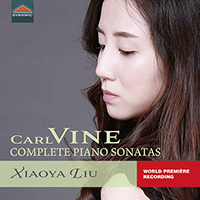
Carl Vine, Complete Piano Sonatas, Xiaoya Liu


There are those who insist that there is nothing new under the sun. They are reassured in this thought, no doubt, but they are wrong. Today we have a very worthwhile example of new. There is a composer new to me and perhaps for many readers, one Australian-based compositional wizard, one Carl Vine (b. 1954), and there is also in this bundle of newness a young pianist unfamiliar to me but fully prepared, an amazing, very simpatico interpreter of the technically demanding and present-day poetic motility of Vine's Complete Piano Sonatas (Dynamic CDS 7931).

There are four sonatas in all, from the years 1990, 1997, 2007, and 2019, respectively. Each one stands up for itself, showing introspection and an exciting, exhilarating motility that Xiaoya makes poetically ravishing without fail. The sonatas have plenty of advanced harmonic elements that mark it all as of our time, yet they also advance the exciting pianoforte movement that burgeoned in earlier days in the inventive creative minds of Chopin, Liszt, Scriabin, Rachmaninov, Sorabji, and Alkan, to name a few that come to mind as I listen. Yet it all covers that advanced unfolding on very much its own terms.

Its considerable demands and its moving cascades of pedaled, sustained torrents are taken on heroically and  very sympathetically by Ms. Liu. I have a hard time imagining a better reading of these gems. And it is clear as I listen repeatedly that Xiaoya Liu is a voice of our time, a most impressive dynamo, an extraordinary brilliance, a thrilling presence.

It is some of the most exciting piano music I have heard in years. Touch, finesse and rolling power stay conjoined in ways no doubt Maestro Vine appreciates, as I think would anyone who loves demanding and well executed unfolding in our present tense! It is marvelous music. Do not miss it. Like a concatenation of many bells bursting out over the aural air, this assures one, stuns and makes one look forward to more!

Wednesday, May 11, 2022

Marti Epstein, Nebraska Impromptu, Chamber Music for Clarinet, Rane Moore, Windsor Music


There is something new under the sun with Marti Epstein and her Nebraska Impromptu (New Focus Recordings FCR 324). It is an album of music for clarinet and various chamber configurations, handled gracefully and winningly by clarinetist Rane Moore and the Winsor Music players. There are five works in all, written between 2001 and 2018.

The music apparently spawned an interaction between a student and the composer, which I stumbled upon on FB but I lost track of when I went back to the newsfeed. It got my attention because it addressed what today's Modern music scene is all about, essentially in the composer's view (rightly) it is less and less about some kind of 12-tone Serialist High Modernism, but then in fact is in a wildly open post-one-thing world. Now any regular reader of this Blog knows I champion that very notion, that what one might hear today exists within a wide expanse of possibilities, and that nothing automatically can be assigned a status above another in terms of "currency." The discussion made me want to hear the album and I realized it was on my stack ready to be heard.

And as it seems plain to me and happily so, this collection of Marti Epstein chamber gems finds its own turf in an ever unfolding, lyrically yet fully tonal palette of brilliant sound color and rhythmically, gradually blooming contrapuntal open form. And the music is in line with the wide-open set of expectations of what one might find in any given collection of New Music these days. So three cheers for that.

So to my mind the five compositions presented here are as interesting and as introspectively encompassing as anything new out there today. Epstein responds to the many things now "in the air" in New Music without joining any particular school in some slavish way. We get processual and repetitive elements but not as a paradigmatic constant, no more than, say, a Modern poet might add reiteration to the substructure of unfolding without, say, committing to the absolute, almost ritual systematicity of a Gertrude Stein. The world has turned and we individually and collectively can take what insights we have gotten from the Modernist generations and move it further along expressively.

Perhaps we are in an age where the program notes are not an essential part of hearing what is going on. We can trust our now fully Modern-and-beyond musical senses to understand and appreciate what is being expressed. The press sheet mentions the influences of Webern, Feldman and Takemitsu as well as the American plains and Nebraskan vistas. I understand and concur--and if I might be so bold to suggest, there is a fragile, terse yet overarching beauty in classic Webern that of course never depended completely on 12-tone procedures, there was more there and Ms. Epstein has taken it to heart!

Each of the five works stands on its own in terms of structure, in terms of syntax and spacing. So we listen with gradually more enthusiastic responses to "Oil & Sugar" (2016), "Liquid, Fragile" (2010), the title work "Nebraska Impromptu"  (2013), "Komorebi" (2018) and "See Even Night" (2001).

Rane Moore's clarinet work here is nothing less than magical. The spellbinding, ever renewing presence of clarinet and differing chamber combinations underscores Ms. Epstein's poetic luminosity, be it clarinet and piano, same with additional flute and violin, or with viola, and then clarinet, violin, viola and cello, or oboe and violin in tandem with clarinet.

Every piece has its place in the contemplative matrix, each revealing a slightly different musico-inventive acumen.

After a good number of hearings I am sold on all of it. Someone of the caliber and originality of Marti Epstein does not come along every day, of course. But we are lucky for such a revealing newness that emphasizes a togetherness more so than an "advancement" per se.  It advances into itself. We are all the better for it. Bravo! Strongly recommended. Music for the present day and ages to come! 

Tuesday, May 10, 2022

Matthew Aucoin, Orphic Moments, American Modern Opera Company, Boston Modern Orchestra Project, Gil Rose


Composers new to us open up unexpected musical autobiographical worlds, when things are right, that we never would hear otherwise. And in the end our musical worlds on the New Music front are built person-by-person, artist-by-artist, composer-by-composer. And happily Matthew Aucoin (b.1990) is one of those potential building blocks of stature today. I have been listening to his two-CD release Orphic Moments (BMOP Sound 1084) and it is filled with interesting orchestral and vocal-orchestral music spearheaded by Gil Rose and the Boston Modern Orchestra Project, along with the American Modern Opera Company.

This release marks the first of a series of collaborations of the Boston Modern Orchestra Project with the aforementioned American Modern Opera Company, the latter co-founded by Aucoin.

The seven works featured in this set were written over a period of seven years, showing a coming of age and artistic development in both orchestral music per se and also with operatic vocal-orchestral works. It is a music of inspired complexity, expressive Modern dynamic and harmo-melodic depth.

Many of the works were written for specific musicians in mind and benefit nicely by having those artists on the performances as applicable. The music can groove and pulsate somewhat and it can also extend outward in intricate multi-stranded musical passages. Like a number of present-day composers the music assumes that both Serialism and Minimalism have passed through our musical consciousness but that it is a time for a beyondness that avoids the doctrinaire specifics of those styles and instead strikes out on its own with a personal expression that is of our time without necessarily making a point of its Modernity per se.

But then again there is no mistaking the fresh Contemporary quality of the music. Listen to the 2016 "Concerto for Piano and Orchestra" and the 2014 title work "The Orphic Moment" with countertenor Anthony Roth Costanzo and you will get a strong impression and a lucidly inventive certainty that is a joy to hear. The remaining five works each have a special resilience and presence that makes it a first rate listen and gives you a bird's eye view (bird's ear?) of the Aucoin musical personality. Very impressive music. Bravo!


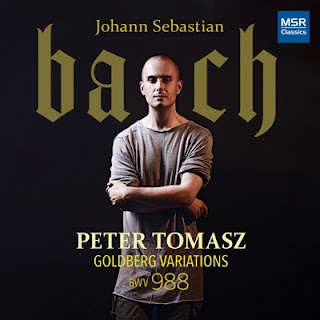
Peter Tomasz, Bach, Goldberg Variations


When it comes to Johann Sebastian Bach, a lifetime can be devoted to hearing it all and not seem enough. The keyboard/harpsichord works always seem ripe for new readings, and so it is the case today with the Goldberg Variations  in dramatic and exciting interpretations by pianist Peter Tomasz (MSR Classics MS1791).

Maestro Tomasz gives us thoughtful readings of the many ins and outs of the set, tender and wistful at times, other times filled with determined and diverting velocity and agility. Glenn  Gould of course is best known for the velocity approach to Bach on piano. Tomasz heeds his own muse as he wends his way through each variation, crisp and rapid trills as suits Tomasz at key points, a pendulum swinging  infectiousness in the movements he takes rapidly, and a kind of nostalgic tenderness for slow passages. It all manages to come across as personal and illuminating in its own right.

Of course this is Bach at his most brilliant, most inventive. Given that many have turned to playing it, it is is desirable and  fulfilling when we experience a freshening via a viable new reading such as this.  Its many facets seem to lend itself to poetic pianisms, perhaps more so at times than say a typical keyboard fugue. (Though of course there is much room in any harpsichord work for a special pianism.) This Peter Tomasz version is quite masterful enough to be an only version if you do not have the music yet. And for those that know the music well it stands upright nicely as a wonderful expression of it all. Recommended.