Search This Blog

Wednesday, September 21, 2022

Miniature Symphonies, Contemporary Examples by Milhaud, Mason, Benton, Nakatani, Scott, The Lowell Chamber Orchestra, Orlando Cela


A reaction to the potential bloat of gigantism and sprawling, lengthy symphonies, we have the counterthrust of the chamber miniature. A timely foray into such realms we find happily in the recent release Miniature Symphonies (Navona NV 6447). The Lowell Chamber Orchestra under conductor Orlando Cela handle the performances with charm and picaresque presence (the latter in terms of an episodic and at times a somewhat wry character).

The symphonies hover around Darius Milhaud as frontier establishing Modern NeoClassical examplar. So we are happily treated to some five refreshingly bittersweet, puckish and edgy Milhaud miniatures, "Symphonie de Chambre Nos, 1-5," each in three movements, each a little gem. They are interleavened and spelled by subsequent endeavors in the miniature symphonic fold, from the explicit Milhaud hommage of Quinn Mason's "Petite Symphonie de Chambre Contemporaine (apres Milhaud)" and on to Brittney Benton's "The Sentinel," Yoko Nakatani's "La Giclee" (the only work here in one, not in three movements), and finally on to Kevin Scott's "Second Little Symphony."

The end result is a nicely differentiated collection of miniatures that say their say succinctly and disarmingly, well played and worth hearing and enjoying. A refreshing program, this.

Tuesday, September 20, 2022

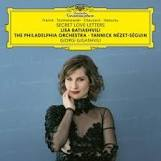
Lisa Batiashvili, Secret Love Letters, Franck, Szymanowski, Chausson, Debussy, Philadelphia Orchestra, Yannick Nezet-Seguin


In the realm of the development of Classical Music history over time of course we know how music in the Romantic phase paid new and more focused attention to depicting feelings and sentiments. And then as time passed composers perhaps found a new emphasis on the expression itself and a language of highly evolved  and increasingly variable forms of expressing ever less literal and eventually more and more abstracted and superchromatic soundings in early Modernism. 

That movement out of Later Romanticism is captured in a kind of freeze frame series in a lively album of violin and orchestral, and violin and piano works,  loosely grouped under the rubric Secret Love Letters (Deutsche Grammophon 486 0462). Each work expresses the secret love idea and I will leave it to you to read the liners for all of that spelled out.

Violinist Lisa Batiashvili teams with pianist Giorgi Gigashvili or the Philadelphia Orchestra under Yannick Nezet-Sequin as called for. The violin performances are ultra-magical, delicately feelingful and expressive in a varied sense, marvelously so. The piano and the orchestra form a perfect foil and express all one might hope for in these works.

The four works represented here are above all beautiful and lyrical, melodically and harmonically. They afford the solo violinist a maximum of expressive opportunities and interpretive openness that Ms. Batiashvili fulfills with real brilliance and panache. It is all told a series of works of true singing, classic late Romantic and early expressive Modernism. And so we go from French and Polish pioneering flights through Romanticism and its depiction of signified feelings to another shore and the future in so-called Impressionism and a new emphasis on expression, on the musical signifier. And funny perhaps but musical Impressionism is less like the painting of "nature" and more like further 20th Century developments in art and music. Literally it is not lily pads in various forms of repose because it is not literal like that, as music there is of necessity and in its own right too a heightened level of abstraction.

The Franck "Sonata for Violin and Piano in A Major" in this performance  is extraordinarily beautiful and lyrical, yet complex. Szymanowski's "Concerto for Violin and Orchestra No. 1" is very expressive in a sort of variegated, airy mysterioso. The Chausson "Poem" has a little less of the orchestrally mystical, shows a little more impassioned a tone but no less poetic for all that. The closing Debussy "Beau soir" comes across as brief, yet sweet.

In the end this has great charm and elan. I do not hesitate to recommend it highly.

Friday, September 16, 2022

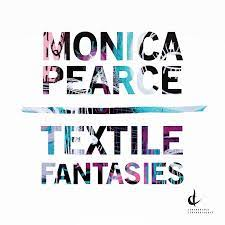
Monica Pearce, Textile Fantasies


Monica Pearce writes music new to me, yet I feel close to it in temperament.   If you do not yet know of her, count her as a significant Canadian composer acclaimed especially for her chamber music and operatic works.  

She gives us a rather astonishing program of music for piano, keyboard and percussion on her just-up album Textile Fantasies (Centrediscs CMCCD 30322). Each of the eight medium-length compositions given a hearing on the album devotes itself to a particular textile and the texture associated with it. So for example there is the opening "Toile de Jouy," which explores the feel of canvas in a rather dense motility for harpsichord. It is almost Cecil Tayloresque in its busy, densely noteful expression.

From there Ms. Pearce takes us to some magical music places, all of which yield a metaphoric connection between texture and sound. Some such links strike me as startlingly surprising, such as the toy piano and tabla raga-like exploration of "Damask," or the percussion ensemble workout with an almost swinging rhythmic thrust on "Denim." Ar how about a sonic colored percussion fantasia followed by rollicking piano-percussion rhythmic spice on "Leather."

"Chain Maille" gives the percussion group a telegraphic periodicity suggested by the woven metal patterning of the chain mail of older times. The solo piano "Houndstooth" forms a ravishing high point of sonic vibrancy, almost George Crumb like in its reflective ecstatics, but then ultimately very Pearce-original and satisfying. I love this! I wont give you any further examples because you I hope get the idea.  Every work is its own mini-adventure, imaginative and meaningful each in its own way.

Go to monicapearce.com to see and hear some videos of this music. The album is out officially on 13 Oct of 2022. It is absolutely lovely at its best, nicely apportioned at any event throughout. I must say I've really enjoyed hearing this one. Do not miss it!

Wednesday, September 14, 2022

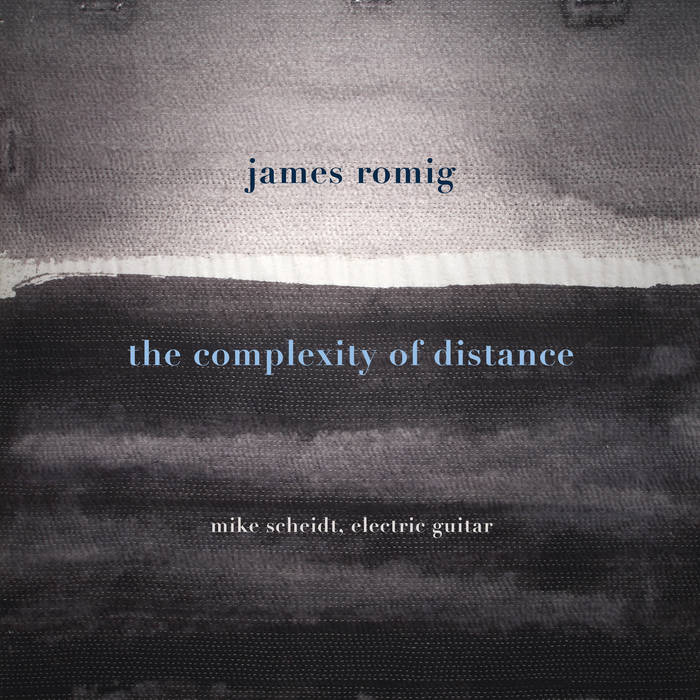
James Romig, The Complexity of Distance, Mike Scheidt, Solo Electric Guitar


,
Over the years, there has been a gradual realization by some that the fully electric guitar, perhaps akin to the hurdy-gurdy or the various other common folk vehicles in Early Music, is ripe to be appreciated as a worthy instrument for serious New Music.  Francis Thorne (1922-2017), American New Music composer, was perhaps the first to excel, to be instrumental in composing for the very electric guitar. Listen to his "Liebesrock" from 1968-69, which happily was part of a CRI release years ago. Beyond that, among other things, there have of course been electric guitarists/composers Terje Rypdal, and Robert Fripp especially, who have pioneered a guitar style that at times came to a kind of New Music viewpoint and gave a very cogent argument for the happy depth of sound color and musicality of the very electric guitar as soloist in Modern Classical ensemble music, or for that matter its parallels in ambient Rock and advanced Jazz.

We segue to the present and another significant milestone with such developments, namely James Romig's The Complexity of Distance (New World Records 80847-2), a full length work for solo metal-strength electric guitar as played adeptly by Mike Scheidt.

The work unfolds gradually with long sustains of power chords that richly fill the aural space. It is in its own way a kind of tour de force of the metal guitar as a New Music solo/orchestral vehicle. Highly recommended. A pioneering achievement!

Tuesday, September 13, 2022

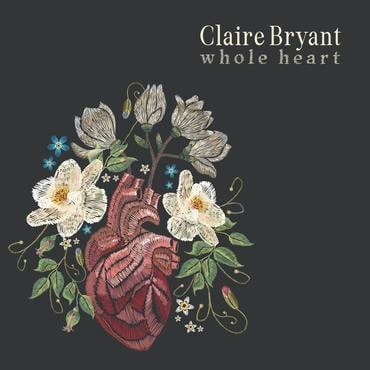
Claire Bryant, Whole Heart, New Music for Cello and Cello with Violin, Viola


Cellist Claire Bryant shows us the beauty and strength of her playing while working through a satisfying series of short works by composers in the thick of New Music and Radical Tonality (if I can keep that latter descriptive moniker-phrase alive here). The program as a whole enriches our appreciation of the sort of early-post timeless depth of composers like Arvo Part, music akin to what he has so wonderfully given us over the years, yet each a step in their own direction. This is music that heightens the expressive virtuosity so readily at hand in Ms. Bryant's playing and too that of violist Nadia Sirota and violinist Ari Streisfeld, as called for.

There is a kind of Plein Air natural yet Modern feel to these works. The composers themselves may not be well known to you, but each partakes of the bare-bones matter-of-fact open chamber sound of solo cello and cello-violin or cello-viola concentrations. There is a pronounced kind of contemplative-meditative atmosphere surrounding each of these works in their own way.

So to consider the composers themselves: there are compositions, one each, by Andrea Casarrubios, Adam Schoenberg, Jessica Meyer, Caroline Shaw, Reena Esmail, Tanner Porter, and Jessie Montgomery.

The entire program captivates end-to-end. The thoughtfulness of the works themselves are matched by the dedicated brilliance of Claire Bryant and her cohorts. I recommend this one to you strongly, especially you all who like me have grown very attached to the solo string presence, the string duos and the unfolding repertoire for such groupings, 

Monday, September 12, 2022

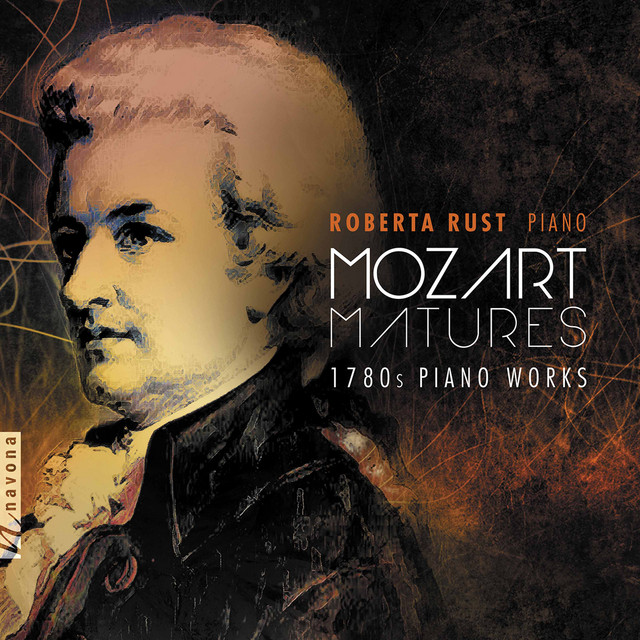
Mozart Matures, 1780s Piano Works, Roberta Rust


Wolfgang Amadeus Mozart stands for the poignant situation where a life was relatively short and fame and fortune nowhere near what it became after death, and it all follows with the cliche that nonetheless rings true that sometimes genius will out, will trump despite the practical difficulty of the lifetime of the artist.

To bear that out there are of course countless recordings and concert attention that never flags. Happily  the performance levels remain high out there. As if to remind us of such things we have pianist Roberta Rust and her framing of the last decade repertoire in a nice way, namely Mozart Matures, 1780s Piano Works (Navona Records NV 6403). 

The juxtaposition of this thoughtful sampling of later Mozart piano works coupled with a kind of lovingly meditative set of performance by Roberta Rust leaves you appreciative and gratifyingly satiated with it all.

Anyone well experienced in Mozart pianism will doubtless know this music, and if not, one should. The "Fantasy" in D Minor and in C Minor, the "Sonata No. 1," the "Adagio" in B Minor, "Eine Kliene Gigue" in G Major, and the "Rondo" in A Minor, all clock in with careful, slightly rubato poetics, not especially keen to show excessive virtuoso expressivity but rather an intimacy that xalled forward the beautify and excitement of it all, and doubtless goes well with, as examples, a crackling fireplace or a luminous night sky.

When all is said one goes away content, human-purring like a satisfied cat, but ready to hear it again--now or sometime later. It may not knock over your water pitcher, or cause the sun to turn green, but it is in its own way down-to-earth yet glorious fare. Recommended for newcomers but also for old hands who are up for listening to a new set of readings. Bravo.

Wednesday, September 7, 2022

Sarah Bernstein, Veer Quartet


Sarah Bernstein is one of those New York originals, a genuine voice, a special straddlemaster between Avant Jazz and Modern Classical, and just herself in there as part of the mix, a violinist of accomplished yet personal, Jazz-related delivery.  So if you check my other blogs,  if you search for her on the Gapplegate Music Review and on the Gapplegate Guitar and Bass Blog you will see that I have covered a bunch of her CDs over the years. And that naturally has to do with how I appreciate her music.

So now there is a new one, a recording of her Veer Quartet (Panoramic Records New Focus Recordings). It is a string quartet made up of Sarah on violin, Sana Nagano, violin, Leonor Falcon, viola, and Nick Jozwiak on cello. All four improvise well, solo singularly or collectively depending on the passage at hand, as well as realize Sarah's compositional frameworks and thematic refrains, some so very much put together in a Modern New Music way, a few others functioning as elaborate near-head motives. The juxtapositions work in the best ways. These are truly Third Stream if you want to resurrect an old name. The music lingers hypnotically at times and sometimes hovers somewhat darkly, which is one of Sarah's ways, happily and very aptly so. The six separate pieces stand each on their own yet segue in ways that make for a marked flow.

This is an outstanding venture if you but give it a chance with repeated listens. Sarah Bernstein burns quietly but warmly as a sometimes hidden but luminous talent in today's adventurous music realm. Kudos!