Search This Blog

Tuesday, January 3, 2023

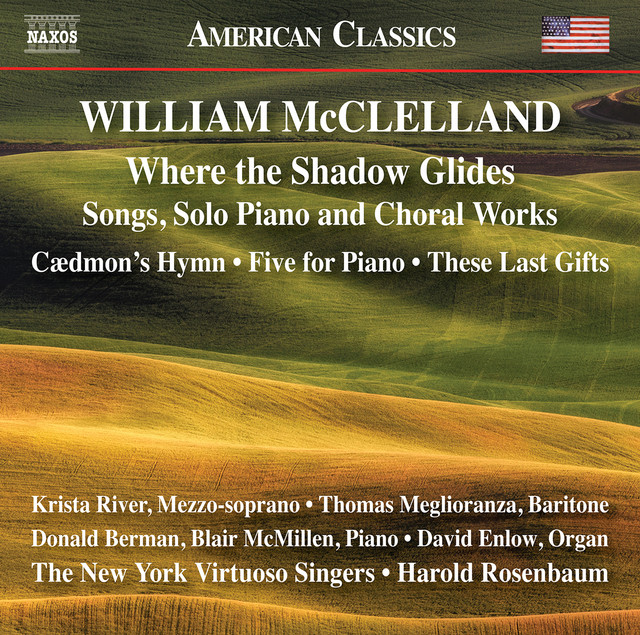
William McClelland, Where the Shadow Glides, Songs, Solo Piano and Choral Works, The New York Virtuoso Singers


Composer William McClelland is a living voice in the New Music of today. According to the liner notes of the album at hand he has been acclaimed the world round as a distinct stylistic influence, or at least that is what is implied in the discussion. I am not one to gauge for the acclamation of the music world for I am not in the thick of it. But hearing the music at hand I can understand if he has a wide following today. So accordingly here we consider the McClelland set entitled Where the Shadow Glides, Songs, Solo Piano and Choral Works (Naxos 8.559906). The album notes underscore that the works performed in this album have in common a music born out of poetry. 

And so on this extensive collection of world premiere recordings we experience it all in a variety of ways. In the choral works early poetic texts give us a special evocative assertion of time and place, while the "Five for Piano" come out of a reaction to as many poems. Then the songs peppered through the program each set particular poetic texts and show us how skilled McClelland is in his ability to carry the feeling of the poems into the musical expression of them He is very talented at such things and we experience the many stylistic ins and outs of the program with fascination and a respect for such a complete musical vision.

This music is not especially avant  garde but more attuned in fact to the echoing of past tonalities and vernaculars, almost a comment on the folk-laced music of Copland without directly quoting but rather alluding to a particular strain of folkdom, perhaps. Yet the music itself presupposes generation of song, of local musics celebrated by large segments of the population, the music of some homeland not directly stated, as in a dream. And that stylistic re-collection-transformation covers multiple style subsets, in the end an authentic and creative re-appropriation of Modern and Contemporary Mainstream roots.

The New York Virtuoso Singers under Harold Rosenbaum  deliver a marvelously unwavering set of performances of the highest caliber. Bravo.

If you sit back and ignore the expectations of what you think a composition should or must be, you are in the right frame to appreciate this cornucopia. Then like me, perhaps too you will feel the adventure of this skilled everything-goes expressivity. Kudos. Listen.

Monday, January 2, 2023

Jacob Greenberg, Living Language, Selected Piano Works by Bartok, Lewis, Chopin, Janacek, and Wang Lu


Here with the first post of the new year I am happy to talk about pianist  Jacob Greenberg's album Living Language (Furious Artisans CD 6830), featuring the select music of Bela Bartok, George Lewis, Frederic Chopin, Leos Janacek and Wang Lu.

The George Lewis is the most overtly Modern of the works, understandably, and at the same time calls upon Jazz influences for a startling cascade of melodic invention. But nonetheless the programmatic  emphasis throughout is on works that develop a highly fluid melodic syntax, a note-to-note speaking as it were, an articulate flow of musical-melodic meaning. Wang Lu's premier recording of "Constellations" brings us more of the High Modernist triumphant with sparkling luminosities of scale-chord assertions of great beauty.

Beyond that we get remarkable flow and brilliance in Greenberg's reading of Chopin's "Mazurkas, " Op. 41, the stunning Bartok workings of his "Improvisations on Hungarian  Peasant Songs" and the equally thrilling ins and outs of "In the Mists" by Janacek. 

Greenberg's lucid phrasings makes some special and spectacular fare out of these exceptional works. I highly recommend this one without hesitation. Listen and you will know, I suspect.

Tuesday, December 27, 2022

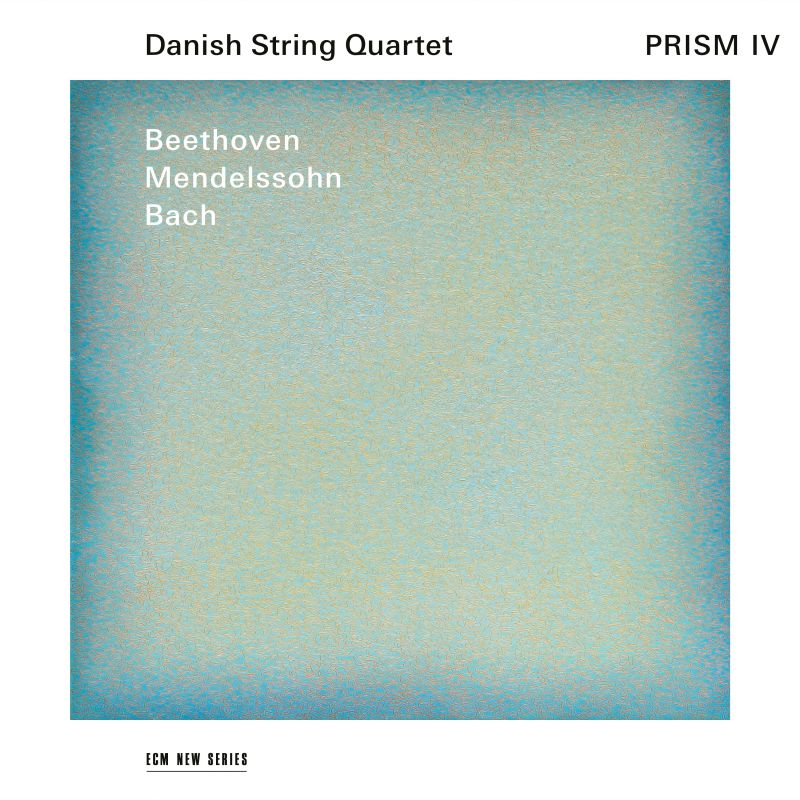
Danish String Quartet, Prism IV, String Quartet Music By Bach, Beethoven and Mendelssohn


"He is lucky; He is experiencing the last Beethoven Quartets for the first time!" So Morris Lang (late great percussionist) told one of his students about another one of his students as I got there a little early for my lesson back in 1972. I had been listening to those quartets myself for a couple of years and I knew how wonderful they were. Of course as I grew into the repertoire I learned that all performances of those works were not alike. Surely, perhaps more tidily, things were changing. 

In time some versions from the LP years were no longer exactly perfect for the world we were in. Little-by-little the peak of Romanticist over-emoting had begun to pass by slowly like a reading of the Eroica Funeral March, so that a fully Modern interpretation might have had for us lots of gravitas and feelingful punch, but less so than a classic Budapest Quartet version might have had, for example? And that less is more like how we feel about such things today perhaps, we who might be in a sort of Neo-Baroque phase of music making, still feeling things but feeling horizontally more flowingly expansive, maybe?

Fast forward to the right now of today and a new recording by the Danish String Quartet, Prism IV (ECM New Series 2564). It is especially notable for a convincingly gravitas performance of Beethoven's String Quartet No. 15, one of the very best of the Beethoven late quartets. And this Danish String Quartet version is as good or better than any I have heard in our present day. It is flawless, not precisely restrained but then not feverish either, with a kind of Apollonion ray of brilliance really, a ray of enlightened musical strength perhaps like never before or since. So hurrah.

And hurrah too for the brief but spectacular  Bach "Fugue in G minor," and for the evergreen Mendelssohn String Quartet No. 2, which the Danish Quartet gives to us as another stately strength-and-height soaring topper of an Apollonian pine.

The Danish Quartet show themselves as a beautifully tall outfit for today, as tall as we might hope to hear and appreciate as we live. Bravo to this music and its makers.  Recommended highly.

Tuesday, December 20, 2022

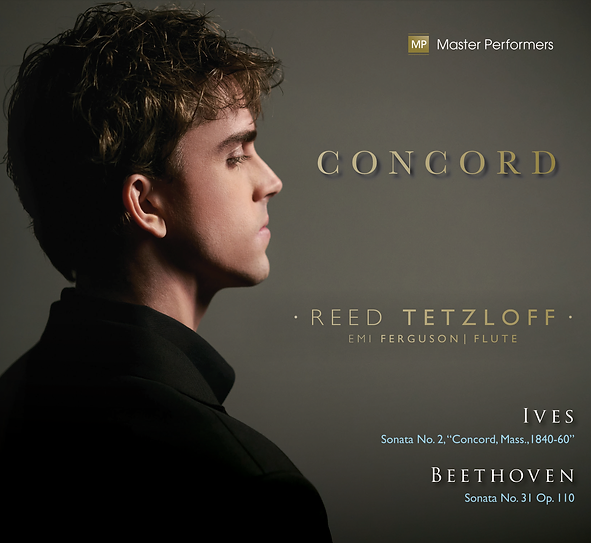
Reed Tetzloff, Concord, Ives Sonata No. 2 "Concord, Mass. 1840-60," Beethoven Sonata No. 31 Op. 110


Charles Ives' "Concord, Mass" was revolutionary and iconoclastic when he wrote it, no doubt the first really important modern solo piano work last century, fiendishly difficult in its extensive clusters, advanced harmonic underpinning and alternatingly volatile and beautifully mysterious arcs that require a complete pianist of extraordinary interpretive abilities. In many ways Beethoven's ravishingly expressive Sonata No. 31 Op. 110 was an earlier counterpart for its uncompromising strength and beauty.

In Reed Tetzloff we have a giant of a pianist fully prepared to take on the formidable challenges of a superlative reading of both works.

The Concord when first entering the potential repertoire of concert pianists in the later '40s-early '50s had a continual flow that needed an exceptional sense of the musicality of the phrasings. Not everyone could meet the continual demands of the work in those early days of Ives musical scholarship. Far from it. As time went by there were ever more fully thought-out performances and we now have with this release one of the real milestones in Sonata realizations. Each movement seems aptly weighted proportionately and the through-phrasing sounds convincing every minute as all holds steady and true as part of the overall journey.

Beethoven's Sonata No. 31 is the unexpectedly perfect foil for the Ives. Tetzloff makes it fully resonant and projecting and thereby shows how both works parallel one another and invite comparison when performed with equal vigor and devotion, as is the case with this wonderful program.

The Ives most definitely reflects how this music seems at last fully of our times, readily understood and beautifully lyrical in the way we now hear such things in an ideal situation. Bravo!


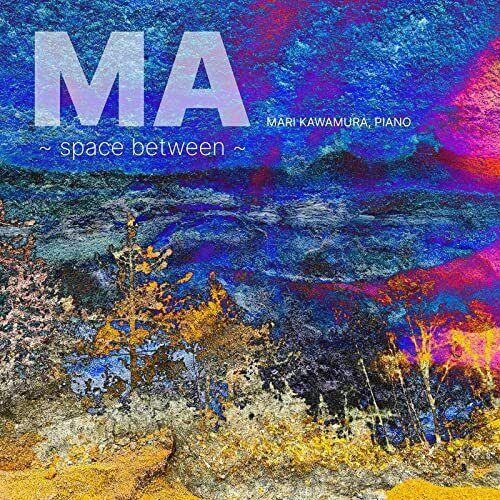
Mari Kawamura, MA ~ Space Between, New and Classic Music for Solo Piano


Mari Kawamura is a concert pianist with a decidedly singular sort of musical commitment, as we might readily pick up on as we listen to her thought-provoking new anthology of solo piano music. MA ~ Space Between ~ (Furious Artisans FACD6831).

The liners give us insight into Ms. Kawamura's view of things. It is worth quoting at length. 

"Kawamura is drawn to music which utilizes the entirety of the piano  as an expressive device. She is as equally fascinated by works that showcase the tremendous agility of the instrument, as by compositions that explore its ability to produce cavernous resonances, complex spectral sounds, and unpitched noise."

Following this we get a true cornucopia of possibilities that accentuate some and most of these aspects as realized poetically and gracefully. That is clear listening to the program entailed. There are some six short Lei Liang works that bring a fully mysterious set of ruminations well worth repeated hearings. It is a reflective Modernity that parallels but does not duplicate a George Crumb. Katharina Rosenberg chimes in with an expansive and spacious analog of expressions most fitting as well.

Interestingly Franz Joseph Haydn's beautiful Piano Sonata Hob. XVI:40 sounds much more adventuresome in the midst of this program than he might in a more Classical Period program. Then Takemitsu and Xenakis both hold forth with extraordinary Modern open qualities, as you might expect, yet especially expressive and expansive in Mari Kawamura's hands.

This is nothing short of marvelous in every performative possibility and it gradually unfolds with every listen until you feel that the pianist surely speaks to all of us open to the cosmic possibilities of musical time and space. Bravo.

This is a landmark set of performances and the compositions ring true in the pianist's very capable and expressive hands. Check this one out without fail, do.

Friday, December 9, 2022

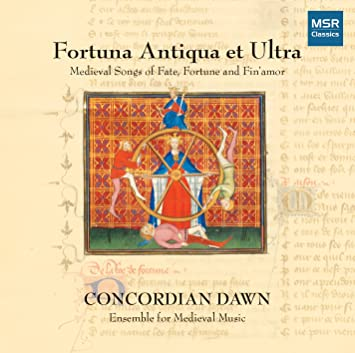
Concordian Dawn, Fortuna Antiqua et Ultra


I do not suppose I stand out from my readers when I say how much I appreciate Medieval music. It is so ethnic the way it is performed these days, whatever than means. Of course one might say that ALL music is ethnic on the other hand. But Middle Ages Europe sounds pretty folksy, pretty directly together and immediate? To me, anyway. So I am glad to have gotten a new one for my ears to love, namely the Early Music group Concordian Dawn and their album Fortuna Antiqua et Ultra (MSR Classics MS 1805).

The CD has the informative subtitle Medieval Songs of Fate, Fortune and Fin Amour (i,e, Courtly Love). And for all that the repertoire is part familiar to me as a fairly avid follower of things Medieval, but yet it is still different enough in its arrangement as to constitute a further step in filling out the outline of possibilities out there for Medieval music, happily. There are some works for a cappella vocal chamber configuration, some for solo voice and instruments, others for instrumental chamber soundings, etc. It is all rather gravitas, as might be expected, and hauntingly well done.

As you listen now the archaic harmonies sound paradoxically almost Contemporary and this group brings that out very nicely, with charm and grace but too with a subtle kind 0f latent strength and power. You feel the timelessness of the cloister or the long buried urban past, tyet too it all speaks to us now in unforgettable ways;

A disk I recommend strongly. If you feel you need the Medieval or find yourself wondering about it, here is a good one to dive into. I for one am glad to have it. Give it a try! 

Tuesday, December 6, 2022

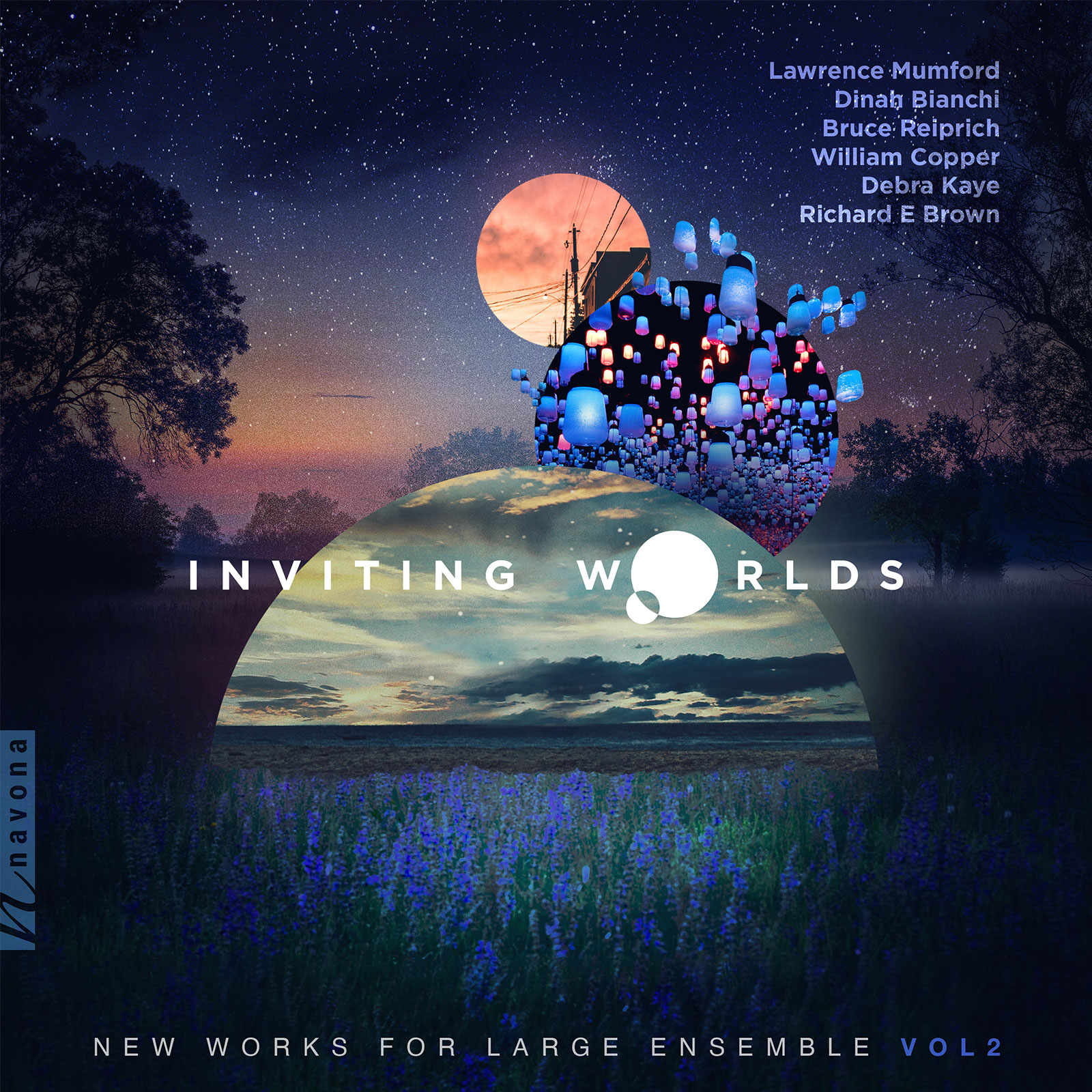
Inviting Worlds, Volume Two, New Works for Large Ensemble, Various Composers


Navona Records flourishes as a lively conduit for New Music and has for some time. Its anthologies of particular categories of newness always promise much and then one listens to each of course singularly to gauge what personal appeal each might offer. 

Right now a new title is getting a long listen on my player, namely the Second Volume of Inviting Worlds (Navona NV644). The Janacek Philharmonic Ostrava do the honors with several conductors sharing the podium. It all sounds right.

The label website talks about the rhythmic dexterity and textural nuance of the modern orchestral  possibilities here. Indeed the six examples by six emerging and emergent composers brings six varied and eclectically worthy approaches to Modern Mainstream decidedly worth hearing.

It might be better to name the pieces and composers and set you loose on the hearing, since there to me is no particular meaningful patterning that is obvious on the verbal level, except all are tonal, all seem to provide an expression of music in our times. Well the website copy notes that our times are indeed "dark," and that each piece seeks to grapple with the present and its complexities. There is a slight influence of Sacre at times rhythmically and perhaps some of Varesian periodicity of form and then the lyric melodicisms of Copland, Barber, etc. and other things besides but you should listen for yourself and get the thrust of it all in your own listening experience.

Take a listen to "Hope and a Future" by Lawrence Mumford, "Chasse Noir" by Dinah Bianchi, "When Quiet Comes" by Bruce Reiprich, "Gold Lights in Blue" by William Copper, "Rising Up" by Debra Kaye, and the eight part "Paisano Suite" by Richard E. Brown.

By all means give this a listen. I am going to listen to Volume One now so I will be back I suspect happily with that. Volume Two is easily recommended. You help the new voices by hearing this. They need your attention and patronage.