Search This Blog

Showing posts with label new music today. Show all posts

Tuesday, January 3, 2023

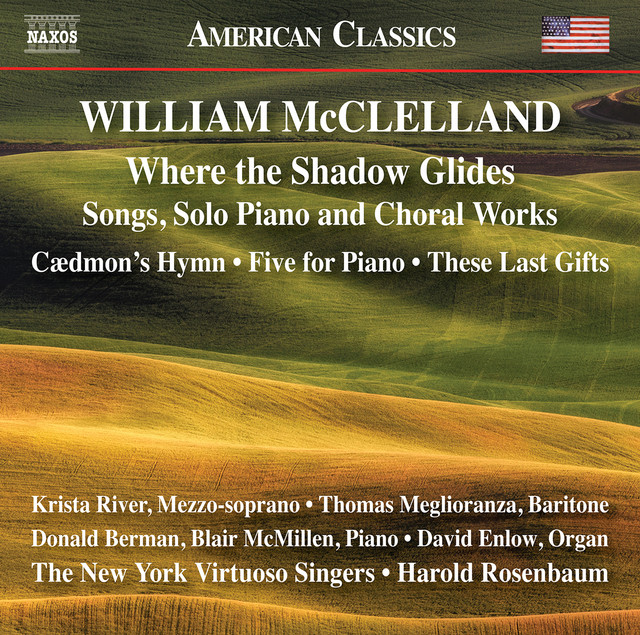
William McClelland, Where the Shadow Glides, Songs, Solo Piano and Choral Works, The New York Virtuoso Singers


Composer William McClelland is a living voice in the New Music of today. According to the liner notes of the album at hand he has been acclaimed the world round as a distinct stylistic influence, or at least that is what is implied in the discussion. I am not one to gauge for the acclamation of the music world for I am not in the thick of it. But hearing the music at hand I can understand if he has a wide following today. So accordingly here we consider the McClelland set entitled Where the Shadow Glides, Songs, Solo Piano and Choral Works (Naxos 8.559906). The album notes underscore that the works performed in this album have in common a music born out of poetry. 

And so on this extensive collection of world premiere recordings we experience it all in a variety of ways. In the choral works early poetic texts give us a special evocative assertion of time and place, while the "Five for Piano" come out of a reaction to as many poems. Then the songs peppered through the program each set particular poetic texts and show us how skilled McClelland is in his ability to carry the feeling of the poems into the musical expression of them He is very talented at such things and we experience the many stylistic ins and outs of the program with fascination and a respect for such a complete musical vision.

This music is not especially avant  garde but more attuned in fact to the echoing of past tonalities and vernaculars, almost a comment on the folk-laced music of Copland without directly quoting but rather alluding to a particular strain of folkdom, perhaps. Yet the music itself presupposes generation of song, of local musics celebrated by large segments of the population, the music of some homeland not directly stated, as in a dream. And that stylistic re-collection-transformation covers multiple style subsets, in the end an authentic and creative re-appropriation of Modern and Contemporary Mainstream roots.

The New York Virtuoso Singers under Harold Rosenbaum  deliver a marvelously unwavering set of performances of the highest caliber. Bravo.

If you sit back and ignore the expectations of what you think a composition should or must be, you are in the right frame to appreciate this cornucopia. Then like me, perhaps too you will feel the adventure of this skilled everything-goes expressivity. Kudos. Listen.

Tuesday, May 9, 2017

Fernando Benadon, Delight/Delirium

Fernando Benadon on Delight/Delirium (New Focus Recordings 179) constructs robust chamber works that are firmly in the new music camp but also have jazz/improvisational elements. Each piece is intricately and satisfyingly built out of finely conceived elements.

The largest ensemble at play occurs on "Cosmicomics" (2013) a brightly shimmering work performed by the Illinois Modern Ensemble as conducted by Stephen Andrew Taylor. As of many works here it is of literary inspiration, depicting two scenes from Calvino's tale of the same name. It has like the other works in this anthology an original feel derived from careful, effective scoring, here for the amassed winds and strings. There are modern, tonally advanced intersections, clusters and expressively wrought foreground elements that altogether create a multidimensional matrix.

The works for smaller groups have a special presence as well whether it is a matter of the early-jazz/new music inflected "Bugi Wugi" (2007) for solo piano or the other small-scale works I am about to describe. "Corxes" (2013) represents a whirl in a car through Barcelona on an early spring afternoon. A feeling of time and space in motion is heightened by rhythmically charged passages for sax, vibes, harp and piano.

"Delight/Delirium" (2016) again makes use of a literary theme, this time from Neil Gaimon's Sandman series, to create a lively matrix of movement for flute/piccolo, clarinet/bass clarinet, harp and piano.

"Rhythmensional" (2015) builds around a jazz-rock drum solo recorded as an improvisation by Dafnis Preito. Benadon takes that initial track and scores very dynamic parts for bass clarinet, viola, vibes and piano. A music of very great rhythmic vitality results, a one-of-a-kind intersection led by the complex drumming and turned into a marvelously intentional new music with perhaps only Frank Zappa as forbearer of this stylistic complex.

It is a fitting conclusion for what is an extraordinarily captivating program. Benadon knows what he is after and realizes it in five movingly fresh works. It is one of the best sort of collisions of jazz-rock influence and new chamber music I have heard in the past decade.

And so I do not hesitate to recommend this to you without reservation.


Wednesday, August 24, 2016

Modes, Society of Composers, Inc., Volume 30

The world of new music continues to flourish. Time does not stand still. We can hear that nicely on the 30th volume of recent compositions for the Society of Composers' ongoing anthology series. Modes (Navona 6051) gives us a wide-ranging gathering of works from seven worthy but lesser-known exponents.

We hear some high modernism from Karen Keyhani on her chamber ensemble work "As Far as Possible," a lively oboe-cello-percussion trio entitled "Valence II" from Robert A. Baker, a solo flute sound poem "Princess Ka'iulani" by Nolan Stolz, a cycle for mezzo-soprano and string quartet "Five Love Songs" from Arthur Gottschalk, Benjamin D. Whiting's electroacoustic "Melodia sin Melodia," "A Mournful Cry" for solo guzheng by Yip Ho Kwen Austin, and a chamber sextet, "Acoustic Field," by Chin Ting Chan.

Time goes by quickly as each work has its say and moves on. It is a bellwether of how diverse new music can be these days, but also a vivid example of the talent and highly evolved craftsmanship that shows itself in such abundance in our times, nowhere more so than on this volume.

Anyone who seeks the new today will find plenty of works of interest here, well performed and happily contentful. Recommended.

Wednesday, November 26, 2014

Martin Bresnick, Prayers Remain Forever

A personal voice among today's composers is not the rule, no less so today than in ages past. There are those few who stand out with a twist, a way of doing what others do, but not like how others do it. Martin Bresnick qualifies, going on his latest release of chamber works, Prayers Remain Forever (Starkland 221). I reviewed his exceptional Caprichos Enfaticos, based on Goya's anti-war drawings, way back on November 14, 2011, and it too is in its own world.

I say he has a "personal voice" once again because all six compositions in the current program turn the contemporary into the Bresnickian with a minimum of means. The largest ensemble, a quartet of oboe, violin, viola and cello, remains intimate, is more like a lively conversation among friends than an imperial utterance destined for the rafters of a large hall. The recorded media seems absolutely right for this music, as it communicates directly to you the listener without pretense or assumption.

Each work occupies a post-modern world of its own. There is "Josephine the Singer" (2011) with its Kafka-referring neo-classical, neo-romantic solo violin that seems to be driving anything but applause, but rather to internalize a search for some kind of meaning in sound. The solo piano pieces differ greatly. "Strange Devotion" (2010) uses space and silence to offset a series of tender diatonics that gradually grow in complexity and modulatory wanderings; or "Ishi's Song" (2012), which features vocals and a definite Eastern pentatonicism folkishness that appeals as it gives you an unexpected turn. It is based on a song sung by the last Yahi-Yani Indian of California.

"A Message From the Emperor" (2010) features two vibes/marimba and a spoken part that concerns the mysterious whispered communication of a royal personage on his death bed to "the solitary one." The latter then sets out to communicate it (and we don't know to whom) to the accompaniment of interlocking contrapuntal shifting patterns on the mallets. The narrative continues and I won't give away the ending, but it is a story mythologically redolent of the East, a sort of musical Zen koan.

"Prayers Remain Forever" (2011) uses cello and piano to an expression not unlike "Strange Devotion," both tonal, modern and post-that working around intervallic and harmonic cyclicality that spirals more than repeats, developing as it evolves.

"Going Home" (2010) is the quartet I mentioned earlier. It begins with simple long notes and intervalic embellishment thematics in the oboe that have a largo-esque Eastern quality. The lyrical deliberateness rings well in your ears.

It is a program of unexpected synergies, a fragile beauty and sensibility that takes it out of our time and places it somewhere in an unknown exotic locale at a time unknown. It is for that a very pleasurable listen, both accomplished and very down-to-earth.

Recommended. A singular addition of one for your collection...