Search This Blog

Tuesday, January 17, 2023

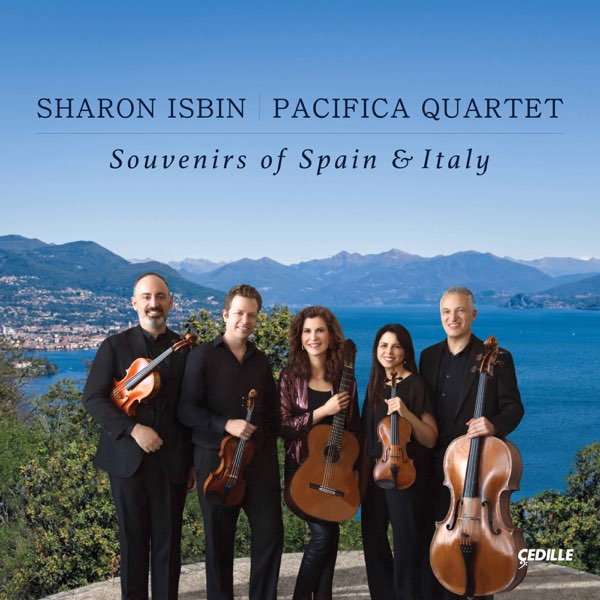
Sharon Isbin & Pacifica Quartet, Souvenirs of Spain and Italy, Guitar and String Quartet Music by Castelnuevo-Tedesco, Vivaldi, Turina, Boccherini


What makes the music of Spain and Italy so lively and expressive? One answer is that both countries had a period of enculturation with originally nonlocal peoples, the Moors and Arabs, and at least in Spain a pronounced Judaic influence as well. Today's post certainly bears out tha liveliness of the music on a very compelling album of music for classical guitar and string quartet, namely the Pacifica Quartet and guitarist Sharon Isbin play Souvenirs of Spain and Italy  (Cedille CDR 90000 190).

One key thing that makes this a winner right off the bat is the quality of the performances, with Sharon Isbin nicely on guitar and the Pacifica String Quartet presence as lively and as authentically dedicated as you might want to hear.

And another key is the beauty and intelligent choice of the repertoire featured in the program. So we have Mario Castelnuevo-Tedesco in a pleasant surprise with his less well-known "Quintet for Guitar and String Quartet," Isbin and Emilio Pujol's arrangement of Vivaldi's "Concerto in D Major," Turina's "La Oracion del Torero for String Quartet," and finally Boccherini's stirring  "Quintet for Guitar and String Quartet."

The music has such a detailed and vibrant feeling and demeanor and serves fully to flesh out the abundant talents of the artists on display here. There way be one or two works you have not heard much if at all, and then in the end it is all the more educational and rewarding to mix familiar and not-so-familiar works in these wonderful performances.

Ms. Isbin is a hearteningly lyrical presence on these erfoamcnes, matching the expressive brio of the strings and putting forward a joyful noise without fail. The simpatico stylistic fluency of the five artists brings the Spanish-Italian qualities to the forefront just as one might hope.

Recommended heartily for novice and seasoned listeners alike.You likely will find many hours of pleasure here as I am doing.


Sunday, January 15, 2023

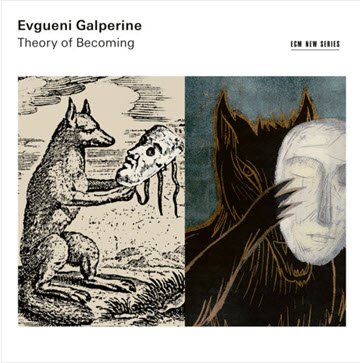
Evgueni Galperine, Theory of Becoming


Over hill, over dale and next thing you know it is 2023 and a new year looms before us. I was glad to listen inside this new panorama and vista for the first time the latest music by Evgueni Galperine, namely the album titled Theory of Becoming (ECM New Series 2744). This is a adventuresome set of ten interrelated works. acoustic and electroacoustic, ambient tonal sound color extravaganzas. The composer notes in the lines that at first it seemed like altogether new territory that was being visited creatively, But the composer found he had set out upon the previous paths he had visited, but as he proceeded further he reached new stops upon the way, new and related stylistic realms. As a listener unfamiliar with this composer I have heard and gradually understood it all after several heartings/

I most say there is much in the way of new ambient sonics and ritually open matrixes that vary in time and space. It all can remind one of some of the zones of the Psychedelic Prog Rock album folks from years back, but then it is much more acoustic and electroacoustically refined and structured.

There are spectacular fanfares and orchestral electronic excitements that contrast with more ruminative reflections in a world that the lyrics to a Stockhausen pieces called in his own words both "near and far alike!"

It is not music that precisely screams Avant Garde as you hear it unfold, but it is by no means a revisitation of old territory so much as it is of the world now, somehow, so resound in ingly sonic in ways ECM-like but post the sort of mellow fare of several decades ago. Sometimes "Dark Side of the Moon" and "Strawberry Fields" come to mind as you listen, only somehow transfixed, then a high modern moment followed by a repetition of remembering but only for a minute and cleanly done ,more like Orff than Glass. And it is all so rather eerie after a while.

If you relax and get rid of expectations you will perhaps like me find it all quite rewarding and involved, underplayed in its subtle nuances but brilliant and determined to go in an original pathway, What it is doesn't have its own frame so we must listen without sone detailed fieldmap. No matter, since all that works for this far-Modern future 2023 as we might hope. The future is here and we can try some of it on for size with this I do believe. Listen. It is worth your time.

Tuesday, January 10, 2023

William Walton, The Complete Facades, Hila Plitmann, Greg Child, Kevin Deas, Virginia Arts Festival Chamber Orchestra, JoAnn Falletta


The resituation of Edith Sitwell's humor-laced, tongue-in-cheek sendup of proper Victorian byways in the poetry drenched Facades stands today perhaps with Schoenberg's Pierrot Lunaire  as two of Early Modernism's most convincing settings of poetic nuances in the new sensibilities fully beyond Romantic sentiment and happily plunging into a kind of meta-abstract, surreal sarcasm that the music serves very much to project and re-produce in the form of speech-song and chamber instrumental.

We recently have gained a new performance of the very complete William Walton chamber orchestral and vocal Facades (Naxos 8.574378), which includes the original 1922 setting, the 1978-79 Facade 2--A Further Entertainment, and first recordings of  two Additional Numbers from 1922 and 1977. Unless I am mistaken, this is the first truly complete Facades on disk. That in itself is saying something, but then too the performances are as fresh and wry as one might hope for, with vocalist-narrators Hela Plittman, Fred Child and Kevin Deas sounding appropriately bemused and the Virginia Arts Chamber Orchestra with an exaggeratedly idiomatic, hyper-proper spoofing quality, all under the very inspired direction of JoAnn Falletta. 

I have listened to and enjoyed a number of performances of this work over the years, mainly on LP. I am happy to say that this version rivals the others I've heard for color and attitude, and then with the new additions to the complete opus and the good price of the Naxos as ever, this version would get the edge and my nomination as a vibrant "yes" for the best choice.

All told when considering some key settings of early post-Romantic Modernity, such as Virgil Thompson's treatment of Gertrude Stein's verse in the two operas he created out of the librettos Stein fashioned (Four Saints in Three Acts and The Mother of Us All), in comparison to this Walton and the Schoenberg Pierrot, there seems an overarching  attempt at a seriousness with Thompson that no doubt grounds its approach in the extensive ambitions of Stein to create a long narrative form, but then if one has listened to Stein's own readings of her shorter poems, one especially might find a humorous over-the-top, playfully mischievous tone that Thompson might have made better use of had his musical attention been directed there. Not to say we should not listen and appreciate the Stein-Thompson collaborations that have come down to us, just that they seem less essential in setting poetry to music than the Walton and Schoenberg seem to me looking back to years of listening, 

Part of that has to do with the immediacy of the sprechstimme speech song of Schoenberg and the rhythmic speech inflections of the Walton. Both give the poetry a kind of harder Expressionist quality that seems in keeping with the poetic libretto-texts. And so also these two works seem much more decisively post-Romantic. Both works are looking back rather fully paradigmatic, and the music meaning in either case extends and agrees with the poetic texts, so for example the rhythmic underpinning and in the end the vernacular directness of a well known sailor's hornpipe in the opening of Facade inform us that this music and its lyrical poetic compatibility both make fun of the pretentions of high theatrical arts one might say. So too the droll waltzes, marches, tangoes, ragtimes, music hall trifles and other then favored English entertainment expressions become fantasmagorical exaggerations that still ring true and delight in their serious silliness.

And then too one recalls the Brecht-Weill theater music of the era and how too they make a heightened fun of things as they ringingly put forward the beautiful Dance Jazz with sarcasm. And so Walton's Facades was along with the Schoenberg landmark--as well as the two Thompson works--the very most effective early Modern poetic compositional send-offs. 

So do not miss this newly complete edition of all the Walton in this triumphant recorded version. Bravo!
Friday, January 6, 2023

Bernhard Sekles, Lieder, Malte Muller, Werner Heinrich Schmitt


Today we have another worthy unknown in the person of Bernhard Sekles (1872-1934) and an album of his Lieder (Toccata Classics TOCC 0651). Contained within this program are a rather bracing set of songs adeptly handled by tenor Malte Muller and pianist Werner Neinrich Schmitt. The beautifully burnished, tonefully tuneful tenor joins with a heroically dashing piano brilliance and finely gradated coloring for some rewarding performances of which doubtless the composer would have approved.

Sekles was in his lifetime a prominent Late Romantic and a staple of music education in Frankfurt. Among his composition pupils were Hindemith and Adorno. He composed successfully in all mediums and his songs were among the most acclaimed of his time. He set up the first Jazz curriculum in Germany and for that was banned when the Nazis took power in 1933. He subsequently died of tuberculosis the following year.

The lieder featured in this rewarding set included his most acclaimed  song cycle, the 1907 "Aus dem Shi-king," but all  represented here impress with inventive and well-wrought significance. They all deserve your attention and as first recordings they are happily finally here for us to appreciate in the years to come. Bravo Muller, Schmitt and all concerned. 

If you like Lieder from this period this is a real find. Very recommended.

Thursday, January 5, 2023

Daniel Carr, Works Volume 3, High Voice and Piano Trio

The hustle and bustle of everyday life can mean that one is continually prioritizing and evaluating the time every day. When and what absolutely must be done? What after that? There are times when I am sent so much music that it is all I can do to open and listen, and beyond that it must involve a backlog, And so recently I found myself combing through and hearing the recent offerings as best I could willy nilly, including Daniel Carr's Works Volume 3, High Voice and Piano Trio (MSR Classics MS 1761). 

I try of course to listen to all I am sent and take it all seriously, so when I put on this CD for the first time recently the name of the composer seemed familiar to me but I had no idea what I'd hear. As I listened I was impressed with the inventive nature of it all, its melodic-harmonic individuality, tonal without especially sounding like  Neoclassical or Neoromantic, Minimalist, Post- or Premodern or Non-Serialist fare, etc. It all suggested the sort of elaborate song brilliance of some of the best singer-songwriters in the Rock High Modern period, and the instrumental work carried that inventiveness into pure instrumentality.  It all seemed very musical and very well wrought and not at all predictable. The emphasis was more or less on a through composed lyrical flow that moved away from repetition but instead made for a beautiful sonance of piano trio and piano trio with a high vocal part.

You will listen if you play this one, first, to the Piano Trio, op. 19, and what a memorably expressive work that is, a nice example of how Carr rolls in the trio chamber mode.

Then as a logical extension we hear "Nine Bethany Swann Songs" for high voice (Mindy Ella Chu, mezzosoprano, very effectively and ravishingly so) and violin, cello and piano (as throughout the Benefic Piano Trio does a fabulous job with the music). Finally there are the same vocal and instrumental forces doing more wonders with the final work "Vocalise."

I can't help at times hearing these vocal songs to be very happily reminded of Joni Mitchell and the sort of lyricism she so personally and musically forged. Not that there is imitation but there is high invention and a touching reflectiveness like the best of Joni, only more through-composed, maybe a little more flowing-river-like to its inevitable end.

This is another one of those composers who refuses to be easily classified. So that means you simply must hear repeatedly the music before you feel yourself completely inside it, or it was the way for me at least. And so I do recommend these works and their considerably committed performances here. Go forth and listen up, then see how it makes you feel. Bravo.

Tuesday, January 3, 2023

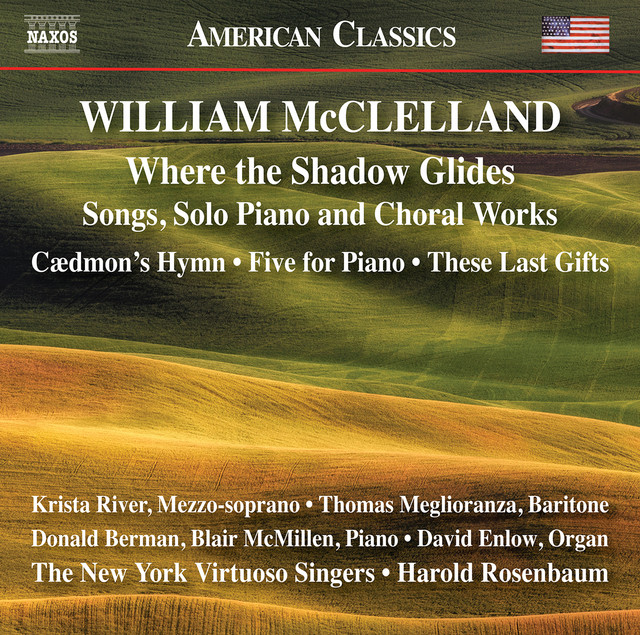
William McClelland, Where the Shadow Glides, Songs, Solo Piano and Choral Works, The New York Virtuoso Singers


Composer William McClelland is a living voice in the New Music of today. According to the liner notes of the album at hand he has been acclaimed the world round as a distinct stylistic influence, or at least that is what is implied in the discussion. I am not one to gauge for the acclamation of the music world for I am not in the thick of it. But hearing the music at hand I can understand if he has a wide following today. So accordingly here we consider the McClelland set entitled Where the Shadow Glides, Songs, Solo Piano and Choral Works (Naxos 8.559906). The album notes underscore that the works performed in this album have in common a music born out of poetry. 

And so on this extensive collection of world premiere recordings we experience it all in a variety of ways. In the choral works early poetic texts give us a special evocative assertion of time and place, while the "Five for Piano" come out of a reaction to as many poems. Then the songs peppered through the program each set particular poetic texts and show us how skilled McClelland is in his ability to carry the feeling of the poems into the musical expression of them He is very talented at such things and we experience the many stylistic ins and outs of the program with fascination and a respect for such a complete musical vision.

This music is not especially avant  garde but more attuned in fact to the echoing of past tonalities and vernaculars, almost a comment on the folk-laced music of Copland without directly quoting but rather alluding to a particular strain of folkdom, perhaps. Yet the music itself presupposes generation of song, of local musics celebrated by large segments of the population, the music of some homeland not directly stated, as in a dream. And that stylistic re-collection-transformation covers multiple style subsets, in the end an authentic and creative re-appropriation of Modern and Contemporary Mainstream roots.

The New York Virtuoso Singers under Harold Rosenbaum  deliver a marvelously unwavering set of performances of the highest caliber. Bravo.

If you sit back and ignore the expectations of what you think a composition should or must be, you are in the right frame to appreciate this cornucopia. Then like me, perhaps too you will feel the adventure of this skilled everything-goes expressivity. Kudos. Listen.

Monday, January 2, 2023

Jacob Greenberg, Living Language, Selected Piano Works by Bartok, Lewis, Chopin, Janacek, and Wang Lu


Here with the first post of the new year I am happy to talk about pianist  Jacob Greenberg's album Living Language (Furious Artisans CD 6830), featuring the select music of Bela Bartok, George Lewis, Frederic Chopin, Leos Janacek and Wang Lu.

The George Lewis is the most overtly Modern of the works, understandably, and at the same time calls upon Jazz influences for a startling cascade of melodic invention. But nonetheless the programmatic  emphasis throughout is on works that develop a highly fluid melodic syntax, a note-to-note speaking as it were, an articulate flow of musical-melodic meaning. Wang Lu's premier recording of "Constellations" brings us more of the High Modernist triumphant with sparkling luminosities of scale-chord assertions of great beauty.

Beyond that we get remarkable flow and brilliance in Greenberg's reading of Chopin's "Mazurkas, " Op. 41, the stunning Bartok workings of his "Improvisations on Hungarian  Peasant Songs" and the equally thrilling ins and outs of "In the Mists" by Janacek. 

Greenberg's lucid phrasings makes some special and spectacular fare out of these exceptional works. I highly recommend this one without hesitation. Listen and you will know, I suspect.