Search This Blog

Showing posts with label modern orchestral music. Show all posts

Thursday, March 7, 2013

Michael G. Cunningham, Gallery: Three Ballets and the Gastein Masterwork

Back when the world was younger and there were no CDs, downloads, wax cylinders or 33.3 RPM LPs, new music had to be heard in person, imagined/constructed in the mind or on the keyboard while examining a score, or dreamed about in some nether world we may never reach. Today it's much easier but that means in my case there may be 30 new composers, new works or at least new performances that reach my desk every week and it's up to me to decide what to cover and then what to say.

I am not complaining. It is a position that has its privileges but at the moment no tangible rewards. Still it gives me the chance to hear much music and that brings me joy. Today, for example, we have the composer Michael G. Cunningham and four of his orchestral works on the CD Gallery: Three Ballets and the Gastein Masterwork (Navona 5893).

What we have are quite reasonable run-throughs of works that have both movement and matter, substance and rhythmic propulsion. The three ballets, "Nyadina," "She" and "Chrysalis at Mardi Gras," have a kind of post-Stravinskian choreographability. They are modern sounding without entering avant garde territory, rich in musical imagery and good listening.

The final work in the program, "Gastein Masterwork," reaches in many ways that nether world of musical imagination that I alluded to earlier. It's termed in the press sheet that came with the CD "a 'prediction' of Schubert's lost work." And as such gives us a four-movement work in the classical Schubertian idiom, with a definite charm and forthright straightforwardness that Schubert himself might find appealing.

That in a nutshell is the music of Michael G. Cunningham as heard on the disk. He is a talent and the music is quite enjoyable.

Tuesday, July 10, 2012

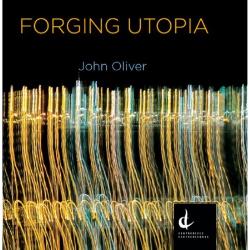
John Oliver, Forging Utopia

John Oliver, composer of orchestral singularities. His new recording of orchestral works, Forging Utopia (CMC 17612) makes it clear that Canada has a new voice, emerging full-blown to those of us who have never heard him.

The National Arts Centre Orchestra under David Allen Miller, the CBC Vancouver Orchestra under Mario Bernardi, the Windsor Symphony under John Morris Russell, and the CBC Radio Orchestra under Jacques Lacombe give the four works quite respectable readings. The works define Maestro Oliver as a keenly sensitive vehicle for realizing massed, complex sounds.

There are Ivesian collages and cacophonies, Messiaenic multi-stylistic contrasts, Zappaesque sarcasms, mysterious washes punctuated by sharp intrusions from various solo instruments, grotesqueries of great disparities, masterful use of mezzo-soprano Judith Forst (on "Unseen Rain") and a general musical narrative style that engages and immerses the listener in fantastic worlds.

He orchestrates with some definite brilliance, making full use of the innovations and sonic possibilities that 100 and more years of experimentation and trial-and-error refinements have created, giving for him a legacy of artistic possibilities. And yet there is something about the music that shines, glistens and speaks in its own right as John Oliver and nobody else.

Each of the four works has its own distinct mood and sound, with "Face in the Abstract" and"Raven Steals the Light" going the more dynamic, spectacular route. The latter is a good one to start with to get a feel for his reworking of 100 years of orchestral innovations and crafting it all into his own personal signature way of proceeding.

This is new music with a capital /n/. It's an exciting program and it will provide many hours of enjoyment and exploration for those who seek the emerging voices of today. I hope we all can follow where he goes next in future releases. He is one of the most promising orchestral composers of today.

Wednesday, March 7, 2012

Tomas Marco, Symphonies Nos. 2, 8 and 9, Jose Serebrier


There's nothing quite like a new discovery to reassure one that the intensive work of listening to new music and writing these blogs is worthwhile. Today I cover the symphonies of contemporary Spanish composer Tomas Marco, more specifically Jose Serebrier and the Malaga Philharmonic's recording of Marco's Symphonies Nos. 2, 8 and 9 (Naxos 8.572684). Nos. 8 & 9 are world premier recordings.

Marco writes dense scores that have national elements as well as multipart structures that sometimes remind one of Ives's poly-thematic complexities, only working with original and Spanish grassroots musical idioms as building blocks to a very personal symphonic vocabulary.

Marco's No. 2 is perhaps the densest and most dramatic. No. 9 combines medieval motifs, the liner notes tell us, with a kind of portrait of the sea spirit "Thalassa." There is a recurring theme that recalls Stravinsky's "Rites" and it weaves its way throughout the work. No. 8 Gaia's Dance has rhythmic and melodic motives that suggest folk dance forms but are treated by Marco as raw material to his larger end of creating multistranded polysemantic orchestral significances.

This is a composer going his own way. There are complex dissonances and simple folk melodies conjoined in labyrinthian matrices, all bearing the stamp of originality. With Jose Serebrier at the helm the complexities of Marco's music are articulated with expressive heft and drive. Tomas Marcos and these symphonies should be heard by anyone with an interest in the modern symphony and contemporary Spanish music. A provocative recording that is not to be missed.

Thursday, December 22, 2011

Arne Nordheim, Epitaffio, Oslo Philharmonic Orchestra


Norway, modernism and Arne Nordheim (1931-2010) go together. The composer Nordheim created a body of work that helped put the Scandinavian music scene on our maps from the 1960s through to his passing last year. A retrospective of some of his orchestral gems, aptly titled after his composition Epitaffio has come out (Simax Classics 1318) and is now readily available in the States. This is a happy occasion, tempered of course by our loss of him from this earth. The Oslo Philharmonic under Jukka-Pekka Saraste and Rolf Gupta definitively perform five of his works, from the "Canzona" of 1960 through to the 2003 "Fonos, Three Memorables for Trombone and Orchestra."

This is high modernist brilliance from beginning to end. To hear these pieces well-played on a state-of-the-art sonic stage is to come away quite impressed, indeed.

The Nordeim orchestral universe skillfully employs a wide spectrum of orchestral sonance and color to create sound poetry of great depth, palpable texture and dramatic expressivity.

His music has some of the discursive logic of Edgar Varese, in that the organized unfolding of the orchestral phrases and sectional entrances entails nothing short of a profoundly meaningful and ingeniously constructed series of human utterances, in this case of course musical. Instrumental colors enter and interact with one another in endlessly recombinatory ways. Nordheim is a master of the full orchestra-as-paint to his imaginary canvas.

Every piece stands out as singular and significant. I especially find the 2003 "Fonos" for trombone and orchestra a knockout as performed here by the philharmonic and trombonist Marius Hesby. As the last piece chronologically it is programmed second-to-last, which allows the ear to experience it as a kind of stirring life-finale, with the brief and poignant "Adieu" giving us a touchingly regretful coda to our evening's program.

Those who may have missed Nordheim's music are excellently served with this anthology. Those who have not will find the performances and sequences revelatory and enthralling.

Very much recommended!

Friday, November 25, 2011

John Carollo, Transcendence in the Age of War


John A. Carollo is an American composer that minds (and mines) modernist roots to forge an expressive personal style. I reviewed his Starry Nights on this blog last July 16, 2011. Now for a look at an earlier release, Transcendence in the Age of War (Navona 5817).

This one covers a wide spectrum of chamber and orchestral forms.

Carollo has a real knack for constructing melody/ensemble lines that have a modern ring to them and tend to soar expressively. This is quite true of the two short pieces for string orchestra, Desiderio and Let Thy Mind Be Still, which like Starry Night from the second album have a kind of Ivesian rootedness combined with a Carollian uniqueness. There is a denser, more active texture to String Quintet No. 1 for 10-String Guitar and String Quartet, but the inventive line knack is again at the forefront.

Fear of Angst for Flute, Cello and Piano has more chromatic expansiveness and a more expanded harmonic range for the first movement. It is also very well conceived. Movement two is quite beautiful, with striking pitch-timbre contrasts between flute and cello, the piano mediating somewhere at the center of the sound. The final movement has a more desolate quality, then some turbulent final bars.

The title piece, Transcendence in the Age of War for two pianos has a dense, restless, endlessly modulating quality appropriate to the subject matter.

So there we are. A very well played set of interesting compositions, some rather sublime, some rather edgy, all showing the inventive talents of John Carollo. If you can only get one of his two CDs, Starry Night would get my vote for its beautiful string pieces. Transcendence in the Age of War comes in a close second. Here is a composer of today that deserves your attention.