Search This Blog

Showing posts with label radical tonality. Show all posts

Tuesday, August 9, 2022

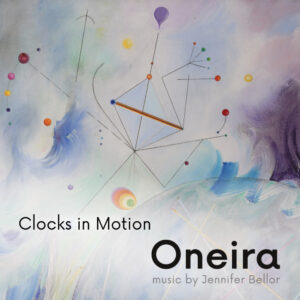
Jennifer Bellor, Oneira, Clocks in Motion


The chamber group Clocks in Motion presents Oneira (Aerocade Music AM012), which gives us an entire album of the music of Jennifer Bellor. None of this was familiar to me until I kindly received this album in the mail for consideration. Several days of listens later, I can say confidently that I now KNOW, and I am happy I do.

Clocks in Motion is a threesome of mallets and percussion with the addition of a guest percussionist to make up a quartet. So we hear John Corkill, Christopher G. Jones and Sean Kleve with guest Megan Arns or Kyle Flans. Everybody sounds excellent as they wind their way through the three specially composed works by Jennifer Bellor.

The composer is the first in what the group hopes will be a long line of artists in residence for their "Clock Shop," a long term, in this case four-year collaboration where she worked with them to workshop, create and develop multiple percussion compositions ultimately to perform and record. The happy first fruits can be appreciated on the CD at hand.

It turns out that Ms. Bellor came through with music that is not rote-ly repetitively Minimalist or New in an expected sense. Rather you might experience this music as I did, as a kind of New Classical Ethnic-Folk hybrid of pentatonic and diatonic musics of infectious rhythm and brightly chiming and syncopating excitement, like perhaps in essence Balinese Gamelan, only wholly original and local to the US like the legacy of percussion group music classics from here, only evolved and inventive in its own ways.

Each work unfolds in nicely built structures of expression, in ways that those who love melodic percussion groups will doubtless find as charming and continually invigorating as I did. Happily recommended!

Tuesday, December 10, 2019

John Burge, Twenty-Four Preludes For Solo Piano, Philip Chiu

Canadian composer John Burge gives to us a finely woven tonal carpet with his Twenty-Four Preludes for Solo Piano (Centrediscs 27319). The cycle of major and minor key centers and their ordering follows that of Chopin's op. 28 Preludes, with one for each of the possibilities in identical sequence.

The more primally tonal preludes to be heard in the set are at times subjected to extended techniques, including inside-the-piano plucking and strumming, overtone reverberation, etc. There are sophisticated Modernisms to be heard that follow and add to the legacy of earlier tonal Modernists, but also set forth cascading post-Romantic blissful barrages and minimalist romps. Nothing is predictable and the surprises sound better every time out.

Burge in this overarching set gives truth to the adage that you can be tonal, Modern and aurally advanced at the same time, provided you can connect your internal dots in highly inventive ways.

Many of the preludes include a descriptive title, either for the sort of musical passage that it promises, or other times as a programmatic allusion. A sampling gives you an idea of what the composer is after so I list a few: "Bells in Winter," "Playground Games," "Linear Reverberations," "The Singing Clock," "One-Note Ostinato" and "Spring Thaw."

Pianist Philip Chiu has the technique as well as the poetic drive to turn the score into living magic and of course that is what all the best sets of preludes require. Each individual prelude in this set is a mini-gem and Chiu coaxes out the implications for some piano music that is as exciting as it is learned, as vibrant as it is well-wrought.

John Burge shows himself to be a genuine force in New Music with this set. I highly recommend it if you look for something new yet tradition-spanning. There is no mistaking this; it is Modern, yet it also assimilates and synthesizes the pianism of the prelude form over time while remaining original. Beautiful job from all concerned.

Friday, October 11, 2019

Michael Byron, Bridges of Pearl and Dust, Specially Priced EP

The Radical Tonality of music on the Cold Blue label to me is important, as it steps beyond Minimalism and blurs its on occasion rather sharp matter-of-factness. A new and good example (and a few more new ones I'll be covering later) is in Michael Byron's Bridges of Pearl and Dust (Cold Blue 0057) a specially priced 15 minute EP that features Ben Phelps on multi-tracked vibraphones.

Often enough you hear a shading of New Music with a hint of the trajectory of Avant Jazz in Byron's works and that is so here. It is a series of multi-articulated rigorously notated arpeggiated interlocking rootsy tonal-diatonic lines that have a modal-pentatonic base implication but not strictly in some formulaic way. The music switches pitch centers now and again to keep ultra-fresh and in the end it all makes wonderfully perfect sense.

The 15 minute span is just about right--so you go away very revived and immersed.

Good music! Listen.

Tuesday, September 1, 2015

Ice Performs Anna Thorvaldsdottir, In the Light of Air

In the lineage of today's music, at least in the ambient, radical tonality, sound color realm of works, one might trace a movement from Satie to Morton Feldman to now as one line. That seems very much so to me in the music of Icelandic composer Anna Thorvaldsdottir, specifically her In the Light of Air (Sono Luminus 92192) as performed by ICE.

The program consists of one longer and one shorter piece, the title track being the former, "Transitions" the latter. The two flow together seamlessly in a sustained mood that begins as a hushed carpet of sounds with emerging motival elements that increasingly come to the forefront as from a mist, only to recede again.

The instrumentation is electronics, viola, cello, harp, piano and percussion, including an installation of metallic ornaments that appear dramatically and percussively in the final "Remembrance" movement of the first work.

"Transitions" was written for the cellist in the ICE ensemble, Michael Nicolas, who alternately personifies "man" and "machine" in the piece, expression and emotion versus maximum precision and accuracy.

ICE, which stands for the International Contemporary Ensemble, is a collective of some 35 musicians, capable of morphing from the smallest chamber ensemble to a rather large chamber orchestra depending upon need. The quintet assembled for In the Light of Air sounds absolutely perfect for the music at hand, which makes sense in that both works were created with them in mind.

That music has considerable magic. There is a sort of sustained ritual tonal wash to the first piece with emerging instrumental segments that stand out as having a discursive logic in the overall scheme and great memorability. The "man and machine" oscillations of "Transitions" embody contrast and color in different ways, displaying the possibilities in a solo cello context, so that there is a sort of inter-resonating totality to it all, a definite stylistic congruity that is strikingly original.

Anna Thorvaldsdottir has given us considerable beauty and great depth in this program. She is a special creative force and one most definitely to watch in the contemporary music world going forward.

As is mostly the case in Sono Luminus releases, the music is on two disks, a standard CD with conventional two-channel playback, and a blueray capable of 5:1 surround sound.

Stunning! Totally recommended!

Thursday, October 9, 2014

Steve Peters, From Shelter

Time today for another from the "radical tonality" modern composer group. Steve Peters comes front and center for an EP of "Three Short Stories" and "My Burning Skin to Sleep", on From Shelter (Cold Blue 0018).

The works play themselves out in slow, folkish diatonic asymmetry. "Three Short Stories" centers around multiple violas played by Alicia Ultan for a haunting, nearly vibratoless counterpoint of intervallic cells that are ever-changing yet have a cantabile, rural song-like unfolding. It is almost like folk fiddling, yet very slow and without an ABA structure.

"My Burning Skin to Sleep" turns to multiple vocals by Marghreta Cordero and the piano of the composer. They continue in the slow deliberate manner of the "Stories", only now we have a repeating chord progression that underpins wordless vocals in a slow counter-interaction of their own. The work goes well with the "Short Stories", almost a continuation of the work by other means and intervallic relations. The delicate chordal ostinato of the piano contrasts against the endless melodic-diatonic, purposeful wanderings of the voices. Plaintive? Just a touch.

I won't say that this is one of the very best of the Cold Blue EPs. Yet it is very attractive, beautifully sedate. The long winding trail of diatonic variations makes this music far from banal.

The performances make the music flow like a pond with a slow undulating motion in the waters. . . a light wind on a fall afternoon, perhaps, making the movement possible.

It is well thought-out fare. Delightful. Meditative.

Thursday, July 17, 2014

Daniel Lentz, Point Conception

We turn today once again to our off-and-on survey of releases on the Cold Blue label, which specializes in modern minimalism and radical tonality. Daniel Lentz and his two-work multipiano offering Point Conception (Cold Blue CB0028) is what is at hand.

Lentz will be known by many as one of the best of the second wave of minimalists. He comes through with flying colors on this one. The title work (1979) is the main event, with Arlene Dunlap realizing the nine piano parts. Each part calls for octave figures, which when played together gives you a kind of canonic sonics that has the flamboyance of a romantic piano concerto cadenza fragment as viewed under an aural microscope, evolving into masses of modulating, harmonically shifting clusters of sound that convey a kind of elation, and more a feeling of constant motion than repetition. The work builds to a rousing climax and one is left with a feeling of satisfaction at the originality, the flow of the work, the excitement generated.

"Nightbreaker" (1990) follows, a shorter work for four pianos realized by Bryan Pezzone. It combines octaves, arpeggiations and cascading figures that modulate fairly rapidly. There are contrasting punctuation sections that break the flow and give you pause. It is a work of brightness and waterfall-like expressiveness.

That in essence is what Point Conception holds in store for you. It is music to stimulate and delight. There are spectacular sonics to be heard here--a kind of multi-piano emblazonment, a heaven of keys and emboldened sounds.

It will appeal to those who love the piano and seek something different. It will appeal to those who want a break from their usual fare. Recommended!

Friday, February 28, 2014

Michael Byron, Music of Nights Without Moon or Pearl

There is music that tries to include everything. There is music that through a kind of mental erasure, eliminates things, like a stone block is chiseled away to reveal an image somehow already there inside, or like a completed drawing that is then subjected to selective erasing to create new form.

Michael Byron, composer of radical tonal music which is not minimalist because the repetition is not the point, writes subtractive music in a way. It is music that creates melody by the intersection of the parts, by making the background come to the front, by creating something not reducible to someone writing melody and harmony on a piano and then taking pieces of that result and assigning them to instruments. Or if he does compose at the keyboard (I have no idea) it is in the realization of the parts that the music comes about, that it sounds, not as much before.

That's how I am thinking of his music as I listen to the three chamber work collection Music of Nights Without Moon or Pearl (Cold Blue 0002).

The first two works interrelate and most closely adhere to the idea of foreground-subtraction as I impressionistically experience it. They do so by virtue of being performed by a mid-sized chamber group, the Calarts New Chamber Players, consisting of two violins, viola, cello, contrabass, two pianos and synthesizer, all conducted by David Rosenboom.

The title piece works in blocks of sound--the pizzicato strings working on harmonically related tonal-melody fragments with a loose pulsation. The synthesizer comes in at angular intervals with a block chord related to the harmony of the strings. The periodicity of its continual sounding and resting has a pulsation that is not in the same ratio as the strings. Finally the two pianos enter with a strummed chord that is rhythmically closer to the pulse of the strings, and as the piece progresses becomes increasingly frequent. In the on-the-surface structurally simple three-section articulations the end effect is of a continually percolating tonality fascinating to hear, with the listening ear taking it all in and at the same time hearing melody come forward as we hold our attention to one or more voices at any point. Finally the piano strums become ever more insistent, then all but disappear to return more quietly as the ear focuses more on strings and synth in the end.

The related work that follows, "Invisible 'Seeds' for James Tenney", has a sectional approach as well. The strings play a sustained arco of tonal-related elements in a progression that contains latent melody in its movement. The pianos punctuate throughout with staccato chords in a somewhat random, irregular pattern that nonetheless works as contrast to the sustained strings. It is in a way a slow movement in contrast to the end-pieces.

The two quite sustained, semi-pastoral mood works set the listener up for a considerably less locked-in chromatic-diatonicism in the final piece. "Entrances" features David Rosenboom on overdubbed multiple (4) pianos working to create an all-over, harmonically complex turbulence that at first almost sounds like something Cecil Taylor would be after in some of his mid-to-later solo works for piano. Yet in the end the music evolves so that motival kernels work off of each other to create a more collaged sweep that increasingly emphasizes more-and-more certain motives. It is a literal phantasmagoria of swirling sound.

Perhaps the idea of a subtractive method is not complete without the additive opposite. After all Maestro Byron is in each case combining x, y and z together in interactions over time. But then it's the effect of the listener mentally creating melody out of the fragments in place of the typical through-composed work that more or less hands it to the listener ready made, that's where you can think of it subtractively. No matter. The melody could also be thought of as cubistic--refracted and broken into different bits as a cubist artist might handle an image.

The point is that the disk gives us three fascinating aural montages that please without managing to fit into any of the pre-ordained structures of pre-modernism, modernism or minimalism. And of course what matters is that all three resulting works are rewarding and fascinating to hear.

Very recommended.
Monday, February 10, 2014

Michael Byron, Awakening at the Inn of the Birds

In the rather undifferentiated, blooming and buzzing confusion of the internet taken as a whole these days, getting attention is by no means as easy as it once seemed. The composer Michael Byron is a good example. He is not exceptionally well-known out there and I hope my review will help more people to discover his music, because it deserves the public ear.

My own private ears have been wrapped around his CD Awakening at the Inn of the Birds (Cold Blue 0012). It is a study in contrasts. Chamber music with more than one mood, five compositions are in the program, combining one or two pianos, synthesizer, a string quartet (the FLUX Quartet) and double bass. Not every instrument is used on every piece. And every work has a distinct identity.

"Evaporated Pleasure" (2001) is for two pianos and has a sort of diatonic turbulence of jagged-edged bursts of sound entering abruptly in short sequences which when combined with complementing bursts create a kind of whirlwind effect.

The title cut "Awakening at the Inn of the Birds" (2001) has a similar objective, only it is for the strings. You realize that it has the sort of total cacophony that a full contingent of birds may get with a collage of calls going simultaneously at dawn in the spring. Neither of these works have any dissonance involved but they manage through their irregularity to sound modern in a sort of ambient post-minimal way. The latter piece is much denser because especially of the strings and their multiple-stop capabilities that Byron takes advantage of. It is more frenzied, too, in an organic kind of way with rapidly articulated phrases that intermingle and interpenetrate. There are repetitions (in a sense like different bird calls) that meld together so that it's not the individual motifs that stand out as much as the entire collectivity.

"As She Sleeps" (2000) is a dynamically contrasting solo piano meditation on a lovely chordal progression that strikes one as having some relationship to Satie in a lyrically mystical mood. It is a fitting end to this disk and groups in some ways with the first two compositions on the program, "Continents of City and Love" (2001) and "Tidal" (1981), both of which are beautiful in a relatively placid manner. "Continents" features nicely paced, slow moving chordal forms in the strings that are punctuated by foregrounded piano figures that break through the sustained beauty with more percussive but related diatonics.

"Tidal" has a similar trajectory only the two-piano interplay is much busier with repeated arpeggiations and melodic cascades played atop a lovely set of slowly moving and sometimes static chordal drones.

I must say it all appeals to my sensibilities. There is beauty and a sort of quiescence-to-turbulence-to-quiescence arc to the entire sequence that pleases and brings one on a kind of musical journey.

Based on this disk it is clear that Michael Byron is another talented voice in Cold Blue's presentation of "radical tonality". His music is neither neo-classic, neo-romantic, neo-modern or quite minimalist either. It straddles the fence and by so doing creates music of our present, music that might not have been possible 50 years ago because we would not have been prepared for it. We are now and Michael Byron gives us his own window into the possibilities, and a fine program too. Recommended.

Tuesday, December 3, 2013

Rick Cox, Fade

Sometimes a piece of music and your own current mood are at geometric or logical opposites. In some cases that means you are playing the wrong music; at other times the music brings you to a different place and that is a very good thing. Today's music is of the latter variety. It is a 25 minute piece by Rick Cox, which he has entitled Fade (Cold Blue 0020). It is very open and spatial, calm and eternal, whereas my own mood is not, thanks in part to the trajectory of my life right now. So in fact I welcome the mood the music takes me, by my own willy-nilly surrender to it.

Cox's work features himself on a very ethereal electric guitar, Thomas Newman on piano, and Peter Freeman on bass and signal processors. Soundscapes of this sort can be busy and climactical, or they can flow like some natural process, a gentle wind across a plain, for example.

Cox's combination of gradually evolving enveloped guitar notes and chords, bass tone envelopes, and isolated piano soundings emerging from a tonally sustained landscape has that natural flow and a more processual unfolding than it has punctuated discrete sonic events. There are no jagged angles as much as gradual curvatures and singular directions.

The result is like a dream of floating in space, like a space walk, slowly drifting in an endless sea of nothingness with no set destination.

It is extraordinarily spatial in that way, very calming but filled with sonic interest. There is nothing programmatic as there might be in a New Age work that aims at the same effect. Here the musical ambience precedes the mood inducement. It is first and foremost a poem of tonal color.

And an excellent one at that.

Friday, November 15, 2013

Daniel Lentz, On the Leopard Altar

Minimalism proper, that form which creates regular patterns to repeat with overlays of changing music and/or shifts in the pattern itself, is still very much with us. Daniel Lentz, one of the better known of the lesser known composers, gives us a good, varied look at his music in On the Leopard Altar (Cold Blue 0022).

To be hair splitting, only the first and fourth piece of the five have overt minimalist qualities. "Is it Love" creates out of keys and a small vocal ensemble a fascinating mix. The keys play a series of patterns in a constant interplay of continuously sounded staccato eighth notes. The vocalists form a choir of ever differing staccato patterns through a process of subtraction (according to the liners) produced in hocket style. "Wolf is Dead" has a similar trajectory, but the vocal parts are less dense and hocket less used in favor of at times a contrapuntal approach. It may not perhaps be as striking as the first piece, but has much about it that keeps the attention focused.

"Lascaux" is to me the most interesting of the more soundscaped works included here. It uses wineglasses and keyboards to create a very beautiful panorama that shimmers with overtones like ever reverberating bells in a dream. "On the Leopard Altar" has a singular vocal line sung by first one soprano, then several to the accompaniment of keys. This one too has a dreamy sound but with more of a leider quality to it. There is a very lyrical side to Lentz when he wants to go that way and this is a great example.

The final, short "Requiem" work combines bell-like sounds with a vocal part that sounds as if a single voice is singing in the middle of a great cathedral and you the listener are experiencing the sound of the voice and the resonance of the cathedral in equal proportions.

So Daniel Lentz gives us two pattern pieces and three pieces more in the through composed, soundscaped, radical tonality vein. Those latter three have great lyrical beauty. The pattern pieces remind us that Lentz makes his own way through the Reich-Glass influence so prevalent in the minimalist genre and sounds out a personal path with its own route through the thickets.

It's a captivating set of pieces that I certainly find of real interest. You may gravitate to them as well. You get a series of spaces to dwell in for a time, relaxing and giving lyrical pleasure. Recommended.

Wednesday, October 16, 2013

Michael Jon Fink, A Temperament for Angels

There is no one way. There are many ways. If we didn't know that at some point in terms of modern concert music, we most certainly do now. Michael Jon Fink gives us a way in his half-hour work for sustained strings/samplers, A Temperament for Angels (Cold Blue 0017). It's another evocative work in the realm of post-minimalism/radical tonality.

Fink builds an ambient world of gradually evolving harmonic blocks, using multi-tracked violas, cellos, digital sampling (sounds like mainly of the strings) and mallet-sustained cymbals. It results in a soundscape that builds and shifts in harmonic content over time, then decrescendos in the end to poignant silence.

It is of a piece with many of the Cold Blue single releases in its singular devotion to tonal atmospherics. And so it too has a definite appeal and impact on the listener in the way it constructs a slow moving, ever-changing, ever-present musical world of its very own.

This may not be the first Cold Blue album to get. I reviewed some others over the last six months and one or two of those might best come first, but A Temperament for Angels has a Zen kind of focus on the nature of complex tone clusters that has genuine merit and holds up well after many listens. Nice!