Search This Blog

Monday, August 29, 2022

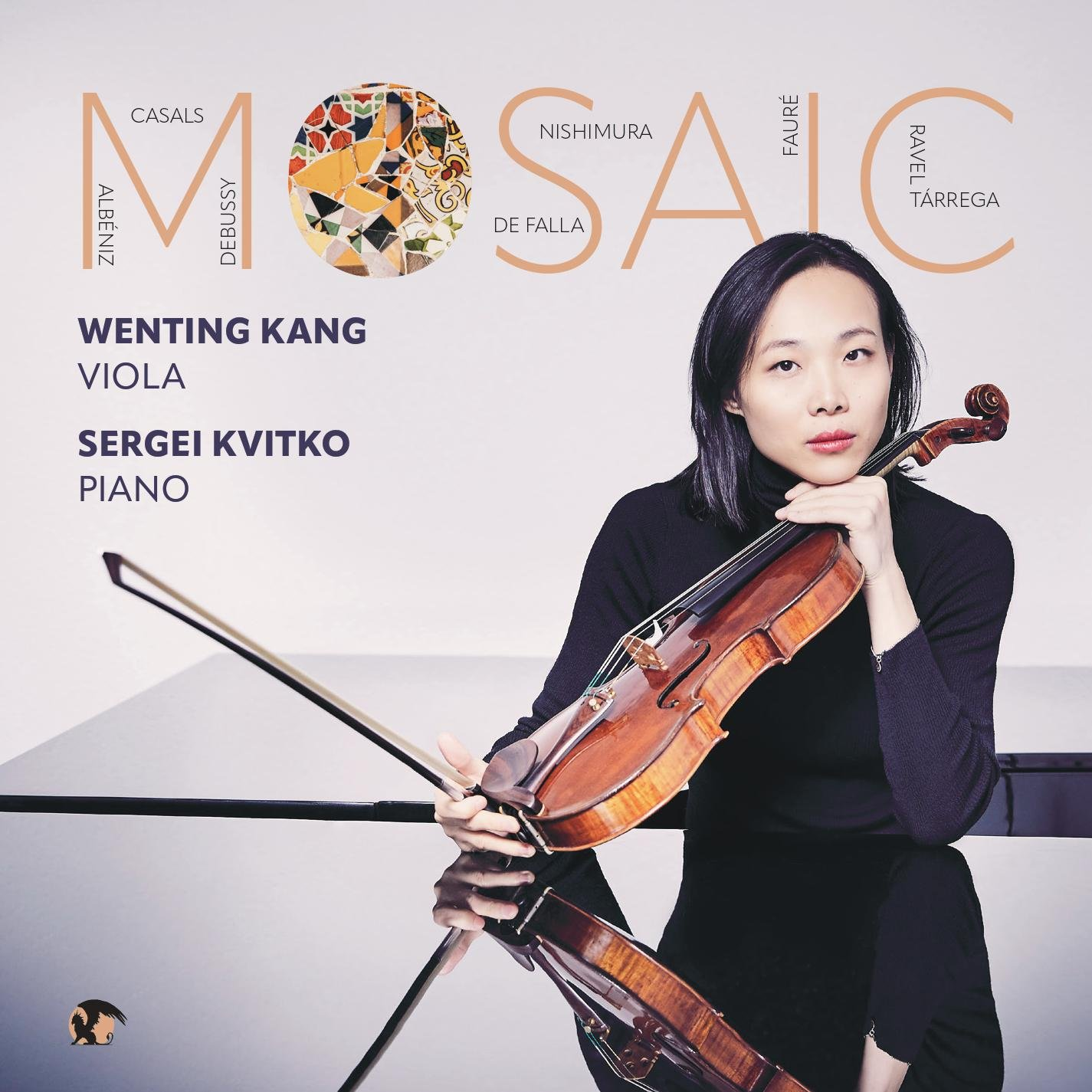
Wenting Kang. Mosaic, French-Spanish Cross Cultural Roots in the Early-Modern Period, Viola-Piano Gems


When we sometimes get smug and think we know it all, then maybe a CD comes our way and we learn to listen again as if for the first time. I can say happily that the album Mosaic (Blue Griffin BGR 609) with the sterling and ravishing playing of Wenting Kang on viola (most ably accompanied by pianist Sergei Kvitko) has awoken me with a kind of renewed appreciation of what the viola can be in addition to showing wonderfully well the beautiful and beautifully rendered repertoire featured here.

What this album so nicely hands to us are a series of works originally intended for viola or otherwise adapted to the viola and piano instrumentation, that notably uncover some of the fertile interflows between Spanish and French musical lifeways. 

Many of the works here will be quite familiar to any dedicated listener to the early 20th Century repertoire. The album excels in its wise choice of interrelated works but then too in its ravishing readings of the works.

Wenting Kang is a viola exponent of true brilliance. She is patently  lyrical without being gushing or cloying. There is a steady beauty of vibrato and burnished tone and she is in the mind to express her part with the utmost in feeling but not with the mannerism that too many string solosts brought with them from the Romantic Era, especially in the recorded repertoire through the 50s if not further and closer to our time, even perhaps through to today.

Perhaps it is an oversimplification to say that the music has a kind of special synthesis between Spanish melodic power and French atmospherics and harmonic girth. Surely that nexus is articulated as well as anywhere by these Kang and Kvitko readings.

The works take on a special life here thanks to the performances. We all doubtless know a good amount of this, but at times nicely transformed, as in the Ravel "Pavel pour une infante defunte" as transcribed for viola and piano by Borisovsky.

One finds much to appreciate in the close readings of it all, with some choice Debussy, Tarrega, Ravel, Faure, Albeniz, and de Falla, but then a nice little surprise by Pablo Casals and an unexpected gem in the unaccompanied viola work by Akira Nishimura (b. 1953) "Fantasia On Song of the Birds."

It hit me from the moment I put it on, with the familiarity underscoring the beautiful performances, and the unknown few also telling us that while giving us fresh music to consider.

Wenting Kang has the sort of presence you might feel when listening to Heufitz, a sound original with a kind of musical aura.  I cannot imagine a violist topping this series of performances,. Ms. Kang clearly triumphs. Bravo!

Wednesday, August 24, 2022

Kuniko, Tribute to Miyoshi


I have long honored Akira Miyoshi (1933-2013) as one of those musical icons of the High Modern era in Japan. For some reason in the States he has perhaps not been as well known as, say, Takemitsu, but I feel he is just as breathtaking when you give his music a chance. Happily we are now given a great further opportunity to savor his musical brilliance with a timely album I am happily catching up with, namely marimba virtuoso Kuniko's Tribute to Miyoshi (Linn OKD 596). This one brings you a kind of mood born of an open space spareness that has nothing to do with repetition and everything to do with space and sound conjunctivity. Listening I though of the aesthetic of haiku, of the traditional Japanese house, of letting something breath and thrive out of the bracketing of a key element or two.

We are treated to five absorbing works performed on marimba marvelously well. The "Concerto for Marimba and String Ensemble"(1969) brings Kuniko together with the Scottish Ensemble and it is thing of cogent beauty. It comes to us after three sparking works for solo marimba and so seems all the more revealing in its facticity and gives us pause before a solo farewell brings us to a complete circle.

If you need a high water mark it is in part felt in the third work, a triumphantly demanding piece de resistance, "Ripple for Marimba Solo" (1999). The overall music arc of building to heights and closing with dramatic space is beautifully spelled out with the sandwiching-framing of the concerto with the opening "Conversation" (1962), the following "Torso for Marimba" (1999) and the closing "Six Prelude Etudes" (2001).

And in the end, the Concerto has such a sonic fingerprint that you feel like you have been in a special musical place, that Miyoshi has given us such a vivid image of things that it stands out, and forms a nicely contrasting part of the program for that matter. And I can scarcely imagine a better performance for all of this. Kuniko shines as brightly as an all encompassing sun. And we are all the better for it.

It is music to dwell in, the more the better it sounds, the more you are inside of the music and its colors, its dazzle and its meditative sureness of purpose, its expressive depth and heights, the more it comes clear in the hands of Kuniko. It is in every way a triumph. Bravo.

Tuesday, August 23, 2022

John Williams, Violin Concerto No. 2, Anne-Sophie Mutter, Boston Symphony Orchestra


With all the world of music unfolding today we are sometimes as in  a maelstrom, a storm of creative effort amidst a sea of unprecedented developments. If trying circumstances can lead to great music, as is the case for example with some gem symphonies that came out of World War II, should we expect the same today? Things seem promising and a fruit of that we hear in the recent music of John Williams, known by many for his expressive and effective film scores, but showing a somewhat more adventuresome and wayward inventive and orchestrational singularity in his concerted works. We can hear that nicely in the recent recording of his Violin Concerto No. 2 (DGG 80035442-02) as played so beautifully by violin titan Anne-Sophie Mutter and the Boston Symphony Orchestra under the composer. 

The concerto is a major feat, a beauty refashioned perhaps of the bedrock Modernist roots of Berg's concerto and perhaps at times of Ravel's "La Valse." There is a kind of thoughtful look backwards to early modern times musically and then a bold jump forward with stridencies, devilishly virtuoso violin emanations that Ms. Mutter is especially well prepared for, and the glowing sort of mysterious orchestration and a rhapsodic yet contemporary fullness as end points that go a long way to taking you ahead for a noteful and insightfully sonic spatial ride. All it needs is your ears to begin the journey.

The follow up to this fortuitous work and fruitful pairing are three workings of "Selected Film Themes" from Star Wars and other memorable soundtracks. They provide lovely carpets for more of Anne-Sophie Mutter and her most beautiful renderings.  Both she and Williams are inseparable throughout, a collaboration that if you are like me invite you to abandon all resistance and surrender to the sheer magic of it all. Is this music meta-classic? Time will of course tell. Nice to hear certainly in any event. Bravo!

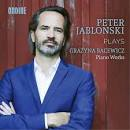
Grazyna Bacewicz, Peter Jablonski Plays Bacewicz Piano Works


The gradually unfolding appreciation of Polish composer Grazyna Bacewicz (1909-1969) continues apace, at least here in the States. There is another enlightening release I have been catching up with lately with no small amount of...delight I guess the word is. It is an album masterfully navigated by Peter Jablonski, entitled Peter Jablonski Plays Grazyna Bacewicz Piano Works (Ondine ODE 1899).

It affirms further that Bacewicz is a genuine voice of last century Polish Modernism in some compelling, advanced harmonic and melodic ways, another way to get beyond the late Romantic gush of pianism to be heard in somebody like Scriabin. I don't mean to over simplify but she manages to sound a clarion call to Eastern European musicways, a bidding to express the present in her very own way, not to lose sight of folk roots and necessarily then to open to the alternation and conjoining of the complex with the simple. But in ever inventive flow with a remarkable ease and fluidity.

So as we gradually absorb and appreciate it all, we get to hear her "Concert Krakowiak" (1949), "Ten Concert Etudes" (1956-57), "Two Etudes On Double Notes" (1955), "Piano Sonata No. 1" (1949) and "Piano Sonata No. 2" (1953).

All these works have undiluted presence and Peter Jablonski brings each one to life with care, enthusiasm, feeling, and formfulness. 

I heartily recommend this one for reasons that I hope are clear. Jablonski triumphs and helps us appreciate the ultra-musical pianism of Bacewicz at her best.

Thursday, August 18, 2022

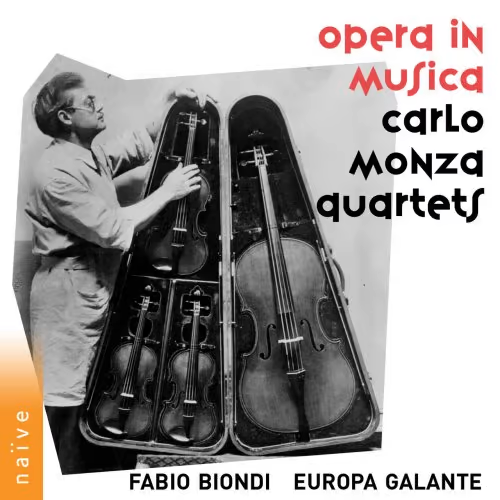
Carlo Monza Quartets, Opera in Musica, Fabio Biondi, Europa Galante


What we still can know anew can startle. So it turns out composer Carlo Monza (1735-1801) is something rewarding to hear, certainly as played so well by Fabio Biondi and the quartet Europa Galante doing a fine thing on the release Opera in Musica: Carlo Monza Quartets (naive CP SPPF V7541).

These quartets, some six in all, are bright, sparkling with brio and depth as realized by these talented players. It is an early Classical kind of confection, not stickily sweet but sincerely, pointedly bristling and bubbling. Violinist Bondi puts it plainly in the liners, "Monza's music is characteristic of the late eighteenth century, with delightful themes, varied moods and a gallant tone."

Doubtless when you awoke this morning you had no idea you'd wonder about this Carlo Monza, But seriously if you want something unexpectedly charming, beautifully played, you will no doubt find this most appealing as I did. Get it, hear it, let it grow on you.


Wednesday, August 17, 2022

Carolin Widmann, L'Aurore, Music for Solo Violin, Music by Ysay, Benjamin, Hildegard of Bingen, Enesu, Bach


Music for solo string instruments seems to be surging in popularity and frequency of performance like perhaps never before. In the past few weeks I have covered several albums partly or solely devoted to such things. So today once more. This time it is an all-solo album put across with wonderful spirit and microscopic nuance by Carolin Widmann, whose excellent playing we have appreciated several times before on here--type her name in the search box above for those review articles.

The album at hand is evocatively entitled L'Aurore (ECM New Series 2709). In it we are treated to some six nicely contrasting, skyfully filled works. The program begins with a short, tenderly meditative working of a piece by the pioneering early music composer Hildegard of Bingen, as realized for solo violin. It is later reprised to dramatic effect. The Ysaye Sonata No. 5 is playful and intimate, thanks especially to Carolin's ecstatic and virtuoso reading. George Benjamin (b. 1960) and his "Three Miniatures" gives us an Expessionistic clangorousness that is a delight to hear in Ms. Widmann's hands. Equally essential is Georges Enescu's "Fantasie Concertante" with its characteristic verve and concentrated line spelling artfulness.

The finale is the spectacularly singing and heartful lyricism of Widmann's triumphant performance of Bach's Partita No. 2, one of the most interesting and satisfying versions I have had the pleasure to hear.

And that is the sum of it, a wonderful offering that affirms Carolin Widmann's place as one of the most singular and accomplished violin soloist alive. I recommend this with no reservations. It is a delight from start to finish.,


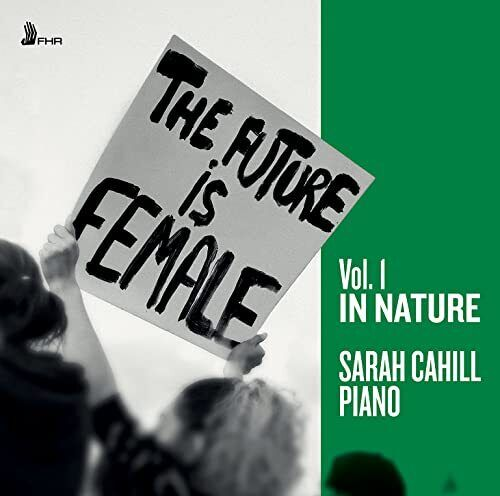
Sarah Cahill, The Future is Female, Vol. 1 In Nature, Piano Music by Women Composers


Of all the music I have listened to over the years, there were at first few female composers recorded who wrote for the solo piano. In years gone by, the emphasis of course originally was of the dominant male composers over time, and of course there was plenty to appreciate as there still is. On the other hand the musical lifeways as expressed in recordings and performances has gradually turned as the world view changed to consider women and their contributions, to resurrect or uncover the talent and achievements of women, even if many were not given the attention of their male counterparts when they lived or until recently.

All that of course has changed and we now have many worthy woman composers to appreciate in the contemporary world but also historically. As a welcome aspect of such things pianist Sarah Cahill has embarked on an ambitious multi-volume set of relevant piano works which are apparently available as a set but now also coming out on individual CDs as well. The project as a whole is entitled The Future is Female and the first installment I have been listening to and I consider here is entitled Volume 1: In Nature (FHR 131).

On this initial volume we are treated to some 16 compositions by women hailing back as early as the 18th century through to today. Ms. Cahill approaches each work with care and sympathy, and not some little amount of flair.

The list of composers is largely unknown or little known to me, but the works themselves bear intense scrutiny, opening up new worlds for those eager for more of such fare. The composers included bears presenting, to give you an idea of the persons involved and when they lived. So we have the music of Anna Bon (1739/40-after 1767), Fanny Mendelssohn-Hensel (1805-1847), Teresa Carreno (1853-1917), Lookadiya Kashperova (1872-1940), Fannie Charles Dillon (1891-1947), Vitezslava Kapralova (1915-1940), Agi Jambor (1909-1997), Evo Beglarian (1958- ), Deirdre Gribbin (1967- ), Mary D. Watkins (1939- ).

So all that as you give it some good listens stands out as well worth hearing and having. The music runs the gamut from early Classical through Modern and beyond. Very good music, very well performed. I thoroughly recommend it for those who find the idea interesting. It is all one could hope for and more besides.