Search This Blog

Wednesday, July 11, 2012

R. Murray Schafer, My Life in Widening Circles

Quite a few years ago when enrolled in an introductory ethnomusicology course it was my good fortune to be assigned R. Murray Schafer's The Tuning of the World, a most interesting book concerned with natural and artificial soundscapes, both local and global, and their symbiotic relationships. It's a book I've continued to reread over the years, very fertile ground for insights and creative catalysts, and a cautionary tale about the effects of our ever-encroaching industrial world on the sonic environment.

Only in the last several decades have I gotten the chance to hear Schafer's music, the latest of which I am currently appreciating, My Life in Widening Circles (Centredisques 17712). It's a series of chamber works ably performed by members of the Land's End Ensemble.

Some of the Canadian composer's works presented here are inspired by natural soundscapes he has experienced in his life, some less so. Five works are represented, two song cycles and three instrumental chamber works.

The song cycles have a dramatic aspect, with a rather wide dynamic range handled powerfully by the vocal soloists--almost too powerfully. Lyrics come out of Bertolt Brecht, traditional sources and Rainer Rilke. The music is bi-tonal at points, and highly crafted.

The instrumental chamber works are perhaps the most successful, with the "Duo for Violin and Piano" standing out as a brilliantly elaborate essay in propulsive brio. The "Trio for Violin, Viola and Cello" is also quite captivating, with moments of starkness and great thematic beauty contrasted with passages expressing a strident aggressiveness.

All the works are of interest. They are just idiosyncratic enough in subtle ways that getting a handle on them takes time. I am not quite there yet. They have a modern-pre-Darmstadtian cast to them in their own way, and they show the sure hand of a highly skilled craftsman. I need a little more time with this music to say more. For now I will note that they document the chamber side of the composer in revealing ways, that the performances are most dramatic and the music worth hearing by all means. Beyond that I will not venture for now.

Tuesday, July 10, 2012

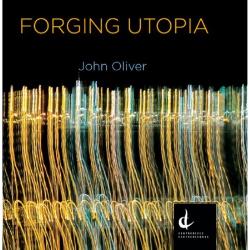
John Oliver, Forging Utopia

John Oliver, composer of orchestral singularities. His new recording of orchestral works, Forging Utopia (CMC 17612) makes it clear that Canada has a new voice, emerging full-blown to those of us who have never heard him.

The National Arts Centre Orchestra under David Allen Miller, the CBC Vancouver Orchestra under Mario Bernardi, the Windsor Symphony under John Morris Russell, and the CBC Radio Orchestra under Jacques Lacombe give the four works quite respectable readings. The works define Maestro Oliver as a keenly sensitive vehicle for realizing massed, complex sounds.

There are Ivesian collages and cacophonies, Messiaenic multi-stylistic contrasts, Zappaesque sarcasms, mysterious washes punctuated by sharp intrusions from various solo instruments, grotesqueries of great disparities, masterful use of mezzo-soprano Judith Forst (on "Unseen Rain") and a general musical narrative style that engages and immerses the listener in fantastic worlds.

He orchestrates with some definite brilliance, making full use of the innovations and sonic possibilities that 100 and more years of experimentation and trial-and-error refinements have created, giving for him a legacy of artistic possibilities. And yet there is something about the music that shines, glistens and speaks in its own right as John Oliver and nobody else.

Each of the four works has its own distinct mood and sound, with "Face in the Abstract" and"Raven Steals the Light" going the more dynamic, spectacular route. The latter is a good one to start with to get a feel for his reworking of 100 years of orchestral innovations and crafting it all into his own personal signature way of proceeding.

This is new music with a capital /n/. It's an exciting program and it will provide many hours of enjoyment and exploration for those who seek the emerging voices of today. I hope we all can follow where he goes next in future releases. He is one of the most promising orchestral composers of today.

Monday, July 9, 2012

Mieczyslaw Weinberg, Chamber Music for Woodwinds

The more I hear of the music of Mieczylaw Weinberg (1919-1996), the more significant he becomes in my mind. The disk in question today, Chamber Music for Woodwinds (CPO 777 630-2), fleshes out a picture of the composer as a singular visionary in the chamber mode. Four works get sympathetic, finely articulated treatment by the performers, and cover a period from 1945 through 1981.

They include the "Sonata for Clarinet and Piano op. 28," "12 Miniatures for Flute and Piano op. 29," "Sonata for Bassoon Solo op. 133," and the "Trio for Flute, Viola and Harp op. 127."

Each piece has its own character, with contemporary elements, some Jewish folk melodics combined with an Eastern European modernist sensibility, and structurally flowing architecture. The works do not sound as if they could have been written by someone else for the most part and to my mind mind rank with Poulenc and Hindemith's woodwind music as some of the finest examples this past century has to offer.

They are played with great vivacity by Elizaveta Blumina, pianist and artistic director of the program, Wenzel Fuchs on clarinet, Henrik Wiese on flute, Mathias Baier, bassoon, Nimrod Guez, viola, and Uta Jungwirth on harp.

This one is a must for modern chamber enthusiasts and for serious listeners to the music of 20th Century Eastern Europe. Weinberg gives us a glimpse of his indiomatic mastery of chamber form with four excellently crafted works, excellently performed.

Friday, July 6, 2012

Prokofiev, Symphony No. 5, The Year 1941, Alsop, Sao Paulo Symphony Orchestra

Why is it that the two masterpiece symphonies from WWII were both written by Russians? I refer to Shostakovich's Symphony No. 7 and Prokofiev's Symphony No. 5, the latter in a new recording by Marin Alsop and the Sao Paulo Symphony Orchestra (Naxos 8.573029).

There is no easy explanation, I suppose. We musn't forget how devastating was the Nazi invasion of Russia during the war. USSR soldiers gave their lives in huge numbers to repulse Hitler. The turning point of the war was most certainly centered around Hitler's strategic disaster. With the two-front war the Nazi's were doomed. And the Russians fought back with relentless will and courage.

That still doesn't account for the magnificence of the symphonies. Of course Shostakovich and Prokofiev were at the prime of their creative powers, symphonists of marked originality, and the allied world needed (hard to imagine in today's cultural climate) symphonies of great, stirring power to rally around and to celebrate a musical analog of events. They most certainly got them.

The fact is, masterpieces are masterpieces; they arise in circumstances that can be as variable as anything in life. Be that as it may, these remarks came to mind as I listened to Marin Alsop's vivid new recording of the 5th.

It is a symphony of unforgettable melodic brilliance, harrowing and triumphant, powerful and tender, transcendent. It was conceived at a peak moment, 1944, when the tide had turned, and it captures the horror and brutality of the war and the joy of impending victory.

Ms. Alsop conducts the Sao Paulo Symphony Orchestra with great elan. The broad sweep of singular themes, great drama, melancholy regret, stirring action, all are rendered with the attention to affect so necessary to do justice to this symphony's great power to move listeners. If I occasionally found that the balance of parts in the recording was not quite what I was used to hearing (I have a number of old LPs of this symphony)--the snare drum part in the fourth movement is felt as much as experienced, sometimes the secondary wind or string parts don't seem as forward in the mix as what I have heard--it is partially because the soundstage is closer in ambiance to an actual concert performance, that perhaps there was less in the way of close, multi-miking going on than in the classic high fidelity days.

At any rate this is a version to turn to again and again with delight. It's very spirited and triumphant. And the inclusion of Prokofiev's moving Symphonic Suite "The Year 1941" makes this a great choice, especially at the Naxos price. This is a symphony that grows in stature the more one hears it. A near-lifetime of listening to it convinces me that it belongs with the greatest symphonies of the past century. Do not hesitate to grab this disk--even if you already have a recording of the work.

Thursday, July 5, 2012

Scott Miller, Carla Rees, Devices and Desires

This morning something new out of the avant camp, a fascinatingly provocative series of composed, semi-composed and improvised duets from Scott Miller and Carla Rees, Devices and Desires (Rarescale 004).

Carla Rees is a flautist of considerable accomplishment, playing with a wide variety of timbres in half, whole, quarter and micro tones. Scott Miller provides the interactive electronics with a considerable inventive flair and attention to complementary washes that have a lively, story-telling quality to them.

The six works presented on this disc flow together well, as the flute and electronics parts create an evocative soundscape of sonic advancement.

The CD results from a session between the two organized to record Miller's "Anterior/Interior". Things went so smoothly that there was time left to record a great deal more. From there the two created some remarkable free improvisations, firmly ensconced in the world of avant-new music rather than showing any influences of jazz per se, though there are times when the rhythmic pulse takes on a regularity and drive that relates as much to comtemporary vernacular as it does to Subotnik's classic "Silver Apples of the Moon."

The result is music that has some of the innovative rigor of middle-to-late-middle-period Stockhausen, though the music has its own sound.

An impressive collaboration that will appeal to the flute-lover and the lover of the new lurking within (I would hope) all of us.

Tuesday, July 3, 2012

David Keberle, Caught in Time

David Keberle, composer of music of brightness, beauty, contemporary in tone color, often lyrical in affect--all this you can hear vividly on his new album Caught in Time (Innova 807).

"Soundings II" for Solo Flute & Flute Ensemble has a ravishing sonance and starts the program off auspiciously. The solo flute part is rangy with the skips, dynamics and timbre advances of the avant garde and the flute ensemble makes use of out-of-time cascades and other ultra-modern effects, yet the music is lyrically tonal. This is what the album is about--the presentation of pointilistic and colorful aural sonorities with the warmth of tonal expression.

Keberle writes brilliantly for winds, as one can hear throughout. "Incroci," an extended work for clarinet and piano, shows this especially well. But his balanced writing style makes room for his vision of the brilliant blends of all instruments involved. The four-part "Four to Go," for example, has a natural flow and very appealing part writing for flute, clarinet, violin, cello, piano and percussion.

His "Three Songs on the Poetry of Yeats" for Tenor and Piano shows that he is a sensitive composer of vocal music as well. Caught in Time makes clear that David Keberle is a composer of the upper tier, fashioning excellently crafted, memorable chamber music for today. It's worth the effort to get this one, without a doubt. I look forward to hearing more of his music.

Monday, July 2, 2012

James Romain, Howl

Modern music for virtuoso sax (soprano, alto, tenor and baritone), piano and computer is what you get on Howl (Innova 811).

It's a series of short and multi-movement compositions featuring James Romain as new music/classical sax presence along with Nicholas Roth at the piano and Mark Engebretson as live computer performer. Each work is different enough that variety reigns. The works are by William Dougherty, Jianjun He, Eric McIntyre, and Engebretson, who contributes two short pieces.

The emphasis is for the most part on the new music aspect of what is possible, less on jazz affinities, though there are some to be found (Anthony Braxton's example is somewhere lurking in the wings at times).

Romain sounds very good, some pieces show a healthy experimentation, the use of electronics gives many of the works a broader palette than one would expect from a chamber ensemble, but for whatever reason (and I cannot pin it down) the sax-piano and sax-piano-computer music tended to engage me more than the passages with computer and sax alone. That's a personal issue perhaps and it has nothing to do with my opinion of the use of computers and electronics, as an even casual perusal of my blogs makes clear.

None of it is dull. No one work jumps out as a masterpiece either. It is a definite feather in James Romain's cap.