Search This Blog

Monday, February 7, 2022

Florence Price, Symphonies Nos. 1 & 3, The Philadelphia Orchestra, Yannick Nezet-Seguin


One of the more rewarding composer revivals recently has been that of Florence Price (1887-1953). whose music underwent a long period of neglect after the Chicago Symphony premiered her First Symphony in 1933.  As an African-American woman she had obstacles to surmount, but thankfully her music is enjoying a re-emergence. I happily reviewed  John Jeter and the Fort Smith Symphony's CD of her first and fourth symphonies (see review of March 12, 2019) . I have a set coming up for review of some of her chamber music, and now I am glad to be hearing and talking about Yannick Nezet-Seguin performances of her Symphonies Nos. 1 & 3 with the Philadelphia Orchestra (Deutsche Grammophon 80034879-02).

The first thing that stood out as I first listened was the quality of the performances and the recorded sound. Both are first-rate. And thanks to the careful yet feelingful readings we get the full-fledged orchestrational  impact--densely scored yet varying in the leading melodic voices changing from instrument group to instrument group over time.

Both symphonies weigh in with alternating pastoral and turbulent Neo-Romantic expression, with a fair amount of Afro-Americana with Spiritual, Ragtime, Jazzy elements exuberantly transformed into a well thought-out symphonic matrix.

Even if you have the Fort Smith Orchestral version of the First and Fourth, you will be I suspect glad to hear the Third, which is equally interesting compared to the others--plus this version of the First is different enough that you will experience it anew.

I am glad we can at last hear Florence Price in some depth. I look forward to more. Grab this one in the meantime. It is fully worth it! Bravo!


Thursday, February 3, 2022

David T. Little & Royce Vavrek, Am I Born, Mellissa Hughes, The Choir of Trinity Wall Street, Novus NY


As I put in the living time of someone with a lifespan longer than some others, I increasingly am filled with some awe and respect for the historicity of given locales, so in the last few years I have pondered the long spans of history for Hackensack and now Cape May. There is a new, ambitious and rather stunning work recently recorded and released that I am appreciating. It relates to my thoughts in the last decade or so, in that it is about the long transform of history, in this case the patch of land in Brooklyn eventually to be torn down to make way for the Brooklyn Bridge. The music was written by David T. Little, the words by Royce Vavrek. It is entitled Was I Born (Bright Shiny Things 0152).

This is diatonic post-Minimalist lyricism beautifully realized by soprano Mellissa Hughes, the always ravishing Trinity Choir of Wall Street and the nicely resonant chamber orchestra Novus NY.

The music teams up with the lyrics to linger with thought and feeling on the uncanniness of time unfolding beneath our very everyday existences.

And with that there is a fragile beauty to it all, a touching introspective ruminating, ultimately on how every moment is in some ways shot through with history.

It is every bit as lovely as your deep memory dreams might be if all is right. Listen to this by all means. It deserves a place among striking Contemporary Modern works of our recent times. Highly recommended. 


Wednesday, February 2, 2022

Gail Kubik, Symphony Concertante, Boston Modern Orchestra Project, Gil Rose


Gail Kubik (1914-1984) I've heard something of over the years, but for whatever reason I did not take notice much. And as is the case with many of the Boston Modern Orchestra Project releases, there is a nicely chosen, excellently performed anthology to be had now and it alerted me to what I was missing.

The album features four orchestral works from the '50s: the Divertimento No. 1 and 2 (1959, 1958 respectively),  "Gerald McBoing Boing," narrated by Frank Kelley, percussion by Robert Schulz (1950),  and the titular "Symphony Concertante" for Trumpet, Viola, Piano and Orchestra, with Vivian Choi at the piano, Terry Everson at the Trumpet, Jing Peng at the viola (1951-1953) (BMOP Sound  1085).

It is a kind of happy meld of a Neoclassical Modernism beholden to, but without imitating Stravinsky in that mode, and then the slower middle moment which is lingeringly,  tonally tempered in a poignant feeling of reflectiveness. Listen to the concerted soloists on the "Symphony Concertante" and you will enter an exceptionally inventive world.

The highly puckish, wonderfully orchestrated first Divertimento opens the program with a magnificent textural beauty, some playful Bach quotations and an absolutely charming way about it. Start with this one if you want to sample it and know what to expect

Each work has Kubik's personal stamp. The "Symphony Concertante" provides the deeply accomplished and expressive climax. Perhaps this '50s period may not have afforded him the recognition he deserved because there were several rather unflexible formulas applied to evaluating the Modernism of the day and Kubik did not quite fit either mold. Now we can listen without firm expectations and see how nicely eloquent and original a figure he was.

After lingering with this program a while I am happy to hail it as something special, both from a compositional and a performance point of view. Gail Kubik needs your attention, your consideration, surely. This album stands out as a happy reason to hear him.

Tuesday, February 1, 2022

Ruperto Chapi, String Quartets 3 & 4, Cuarteto Latinoamericano


Imagine a comprehensive list of all the composers worthy of the name, all who ever lived whose music survives in one way or another. Would that make a book the size of the old Manhattan phone book? Sure, one way or another. Maybe bigger. And yet music lovers like me wake up every morning assuming they know all that is important in terms of names and schools. But of course there is no true end of knowledge, no matter where you are situated.

So this morning I listen to the music of Ruperto Chapi (1851-1909), specifically his String Quartets 3 & 4 (Sono Luminus DSL-93254) as played with fire and precision by Cuarteto Latinoamericano.

Who was this? Is this?  He was a Spanish national, born in Villena. He established lasting appreciation in Spain for his Zarzuelas, garnering great fame with the 1897 La Revoltosa. He became interested in chamber music towards the end of his life with the advent of his four string quartets beginning in 1903. We have the World Premiere recordings of his third and fourth on today's program and they are substantial and detailed, filled with a post-Romantic Spanish zing perhaps in a kind of Neo-Classical Modernist way, with ,lyrical moments that suggest the kind of dramatics of Zarzuelas without direct reference.

Anyone who like me appreciates the rise of Spanish efflorescence over the last century or so will be quite pleased with these gems, I suspect. By all means give them a listen. Bravo to Cuarteto Latinamericano for bringing us the happy revival of some works that deserve acclaim and renewed attention.

Thursday, January 27, 2022

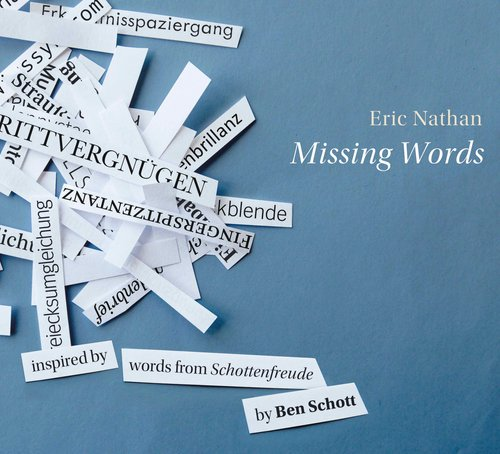
Eric Nathan, Missing Words


Based on the volume I have been listening to with some joy, composer Eric Nathan shows himself to be a Neo-High Modernist of true inventive thrust. The album at hand is the chamber series contained on two CDs and entitled `Missing Words (New Focus Recordings FCR 314 2-CDs).

The idea of the music is that when English fails, one might switch to German, and if that fails, music should step in to give us in poetic clarity the complete thought message. As you listen, or as I did anyway, the programmatic idea lives on in the main as an inspiration for the series of six works. And as you listen you feel a musical narrative that you understand apart from any words.

The six works cover a full gamut of instrumental possibility from cello and piano (Parry and Christopher Karp, respectively) to the Boston Modern Orchestra Project as conducted and directed by Gil Rose. I do not think a blow-by-blow description will substitute for the experience of lingering  within this cornucopia of music--and that is fitting since the idea is that music says what words cannot. In general though keep in mind this is a Modern sort of vocabulary, at times rooted in a sophisticated tonality and then expanding to a more spacious plethora of note relation choices.

What most strikes me about this series of Nathan's works is indeed how fluid, eloquent and assured is each of these works. This to my mind presents a series of works whose importance I suspect will in the years to come be a very memorable part of the music of our time. And it obtains that rather lofty spot in my ears in the most natural of ways. I do recommend this album highly.  It is most original fare, played with poetic assurance. Anyone who values the "new" in New Music should experience delight in hearing these works. By all means check this one out!

Tuesday, January 25, 2022

Sarah Hennies, Spectral Malsconcities, Bearthoven, Bent Duo


Things that are called Experimental Music could be anything these days. So when I saw that as applied to the album Spectral Malsconcities (New World 80824-2) featuring two compositions by Sarah Hennies, I had no definite idea what to expect.

Turns out it is a chamber Minimalism where each work sets out a multi-layered cycle of repetition and development. The title work, Spectral Malsconcities (2018) is scored for piano (Karl Larson), contrabass (Pat Swoboda), and percussion (Matt Evans), the three musicians collectively known as Bearthoven. 

The work has various episodes and densities, but the multiple velocity parts seem especially interesting to me, partly because I myself have worked in this mode. What is fascinating is the way three different rhythmic velocities group together and then lag apart over time. Other sections are deliberately sparse.

So also the second work, Unsettle (2017) scored for  piano (David Friend) and percussion (Bill Soloman). These two artists are known together as Bent Duo. This second piece is even more stark and may be something requiring a bit of patience if you are not accustomed to the more thorough kinds of Minimalism.

And I suspect how you will react to this two-work program will depend upon whether the edgy side of Minimalism appeals to you, interests you and/or stimulates you. If you give "Unsettle" some time it starts to build and sends you to a mesmerized place.

So do not hesitate if the sparse kind of atmosphere appeals to you. This has a kind of conviction to it, born of a kind of good faith phrasing gesture set. It is deeply concentric, quite serious about the musical world it seeks to convey. Listen to the first work and that should tell you what your reaction will be. It is all pretty fascinating as far as I am concerned.


Monday, January 24, 2022

George Walker, Five Piano Sonatas (1953-2003), Steven Beck


I've been listening to New Music for a very long time now and if you mention the name George Walker I remember a few LPs that featured one or more of his compositions. He has or had (1922-2018) his own very expressive way, Modern but his own dynamic choice of notes and space. If you did not know he was African-American would you have guessed from his works?  I do not know about your ears but surely he stands out in general and as somebody worthwhile with or without categories.

There is a new album out and it re-affirms his special musical way. It is his Five Piano Sonatas (1953-2003) (Bridge 9554) with Steven Beck doing a fine job playing all five relatively short works.

Each one is a sort of pithy gem. Each has a nicely chromatic density, and a spatial-aural, articulate and dense tumbling quality that sounds ever fresh and inventive. They spin out of the program in chronological order and at the same time they unfold as a definite relation of continual self-development, all with a special virtuoso quality that comes out of the music rather than causes the outcome, so to speak.

So there we go. This is beautifully involved, strikingly expressive piano music that you who have good ears will understand and love, I hope.