Search This Blog

Thursday, April 14, 2022

Grazyna Bacewicz Piano Works, Peter Jablonski


Polish composer Grazyna Bacewicz (1909-1969) is an important Polish Eastern European Modernist that I have only come to know musically in the last few decades. In that way I am not unlike many New Music appreciators in the US. It took some time before we got to hear her music. And it turns out it was very worth waiting for.

An excellent example is a new disk by pianist Peter Jablonski, Bacewicz Piano Works (Ondine ODE 03992). When one encounters such fare, of course one hopes the works are stimulating and the performances enthusiastic yet precise, or something like that. I must say this volume gives us both and therefore establishes itself as an important advancement on the average person's knowledge (that would include me!) while also giving the solo piano music enthusiast some fare that fully deserves emergence into the light of day.

It consists of some five major works from Bacewicz's middle years: so there is the 1949 "Concert Krakowiak," the 1956-57 "Ten Concert Etudes," the 1955 "Two Etudes on Double Notes," and the Piano Sonata Nos. 1 (1949) and and 2 (1953).

What perhaps is most striking to me is how firmly pianistic all are and then also how she is an original contributor to the lively Eastern European developments of Modern times through extending the idiom while also reflecting something of the earthiness of a nationalist folk influence represented in oblique traces and shades. You have an original stance but then you might note an affinity with the unfolding of the Slavic potential to the notes we have to work with, including the Expression-laden open harmonic captivations of Scriabin, in the related period works of Prokofiev, Shostakovich, Weinberg, Bartok, Janacek, and the like. She fits in originally with her own take on the possibility of the earthy yet new.

It is a damn fine album. Listen!

Tuesday, April 12, 2022

CPE Bach Wurttemberg Sonatas Nos. 4-6, WF Bach Keyboard Sonata, David Murray


The sons of Bach have prodigious talent, at least some of them, so that even if they were not the sons of Bach we would likely be listening to them still. C.P.E. is a real talent of course, as is J.C. and even W.F.!

There is a nice volume just out that frames such things in the right spirit. It is pianist David Murray and his recording of the Wurttemberg Sonatas 4-6 by C.P.E. Bach and a Keyboard Sonata by W.F. Bach (MSR Classics MS1716).

First off this one stands out through David Murray's performances, rewardingly forward moving yet also brightly phrased in legato poetics. He sounds very right.

And of the piano versions of the sonatas we hear in this volume, they are magical examples of the emergent Rococo post-Baroque. All of the works have a remarkable inventiveness, an unforced brilliance, a refreshingly alive quality. Just listen to the first movement of the WF Bach Sonata and it I hope will jump out at you. Only one copy of the sonata survived the ravages of time, and the work is as yet unpublished. That is astounding but no matter because Murray gives it all to us in ways we recognize, we are heartened by such focused concentration. And the counterpoint is delicious as it emerges in variations from the original themes, And the legato expressivity sings out to you with an contained joy that sparkles and shines like a spring sunrise.

Happily recomended!

Rain Worthington, Passages Through Time


In my series of reviews on this site there are certain composers I have been happy to cover come what may. One of them is Rain Worthington. (Type her name in the search box above for additional review articles). Her latest is a collection of eight works that go together well in an album entitled Passages Through Time (Navona NV 6398).

Ms. Worthington's music is marked by an eclectic folk-local-archaic sacred-pan-stylistic timelessness.  The liner insert to the album tells us that the album centers around a universality of communicability in the nonverbal world of instrumental music. And indeed there is unmistakability a mood and expressivity in a minor or quasi-modal archaic-based idiom unfolding in each of these works. The musical syntax should be quite comprehensible to anyone musically inclined. The music fuses or references multiple stylistic elements so that there is no definite singularity as much as there is a manifold multiplicity--in the case of this music you hear a kind of World Music archaicism, a commonality at times with Medieval, with Postmodern Radical Tonality, with a sort of World Folkishness.

Each piece embodies a sonarity born of the instrumental configuration of each and a common minor expressivity.. The musical trajectory is meditative and contemplative and then expansive in turn.

So we listen.  "Full Circle" starts things off for orchestra, followed by "Night Stream" for two violins, "Within Deep Currents" for orchestra, "Balancing on the Edge of Shadows" for violin and piano, "Shadows of the Wind" for orchestra, "Resolves" for solo cello, "Dreaming Through Fog" for orchestra, and "In Passages" for violin and chamber orchestra. Performances are first rate throughout. The music hangs together like a series of Japanese woodcuts, each at base related in a continuum, like as a set series,  but each decidedly distinct in its end sequence and overall sonarity. 

I cannot think of a single thing to say negatively about this offering. It is beautiful and original, rugged and tender, seriously expressive and an uplifting example of what musical humans are doing these days. I have found Ms. Worthington ever her own stylist and ever inspired. This volume is no exception. It is a joy to hear.

Strongly recommended.


Monday, April 11, 2022

Johanna Beyer, Music for Woodwinds


Of the composers of the 20th century, there are many, of course. Every so often I come across one who has not ordinarily been a part of my listening rounds in the past, but turns out to be worthy and important. Such a figure is the German-American woman composer Johanna Beyer (188-1944). There is a recent collection of her Music for Woodwinds (New World 8-826). I cannot say I've heard these before, and the music is substantial so it is a treat to listen to them. They are angular, They are Modern pre-Ultramodern in that they have an advanced harmonic-melodic chromatic bent and a definite character and personal edge to them. Some are somewhat more classically tonal but everything retains a Beyer touch and sonarity. Sometimes too there is a subtle suggestion of the Beethovinian Impressionism of the Moonlight Sonata and that is welcome, too. The performances are exemplary.

She spent some time in the States  in 1911-14 but it was her second and permanent migration to New York in 1923 that was critical, in time studying with Dane Rudhyar, Ruth Crawford, Charles Seeger and Henry Cowell. All of them had some significant impact on her style so it seems, and they steered her in the New Music creative direction, something for which she had a definite affinity.

The works span a period from 1933-41, clearly a productive time for her compositionally. The works are instrumented in a variety of ways, all with fine results. So we hear music for clarinet and piano, for oboe and bassoon, oboe and piano, clarinet and bassoon, bass clarinet and piano, woodwind quintet, and woodwind trio. 

It all hangs together convincingly and indeed has a kind of originality and currency that is a pleasure to hear. I am glad to have this and look forward to hearing more of her work. She is the real thing! 

Recommended.


Wednesday, March 30, 2022

Magdalena Hoffman, Nightscapes for Harp

An excellent harpist is not so much a common thing as a treasure. So as I listen again to Magdalena Hoffman and her album Nightscapes for Harp (Deutsch Grammophon 486 1724) I recognize just how accomplished a harpist she is. The program consists of some 18 brief but rewarding pieces for the instrument, spanning the Romantic period through to more current times. So we enjoy  evocative works from Chopin, Respighi, Pizzetti, Britten, Field, Penie, Clara Schumann, Tournier, Fred Hersch, Damase. Understandably some works are adapted from the original piano part, others were meant for the harp from the first, but all sound eminently idiomatic and gorgeous in Magdalena's very capable hands.

Throughout Ms. Hoffmann's technical and interpretive prowess is at the forefront. Sometimes only naturally you recognize in the arrangement of piano pieces for harp the original right hand melodic and left hand accompanying figures, and then otherwise we hear a composer's idea of the harp in its own right, a kind of orchestra of its own at times, an intimate chamber expression other times.. Either way Ms. Hoffmann phrases and elocutes magnificently throughout.

The "Nightscape" thematics are not an afterthought but rather built into the fashioning of the program and its execution. So we get Nocturnes and other pieces, music of mystery and magic, of heightened meditative and soaringly dream-like reveries.

As the harpist says in the liners, "My instrument creates a special for this nocturnal intimacy, and also for the fantastical and magical. There are good reasons why the harp is often used in orchestral works to evoke the unearthly and the supernatural. [On this album] I wanted  to use the harp to tell different nocturnal stories, to dance through the night and dream the night away."

In this poetic aim Ms. Hoffmann succeeds admirably. There is magic and dreams from start to finish. I recommend this strongly for all who seek an otherworldly musical state. Bravo!


Tuesday, March 29, 2022

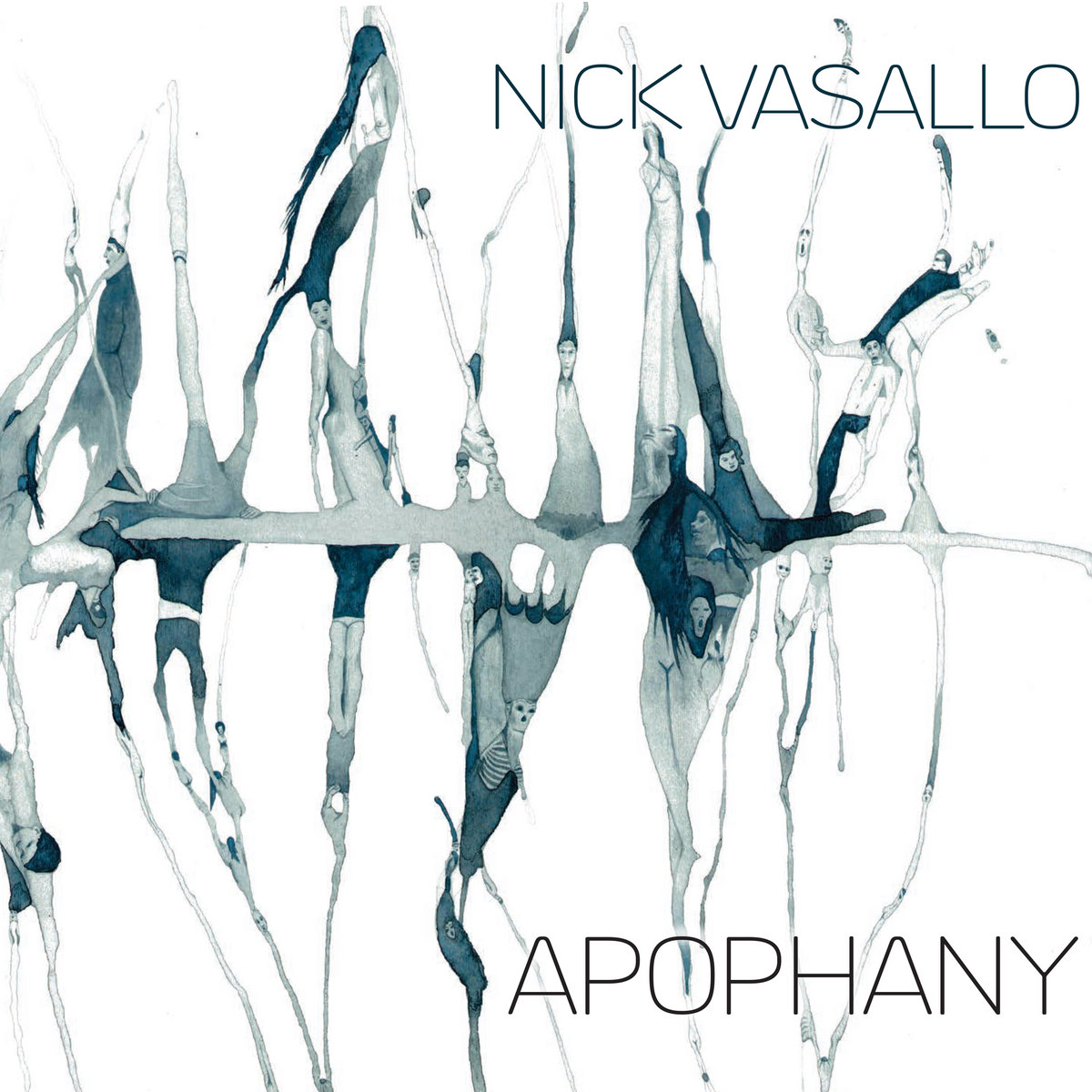
Nick Vasallo, Apophany


It is probably true that historical forces at work in any given time  period can be either more or less auspicious for creators of music, and then of course perhaps only for some, not necessarily all. Certain periods of time may inspire, depending on how one is situated., and that may have nothing to do with the economics of it. "The cricket sings for love," as Des Prez has his singers sing. He meant to remind his benefactors to pay them!

In the course of my studies I remember somebody (but forget who!) raised the question of whether tempos generally increase in apocalyptic times. It is one of those things that would be hard to verify one way or another, since not all music indicates an exact range of possibilities, etc. And of course for other elements of music we can quickly get mired in speculation. For example, not all peoples think minor modes are "sad;" dissonance has meant different things at different times, and harmonic complexities are not always registered on a uniform emotional range depending on where you are and when. So Gesualdo is one thing, Ligeti another.

My own intuitions suggest we are in a historically unprecedented time in terms of world human and natural happenstances. So are we cranking out more masterpieces per square foot of creative time now? I chuckle because it is an impossible question. Who can say for sure until we are long gone and "posterity" has had its say?

On the other hand, we can put that aside,  jettison such thoughts and concentrate what is in front of us, the music of today one way or another, and appreciate the many points of musical light that penetrate our musical selves right now. Case in point is a recent anthology of works by present-day composer Nick Vasallo entitled Apophany (Numa  150). I have been listening closely to it and now I think I can speak of it with some certainty.

There are a wealth of contrasting and sonically distinct musical fingerprints on the nine works that make up the album.  They vary from concert choir to chamber ensemble, chamber orchestra to wind band to full orchestra.

The music itself tends to be a flexible thing, often with a dynamic High Modern contemporaneity that includes sonic color weaving, with skillfully eloquent use of advanced harmonic ranges of consonance and dissonance.

Perhaps the most stunning and interesting (to me) works include "Ozymandias" for heavy metal electric guitar, rock backup and chamber ensemble. It is a convincing melding of caustic electricity and expressionist currency. Since such an endeavor is inclined to be rare these days and since this work comes together well it is a good place to consider how such meldings can stand out and give us musical pause. It is a rather excellent example of such possibilities and so stands out. "Inches Away from Freedom" continues the Metal-Avant onslaught nicely with heavy underpinning and glowing agitation. "Black Swan Events" completes the hard edged trilogy of electricity. These three interrelated works alone make this album important

But from the very start with "Ein Sof" the music bursts forward with an agitation for orchestra that aptly presages and anticipates the conclusion as it works nicely with a pronounced stridency. "When the War Began" continues the dynamic outbursting in varied electrifying ways.

"The Prophecy" maintains our interest as it mixes things up with a choral interlude that brings to us a kind of chant-like elementality that is good to hear, a listen of note no matter how many times you hear it. "ATUM" continues the dramatic soundscape with a chamber ensemble of expressionist clout. "The Eternal Return" matches what came before and adds emotive megaliths of ensemble sound. Then follows "The Moment Before Death Stretches on Forever, Like an Ocean of Time" with events of turbulence and moving starbursts of dramatic vistas.

It is an album that will keep your attention throughout and also sports some of the most successful combinations of Metal and High Modernist New Music I have heard in years. Listen, by all means.

Tuesday, March 22, 2022

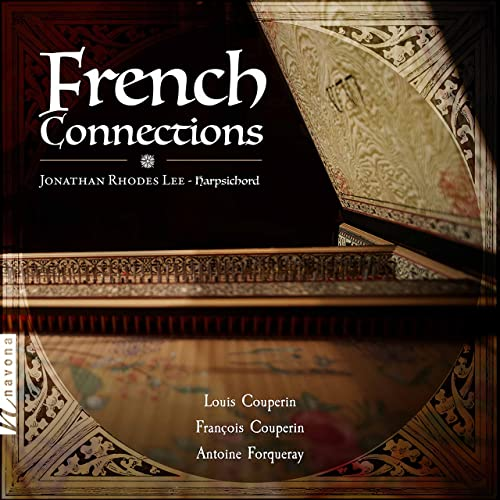
French Connections, Jonathan Rhodes Lee, Harpsichord Music by Louis Couperin, Francois Couperin, Antoine Forqueray


If you want to bring a smile to my face, send me some music from the French Baroque. As I remarked on my FB wall the other day, at its best there is a sweetness, a kind of Romanticism of its own,  that sets it all as a thing apart in ways that differ from any other period and style. So happily the other day the mailman brought such a release, an album of harpsichord music done beautifully and meticulously by Jonathan Rhodes Lee, the program entitled French Connections (Navona Records NV6389).

The combination of nicely chosen works and committed performances makes this one a happy go of things. I have heard most all of this music in other versions, but I must say that the sequence here seems especially inspired, a great introduction for those that do not know much of this but then also a nicely put-together selection even for those well versed in it.

The program consists of three series of interconnected works--Louis Couperin's "Pieces in F," Francois Couperin's "17th ordre,"from "Troisieme Livre de pieces de clavecin," and finally  Antoine Forqueray's "Selections from suite no. 5" as arranged for solo harpsichord by Jean Baptiste Forqueray. I know these latter pieces in their original scoring for solo viol, and so I am glad to hear them in this way.

The idea of putting together a series of dance music pieces into a suite is most admirably exemplified by the Louis Couperin "Suite." His nephew Francois follows with a suite where nicknames are in part the orienting principal. Finally we get Fouqueray's Suite selection where the virtuoso element is more toward the forefront.

Well now I must say in conclusion that this all constitutes a delightful set of works played with both care and zeal. French Baroque harpsichord styles come though with clarity and concentrated zest. I thoroughly recommend this music! Molto bravo!