Search This Blog

Tuesday, May 3, 2022

Orion Weiss, Arc I, Piano Music of Granados, Janacek, Scriabin, 1911-1913


Pianist Orion Weiss gives us on his album Arc I (First Hand Records FHR127) the first installment of a three-part, ambitious series of historically grounded solo piano anthologies. This first part looks at the period of 1911-13 as a world on the brink of WWI and grappling with what was coming, shining on a kind of hope yet at moments filled with despair for what might be ahead. The volume helps express a historical tuneful and timefulness with three piano compositions that illuminate a sort of musical mood index of a state of being expressing the impending advent of a world-changing crisis that transformed all in its path in time and in a way made Modernism possible after a levelling of the status quo that was decidedly fading before the sweep of change that hit Europe like a tidal wave. By situating the works in the chronology of world cataclysms it invites experiencing the works in situ and as reflections of the world in which stunning piano moods emerged. Of course that does not mean we should apply some absolute blanket of causality, rather it is to consider the works within their experiential backdrops.

So we get "Goyescas" by Granados,  "In the Mists" by Janacek, and "Piano Sonata No. 9" by Scriabin, all written in a three year sequence, Granados in 1911, Janacek in 1912, and the Scriabin in 1913.

That the three works considered in a continuum.gradually increase in turbulence is something that we might experience as an opening into a event scenario that corresponds with the music; it is something we can sense and yet we do not have to pin it all down absolutely. Palpably it does invite experiencing in this way and in the process it gives us another dimension to consider outside of the works as individual entities in themselves.

And Orion Weiss gives us performances fully worthy of the importance of each of these works. We feel the drift of historical events yet of course the ability of classic works to state the world in their own terms.

This one is enthusiastically recommended. History, the early vitality of Modernism and a wonderful performative pianism join together for an experience well worth your listening time.


Monday, May 2, 2022

George Perle, Solos & Duos


George Perle (1915-2009) is one of those New Music composers whose importance was perhaps overshadowed by the vagaries of fortune. It wasn't so much that he was unknown, but then he might have been performed more often than he was, maybe. At any rate he was an American Modernist of a very accomplished sort and any earnest recorded attention devoted to his music is something New Music lovers should find of interest. I think back to a New Music concert I attended in New York as early as 1972. There was a Perle work on the program and I liked it much, but then for whatever reason, I never quite found things to check out on record to speak of. I suspect part of that was my fault but at any rate I am glad his music has become increasingly available in recent decades. On here for example I happily reviewed a BMOP recording of his "Serenades" in 2019. Look it up for more about him and his music.

So in that vein a significant new release has come across my desk and I duly report in after a bunch of listens. It's a two-CD set of Perle Solos & Duos (Bridge 9546A/B). On it we are introduced to some 16 works, a number with several movements, all focused around the simple presence of one or two instrumentalists and the Perle magic. He is a committed High Modernist and so the music has the full-fledged edgy harmonic-melodic underpinnings and asymmetrical and non-repetitive rhythmic thrusts one might expect to find in this style set. Yet too it sports a definite individuality if you give it the requisite time to become familiar with it all.

So in the course of the two-CD's unfolding we hear several solo piano works, several solo violin pieces, a work for solo clarinet, one for clarinet and piano, one for violin and piano, one for cello, two for cello and piano,  for double bass, and two for bassoon. The works cover a wide range of time between 1943 and 2004. There is a kind of unified expressionist High Modernism at play throughout and perhaps the principal variable is the idiomatic writing for each instrument.

The instrumentalists are all well prepared and well endowed with technical prowess so that each piece gets a concentrated focus and comes off well without exception. Richard Goode is on piano for one of the works, so that gives you some idea of the high caliber of all involved.

The seriousness of intent and the comprehensive instrumental possibilities make this a welcome addition for all those who appreciate George Perle or would like to explore his works and do not know a great deal of his music as yet. Either way this is a fine program. I recommend it strongly.


Friday, April 29, 2022

Claremont Trio, Queen of Hearts, Newly Commissioned Works for Piano Trio


Every so often a chamber group comes my way who I have not paid enough attention to, who impresses in exceptional ways and makes me take notice. That is very true of the piano trio known as the Clairmont Trio, as heard in their recent release of commissioned new works, Queen of Hearts (Tria Records CD). It is in celebration of their 20th anniversary, and a happy thing that. On the program we get six works or sets of works especially commissioned by the trio. The results are a testament to the Trio's discerning patronage of some very talented new voices on the scene, and too also the exceptional flexibility and virtuosity of the Claremont Trio.

This is modern Piano Trio music on the tonal side, nicely complex and expressive, all worthy vehicles for the trio to show us their remarkable sensitivity and expressivity, their exceptional interactive prowess. Every work here is interesting, some for a kind of modal tonality or heightened rhythmic flow and sometimes an expanded tonality that points to modern traditions, so to speak.

The way the Clairmont jump into each work makes you want to hear them do more--they are exciting and poetic whether it is "Four Folk Songs" by Gabriela Lena Frank, Sean Shepherd's "Trio," "A Serious Man" by Judd Greenstein, "Three Whistler Miniatures" by Helen Grime, Nico Muhly's "Common Ground" and finally Kati Agoca's "Queen of Hearts."

It is one of the most engaging and enlivening Modern Chamber disks of the last few years. If you appreciate some vital Modern works played remarkably well, this one is a must. I can't wait for more from these fine young talents!


Wednesday, April 27, 2022

Lux Aeterna, Choral Works By Ligeti and Kodaly, Marcus Creed, Danish National Vocal Ensemble


As I sit here and listen happily to Lux Aeterna (Our Recordings 8.220676) I wonder why it should strike me as out of the ordinary, not entirely expected. I wonder why my initial reaction to the pairing of choral works by Gyorgy Ligeti and Zoltan Kodaly seemed unusual to me. They both are Moderns, of course, both have Hungarian roots, and both have Slavic aspects to their music. Still, they contrast in that Ligeti is of course more advanced in the avant sense than Kodaly. And perhaps it may sound odd for me to say this, but as time goes by the degree of avantness seems not to matter as much as it once did to me. The music convinces or it doesn't, regardless of the degree of advancement. It is I think a part of being in the world we are in, where there is a multiplicity of styles and tendencies.

All that only makes sense of course if the program and its performance hang together. That is most certainly so with this album. The Danish National Vocal Ensemble under conductor Marcus Creed puts a greatly expressive focus on each piece of music, conceiving the essence of the program in moving and absorbing ways.

So we appreciate how all concerned make High Modern sense and yet also have a sort of folk quality --whether it be a matter in the case of Ligeti of his "Lux Aeterna" (1966), the earlier works "Zwei a cappella-Choir" (1955) "Matraszentimrei Dalok" (1955) or the "Drei Phantasien nach Friedrich Holderlin" (1982). The 1955 works understandably have a slightly more down-to-earth almost nationalist dynamic than the title work, and the "Phantasien" nicely falls somewhere in between stylistically.

They are all excellent examples of how Ligeti does not easily fall into a neat cubbyhole in terms of style and trajectory. Every work in many ways forms an indivisible exemplar, a set of one. And as one gets to know each work here one feels in the presence of a master in exceptional control of his resources and creative expressibity.

And it so happens that the earlier works set up nicely a contrast with the Kodaly works, how a kind of folk veneer bounces off a contemporary stance in either case, with Kodaly perhaps a more elemental Modernism and melodic Folk hybrid with his "Evening Song"  (1938), "Evening" (1904) and the  "Matra Pictures" (1931).All three remind us what a powerfully inventive lyrical voice Kodaly could be.

And as it so happens the four compositional groupings by Ligeti and the three shorter ones by Kodaly are fine offerings and work well together in their essential rootedness. It is a pleasure to experience this one. Recommended highly.

Tuesday, April 26, 2022

Palaver Strings, Ready or Not, Music for Strings By Women Composers


Music unfolds for us in our lifetime, should we be so inclined, into the infinitude that it always has been. It seems like in my experience the period leading up to the present has been chock full of the most diverse and influential music accessible for us perhaps as never before, should we take the trouble to explore it all. Today is no different, at least for me. So I get rolling this morning with an album that breaks new ground in its eclectic desire to cover as much New and/or worthwhile Early Music as possible as vividly realized by a state-of-the-art string orchestra.

It is a fine and refreshingly unique program of Early-to-Modern music by women composers covering a broad swatch of possibilities with things we are fortunate to hear now as played with a good deal of imagination and focus by the orchestra known as Palaver Strings. The album, appropriately dubbed Ready or Not (Azica Records ACD-71342), keeps a tonal center regardless of the work and then covers a sort of Early-to-Post-Modern realm of folkish palate-freshening in a number of guises.

Grazyna Bacewicz's "Concerto for String Orchestra" opens the program with an energetic three-movement vibrancy of Polish rootedness. It is one of Bacewicz's strongest such works, a stunning presentation that rings out and rings in simultaneously. 

Beyond that we have Maddelina Casulana's miniature folk harmonic "Non puo il mio cuore" as arranged by Jesse MacDonald. From there we go on to a touching minor-feelingful-dirgish "Lagrime mie" by Barbara Strozzi as arranged by Adam Jacob Simon. Mezzo-soprano Sophie Michaux takes a stunning lead in this songful poeticism.

Akenya Seymour brings a very lively folk-jazzishness to her three movement "Fear the Lamb." Poignant blues reworking and stunning extensions of harmonic movement make for an exciting Third Stream wonderment that wears well and feels virtually-effortlessly authentic in its own way.

The three part folk fiddling influenced "Treehouse/Jig for John #2/Fore Street" by Liz Knowles/ Elizabeth Moore has stunning earthiness and sheer joy. It closes out the program in ways one could not imagine being topped, a wonderful end. 

The full-blown sympathy of Palaver Strings to the put-forward newness and/or evergreen foundations of the works make for an ideal present immediacy. I give you encouragement to hear this one, and I recommend it highly. Download and CD are available now. Either way it is something consistently worthwhile and refreshing. .

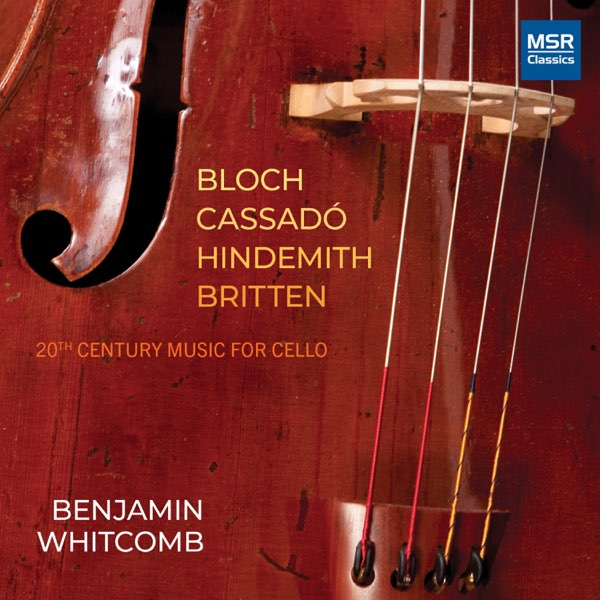
Benjamin Whitcomb, 20th Century Music for Cello, Bloch, Cassado, Hindemith, Britten


Perhaps to some the idea of music for unaccompanied cello is something esoteric, off the beaten track. But it is more the case now than not that the repertoire is being represented on disk far more than it might have been 50 years ago or so. A very good example is the music before us today, with cellist Benjamin Whitcomb in a nicely turned volume of 20th Century Music for Cello (MSR Classics 1798), covering relevant works by Ernest Bloch, Gaspar Cassado, Paul Hindemith and Benjamin Britten. Some may recall or even have his first volume in the series, which I reviewed with pleasure here this past April, 2020. 

The first thing one might note on listening is the finely granular readings and masterfully commanding performances of these works by Benjamin Whitcomb. He is not in any way attempting to grandstand his way through these pieces, but rather seems purely inspired by the music and responds with a deeply detailed, middle ground between the far end of expressionism and the somewhat contrasting one of unrelenting abstraction. None of these works are in the High Modernist panoramic breadth of leaps and bounds (i.e. twelve tone or atonal, very dissonant and/or fully dedicated to a kind of anthematic post symmetrical infinity of unfolding. Nor is this music in Whitcomb's reading filled with Romantic  sentimentality. So in that way Maestro Whitcomb's response seems exactly right for the music, and in fact he is more a composer's faithful representative than a cellist's cellist, so to speak, at least as I hear it.

My ears over the numerous listens I have given this program perk up especially at the rendering of the stand-up, complex striations of the Paul Hindemith "Cello Sonata, Op. 25, No. 3," an exemplary work from his ambitiously contemporary early period (1922) in Germany. Each time I hear the sequence of works the Hindemith stands out nicely as a high point among high points.  So too the Benjamin Britten "Suite No.1" expands the tonal center outwards and sounds more Modern in that way than not. The nicely spaced and open field melodic unfolding gives us a kind of poeticism not at all programmatic and so a typical but satisfying venture into art for art's sake, so to speak. 

And both works as done with panache by Benjamin Whitcomb take on a special life and become memorable in all their complexities, as a music that reminds us of itself the more times we hear it--which after all is what music should ideally be in contexts where it is all about carving out a musical landscape of some sublimity and uncompromising strength.

Yes and then the opener by Ernest Bloch, "Suite No. 1 for Unaccompanied Cello" (1958) has something of a Semitic quality that is subtle yet distinctly there to appreciate as you pay attention to how it plays itself out, minor and ornate and expansive.

Then we have something by a composer less known to us, one Gaspar Cassado (1897-1966) and his "Suite for Solo Cello" (1926)--in its own way very declamatory, articulate, fanfarish and deliberately dramatic and outreaching. Then follows a folk-like dancing moment before a concluding melding of song and fanfare. It all is nicely satisfying.

Perhaps this is not the kind of album you would see is out and say to yourself, "I've got to have this one!" But when you play it enough you realize you are lucky to experience it, that it is a special thing any "Modernist" and cello appreciator will be glad to have to hear often, I suspect. So please give it a listen and perhaps it will makes its way into your musical being like it did for me. Recommended!

PS See the April 7, 2020 article for a discussion of the previous volume of Whitcomb playing 20th century Modern repertoire for unaccompanied cello.

Tuesday, April 19, 2022

Arcomusical, Emigre and Exile


Every so often an ensemble comes along that is dedicated to some sort of stylistic-meta-acoustical  way of playing-listening. Steve Reich's ensembles were/are that, as were some of course that Harry Partch assembled and so also Lou Harrison. Arcomusical is a new ensemble in that general channel of stylistic expression. Their third album is now available, entitled Emigre and Exile  (Panoramic Records Pan25).

It is some four composers giving us single movements with one exception, that is Matt Ulery's title work with its six movements. Then there are three pieces by Gregory Beyer, and one apiece by Jeremy Muller and Alexandre Lunsqui.

Each work forwards an instrument not typical of western  chamber music, such as the single stringed Brazilian Berimbau, or at times the inclusion of one or more typical western instruments, such as contrabass, vibraphone. for coloration and sometimes played in a non-standard manner for an even more pronounced coloration.. The Berimbau ensembles are inspired, beautifully sonic and a major reason to listen. But also the compositional approaches are all worth your attention over and above the sonic wonder of it as an entirety.

The music pulsates in engaging ways. Everything has a kind of tribal folk-avant forward momentum, an elementally riff-like tonality, with repetition ostinatos not at all formulaic. One hears Asian elements both Southeast and Indian, Chinese, Japanese, Korean, some African momentums and Lou Harrison-esque transformations into a New Music singularity.

I've been an admirer of Matt Ulery's music for some time--I've reviewed a number of his recordings on the blogs over the years (see indexes on this and the Gapplegate Music Blog for those). This music has a departure element that fits in more specially for this ensemble. The other composers too line up the musical language to further flesh out the ethno-lyrical element so pronounced and well done here.

This is not an ordinary sort of album. It is uplifting and unusual. T recommend it if you are wanting something different, something off the well beaten path. Bravo.