Search This Blog

Wednesday, May 4, 2022

Max Richter, Exiles, Works for Orchestra


Sometimes lately I do some internet work in the morning and just keep playing the featured selection while I am doing that. By the time I am ready to write about it I get four-square insight into just how much the music is getting to me, or of course sometimes less so. Today the selection is orchestral music by Max Richter, a volume entitled Exiles (Deutsche Grammophon 486-0445).

Now I've heard some of Richter's music in the past and generally liked it, but it did not stick in my head very long. That sometimes has to do with a particular time frame where you might have been distracted or was not able to listen without interruption. Well no matter. This Max Richter album gives us a well-rounded portrait of the artist with six works. all distinctive in their own way. Think of Barber's "Adagio," Arvo Part's instrumental writing, the expressivity of later Glass--now do not expect to hear exactly that but something Richter establishes as his in part certainly of the later Minimalist camp but unwinding as more ostinato-like as in Pachebel's Cannon at times--in other words more at times an ostinato bubbling up against other ostinatos and an expressivity that does not rely on the kind of dervish entrancement of earlier Minimalism.

Each of the six works linger almost timelessly at some point. They establish themselves on their own ground each one and than travels along on the special path the work defines and then travels, each in its very own way, building contrasting ostinatos to create a gradually more dense expression. Drones, sustains, lyrical snippets that build atop the flow are significant and enough out-of-the-ordinary/inventive as to make you sit up and take notice.

We should not be surprised if Minimalism stands or falls on the quality of the inventions, just like every other genre and subgenre we have encountered in our musical lives, following from the idea that each genre may have its own parameters on what constitutes good invention. That could easily be the topic for a book and I would love to read such a one or address it myself? No matter right now.

The Baltic Sea Orchestra under Kristian Jarvi sounds just right for the music, feelingful without gushing, accurate without a machine-like sameness. It comes across the more you listen as somehow descriptive of our everyday life nowadays? Easy to say that, no doubt, but seriously it sounds contemporary even Modern without keeping slavishly to a particular thrust.

I happily recommend this to those who think after reading this post think they might like it--I suspect you will take to it like I did.


Tuesday, May 3, 2022

Tyler Kline, Orchard, A Collection of 50 Short Piano Pieces


Tyler Kline is a composer of Modern-Tonal and Post-Tonal imagination. I cannot say I've had much exposure to his music--that is, until now and his Orchard: A Collection of 50 Short Piano Pieces (Neuma 2-CDs). My eyesight does not handle the modern graphic design trend of very small lettering so I cannot read the liners but wait, I have the press sheet. Fourteen pianists from around the world take part in performing the works, and they do a fine job I must say.

What is remarkable and in part transcends what words can express is the abundance of inventive pianisms, all inspired and thought-out, with a certain tenderness at times and other times a dynamic rugged quality that is both whimsical and serious at the same time? It has something of the playfulness of the Alt Moderns, I mean French Impressionists and Satie, a hint of Messaien, then too Cage, Feldman, Crumb, ritual suspensions and repetitions that say their say quickly then go. it is piano music to follow much beyond the folks we have lived with since, say, 1900 to the present, those folks, and an element I cannot quite wrap into words. And given that there are 50 miniatures it is not a simple thing to characterize. 

Given the short and quixotic flight of work-to-work, tones-to-tones, being-to-between-piece expectations, there is almost a compendium of Modern pianistic possibilities here. The idea that this is a kind of musical orchard makes sense, in that each fruit relates to all the other fruits yet none is exactly like the other.

The harvest of this piano work orchard gives you two full CDs or new and refreshing fare, very pianistic yet also unexpected in how there are journeys through original thoughtful key playfulness.

I must say that this extensive collection of piano musical moments brings me to a happy listening place. Anyone who sees the poetry in the piano solo will no doubt find it here as I did. A real boon to all inclined. Bravo!

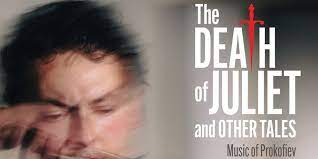
Yevgeny Kutik, The Death of Juliet and Other Tales, Music of Prokofiev, with Anna Polonsky


Prokofiev, when I was a young listener, specifically as it was in the USA, was distinctly not as popular as Stravinsky, at least in general terms. There of course were reasons for this, partly that Stravinsky was on the American musical scene. 

Today that may have changed. In terms of sheer numbers of new releases, Prokofiev has been getting a great deal of attention lately, possibly more than Igor these days. It is of course not a kind of horse race, or should not be, so it is not in my head all that important, but interesting and informative nevertheless. I would not want to choose between the two, because each has a brilliance that goes on untarnished to this day. 

Nonetheless I check in today with a welcome new release of works for violin, namely Yevgeny Kutik's The Death of Juliet and Other Tales, Music of Prokofiev (Marquis 114718162328). In the realm of Prokofiev chamber music violin performances there of course is Oistrakh as a sort of benchmark, with  Heifetz on the sweeter end, then Stern more or less in the expressive middle, and my favorite version of the Violin Sonatas on an old Columbia recording, that by Joseph Szigeti.

Yevgeny Kutik takes on the Sonata No. 2 as his own and acquits himself well. He has some of the exuberant, almost strident enthusiasm of Szigeti, with some of the sweetness of Heifitz. Pianist Anna Polonsky forms a vibrant and engaged counterpart throughout.

I am not one to complain, but the graphics on this CD, like so many others these days is not geared to be readable. The list of selections is printed in a very small point size, a goopy red which when put onto a gray screen is impossible to read. So there are other compositions here and let me try to decipher what they are. There is a short solo violin piece that I cannot possibly decipher the name of. It is traditional, arranged by Kutik. There is another nicely attractive solo violin version of "The Death of Juliet," and a fine thing it is. It is plaintive, sorrowful and unmistakenly Prokofievian! The old standby "Song of the Volga Boatman" is arranged by I can not read who. Sorry, the booklet design makes reading quite difficult. Then there is "Kalinka for Solo Violin" by Ivan something-or-other, arranged by somebody or other. Again, I apologize for my inability to read it all.

Happily there follows Prokofiev's "Sonata for Solo Violin" which is given a brilliant reading. Then follows two traditional pieces for solo violin, arranged by folks other than Prokofiev.

And then as already mentioned the Violin Sonata No.  2 concludes the program with a very personal, dedicated performance that may not quite reach the heights of Heifetz, Kogan or Szigeti, but it holds is own in spite of that.

All in all this volume heralds Kutik as a major force in Russian violinists today. Any fan of Prokofiev and Russian tradition will find this to their liking I suspect. 


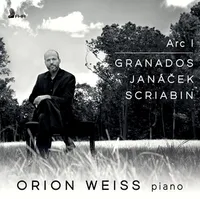
Orion Weiss, Arc I, Piano Music of Granados, Janacek, Scriabin, 1911-1913


Pianist Orion Weiss gives us on his album Arc I (First Hand Records FHR127) the first installment of a three-part, ambitious series of historically grounded solo piano anthologies. This first part looks at the period of 1911-13 as a world on the brink of WWI and grappling with what was coming, shining on a kind of hope yet at moments filled with despair for what might be ahead. The volume helps express a historical tuneful and timefulness with three piano compositions that illuminate a sort of musical mood index of a state of being expressing the impending advent of a world-changing crisis that transformed all in its path in time and in a way made Modernism possible after a levelling of the status quo that was decidedly fading before the sweep of change that hit Europe like a tidal wave. By situating the works in the chronology of world cataclysms it invites experiencing the works in situ and as reflections of the world in which stunning piano moods emerged. Of course that does not mean we should apply some absolute blanket of causality, rather it is to consider the works within their experiential backdrops.

So we get "Goyescas" by Granados,  "In the Mists" by Janacek, and "Piano Sonata No. 9" by Scriabin, all written in a three year sequence, Granados in 1911, Janacek in 1912, and the Scriabin in 1913.

That the three works considered in a continuum.gradually increase in turbulence is something that we might experience as an opening into a event scenario that corresponds with the music; it is something we can sense and yet we do not have to pin it all down absolutely. Palpably it does invite experiencing in this way and in the process it gives us another dimension to consider outside of the works as individual entities in themselves.

And Orion Weiss gives us performances fully worthy of the importance of each of these works. We feel the drift of historical events yet of course the ability of classic works to state the world in their own terms.

This one is enthusiastically recommended. History, the early vitality of Modernism and a wonderful performative pianism join together for an experience well worth your listening time.


Monday, May 2, 2022

George Perle, Solos & Duos


George Perle (1915-2009) is one of those New Music composers whose importance was perhaps overshadowed by the vagaries of fortune. It wasn't so much that he was unknown, but then he might have been performed more often than he was, maybe. At any rate he was an American Modernist of a very accomplished sort and any earnest recorded attention devoted to his music is something New Music lovers should find of interest. I think back to a New Music concert I attended in New York as early as 1972. There was a Perle work on the program and I liked it much, but then for whatever reason, I never quite found things to check out on record to speak of. I suspect part of that was my fault but at any rate I am glad his music has become increasingly available in recent decades. On here for example I happily reviewed a BMOP recording of his "Serenades" in 2019. Look it up for more about him and his music.

So in that vein a significant new release has come across my desk and I duly report in after a bunch of listens. It's a two-CD set of Perle Solos & Duos (Bridge 9546A/B). On it we are introduced to some 16 works, a number with several movements, all focused around the simple presence of one or two instrumentalists and the Perle magic. He is a committed High Modernist and so the music has the full-fledged edgy harmonic-melodic underpinnings and asymmetrical and non-repetitive rhythmic thrusts one might expect to find in this style set. Yet too it sports a definite individuality if you give it the requisite time to become familiar with it all.

So in the course of the two-CD's unfolding we hear several solo piano works, several solo violin pieces, a work for solo clarinet, one for clarinet and piano, one for violin and piano, one for cello, two for cello and piano,  for double bass, and two for bassoon. The works cover a wide range of time between 1943 and 2004. There is a kind of unified expressionist High Modernism at play throughout and perhaps the principal variable is the idiomatic writing for each instrument.

The instrumentalists are all well prepared and well endowed with technical prowess so that each piece gets a concentrated focus and comes off well without exception. Richard Goode is on piano for one of the works, so that gives you some idea of the high caliber of all involved.

The seriousness of intent and the comprehensive instrumental possibilities make this a welcome addition for all those who appreciate George Perle or would like to explore his works and do not know a great deal of his music as yet. Either way this is a fine program. I recommend it strongly.


Friday, April 29, 2022

Claremont Trio, Queen of Hearts, Newly Commissioned Works for Piano Trio


Every so often a chamber group comes my way who I have not paid enough attention to, who impresses in exceptional ways and makes me take notice. That is very true of the piano trio known as the Clairmont Trio, as heard in their recent release of commissioned new works, Queen of Hearts (Tria Records CD). It is in celebration of their 20th anniversary, and a happy thing that. On the program we get six works or sets of works especially commissioned by the trio. The results are a testament to the Trio's discerning patronage of some very talented new voices on the scene, and too also the exceptional flexibility and virtuosity of the Claremont Trio.

This is modern Piano Trio music on the tonal side, nicely complex and expressive, all worthy vehicles for the trio to show us their remarkable sensitivity and expressivity, their exceptional interactive prowess. Every work here is interesting, some for a kind of modal tonality or heightened rhythmic flow and sometimes an expanded tonality that points to modern traditions, so to speak.

The way the Clairmont jump into each work makes you want to hear them do more--they are exciting and poetic whether it is "Four Folk Songs" by Gabriela Lena Frank, Sean Shepherd's "Trio," "A Serious Man" by Judd Greenstein, "Three Whistler Miniatures" by Helen Grime, Nico Muhly's "Common Ground" and finally Kati Agoca's "Queen of Hearts."

It is one of the most engaging and enlivening Modern Chamber disks of the last few years. If you appreciate some vital Modern works played remarkably well, this one is a must. I can't wait for more from these fine young talents!


Wednesday, April 27, 2022

Lux Aeterna, Choral Works By Ligeti and Kodaly, Marcus Creed, Danish National Vocal Ensemble


As I sit here and listen happily to Lux Aeterna (Our Recordings 8.220676) I wonder why it should strike me as out of the ordinary, not entirely expected. I wonder why my initial reaction to the pairing of choral works by Gyorgy Ligeti and Zoltan Kodaly seemed unusual to me. They both are Moderns, of course, both have Hungarian roots, and both have Slavic aspects to their music. Still, they contrast in that Ligeti is of course more advanced in the avant sense than Kodaly. And perhaps it may sound odd for me to say this, but as time goes by the degree of avantness seems not to matter as much as it once did to me. The music convinces or it doesn't, regardless of the degree of advancement. It is I think a part of being in the world we are in, where there is a multiplicity of styles and tendencies.

All that only makes sense of course if the program and its performance hang together. That is most certainly so with this album. The Danish National Vocal Ensemble under conductor Marcus Creed puts a greatly expressive focus on each piece of music, conceiving the essence of the program in moving and absorbing ways.

So we appreciate how all concerned make High Modern sense and yet also have a sort of folk quality --whether it be a matter in the case of Ligeti of his "Lux Aeterna" (1966), the earlier works "Zwei a cappella-Choir" (1955) "Matraszentimrei Dalok" (1955) or the "Drei Phantasien nach Friedrich Holderlin" (1982). The 1955 works understandably have a slightly more down-to-earth almost nationalist dynamic than the title work, and the "Phantasien" nicely falls somewhere in between stylistically.

They are all excellent examples of how Ligeti does not easily fall into a neat cubbyhole in terms of style and trajectory. Every work in many ways forms an indivisible exemplar, a set of one. And as one gets to know each work here one feels in the presence of a master in exceptional control of his resources and creative expressibity.

And it so happens that the earlier works set up nicely a contrast with the Kodaly works, how a kind of folk veneer bounces off a contemporary stance in either case, with Kodaly perhaps a more elemental Modernism and melodic Folk hybrid with his "Evening Song"  (1938), "Evening" (1904) and the  "Matra Pictures" (1931).All three remind us what a powerfully inventive lyrical voice Kodaly could be.

And as it so happens the four compositional groupings by Ligeti and the three shorter ones by Kodaly are fine offerings and work well together in their essential rootedness. It is a pleasure to experience this one. Recommended highly.