Search This Blog

Tuesday, June 6, 2023

Debra Kaye, Ikarus Among the Stars, New Modern Works of Note


Living, breathing composer Debra Kaye has happily come to the attention of this blog with a few releases that nicely included her music (type her name in the search box above to access those articles). Now we hear a full CD devoted to her compositions, and a good thing that very much is. Ikarus Among the Stars (Navona NV 6521) brings together some six compositions from select chamber works through to a significant finale, the title work, commissioned by the Portland Youth Symphony Orchestra, filled with a most interesting fusionoid melding of Modern Orchestral and Contemporary Pop, Hip-Hop, and Prog Rock stylings that fascinate and move the needle forward on what can be done and done well in the Modern spheres. Sometimes I catch myself going to say, well this is tonal, but then I realize in the Modernity of today Atonality and/or Serialist ways are pretty much relegated to past masters, the no-longer active cadre of composers of yesterday and the day before yesterday. Of course that is not to say that noise and sound color options are not important these days in the avant garde, and good for that if done well.

To keep on the main point though this album affirms Ms. Kaye's stature as a singular voice for today's Modern scene. Each work gives us a world of its own, from 'The Exchange" and its brittle clarion voicings for clarinet and cello, to the serious, probingly inventive demeanor of the First String Quartet,  "Encountering Lorca."

Each work is a gem and together we find upon multiple listens a compelling argument for Debra Kaye as a key "new" voice in American music today. This music will give you a nice introduction to her music if you do not already know it. Bravo.

See this link to find out where to stream the album: https://www.navonarecords.com/catalog/nv6521/


Thursday, June 1, 2023

Poul Ruders, Rudersol Chamber Players, Clarinet Quintet, Throne, Piano Quartet


Ours Records came out a while back with a nice recording of the music of Danush composer Poul Ruders. I was happy to check it out and review it.  See index box above for that article on his larger forces music as well his presence on a piano anthology.

Today we have a nicely moody addition of three chamber works penned between 1988 and 2016, well performed by the Rudersol Chamber Players, It covers his Clarinet Quintet, his Thrones, and his Piano Quartet (Our Recordings  6.220680).

These are deeply meditative, exploratorily modern works with an emphasis on well constructed chamber depth and close focus. The harmonic content is a nicely advanced modern sort with a good shade of dissonance to give it all distinctive character. It should appeal to all devoted Modernists out there but if you are not yet give this some time and it may convert you. Good show, bravo.

Sample some of his music on YouTube https://www.youtube.com/channel/UCgNmSfU9fjf__i5zs65-h3g/playlists

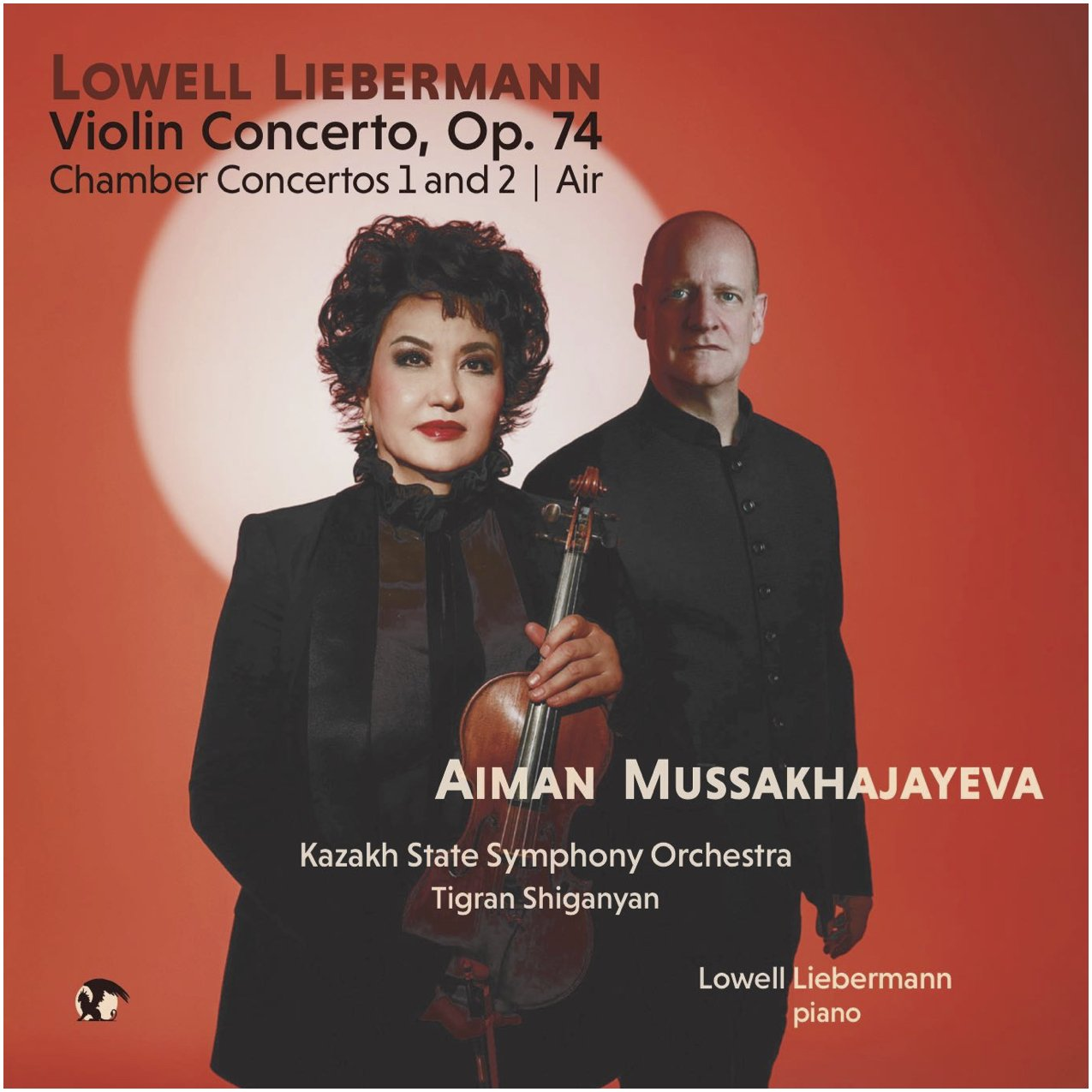
Lowell Liebermann, Violin Concerto, Aiman Mussakhajayeva, Kazakh State Symphony Orchestra, Tigran Shiganyan


Living composer Lowell Liebermann is seemingly riding a wave of popularity unusual for a living artist as a rule, with many performances and much acclaim in recent decades that put him  toward the apex  of the contemporary scene. To further that end we have a  notable new recording of four concerted works for violin in the hands of superlative violinist Aiman Mussakhajayeva. She joins with the well prepared Kazakh State Symphony Orchestra under Tigran Shiganyan for a welcome premiere of four Liebermann works from the millennium and beyond, featuring the especially vital Violin Concerto of 2001 (Blue Griffin Records  BGR645). Also included are the well wrought companions of our current era in his Chamber Concerto No. 1 for violin and the composer at the piano in a new version for string orchestra as the ensemble,  and similarly the Chamber Concerto No. 2 for violin and string orchestra, and then finally the 2011 "Air" for violin and string orchestra.

There is real magic in this music, in some ways reminding of the essence of the Berg Violin Concerto in its expression drenched rhapsodizing, and perhaps also recalling indirectly the late Romantic lyricism of a Samuel Barber, not in obvious ways but effectively and poetically. It is tonal music in an inventive original mode while hearkening back as a glancing remembrance to Impressionist dazzling and shimmering  of light and sound last century, combined with a heightened expression not typical of the full Modern period but lively in the edges recalled of a long time past if you will. All four works have the real potential of joining the permanent repertory of classic concerto fare, deservingly.

This is music to stop questioning, to let play and find what the composer intends and then if of like mind, to surrender to most willingly.  It is a gem of a program to appreciate over a long time I would think. I recommend a listen for your understanding and then repeated listens, too. A good one for your latest Modern Concerto holdings. But that of course is up to you.

Stream the music starting at this link to get a glimpse of it all. https://www.youtube.com/watch?v=nf7aCb_uotA&list=OLAK5uy_lk9TTHQQ3WuJWDnINp7qU5tcDXlpN6-aE

Monday, May 29, 2023

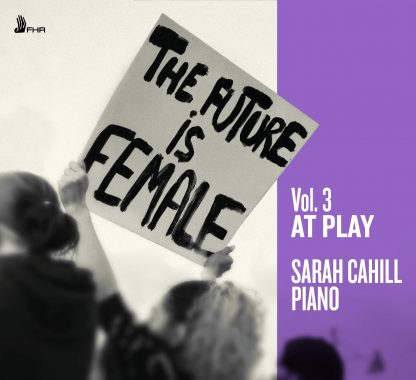
Sarah Cahill, The Future is Female, Vol. 3, At Play, Woman Composers for Piano, 1700s to Today


Multi-stylistic piano poet Sarah Cahill  chimes in with her Third Volume of The Future is Female, At Play (FHR 133) which provides us with some nine female composers and their compositions in a creative vein, with a wealth of inventions ranging from the period around 1700 through to today. What is rather exhilarating about it is the significant form of it all and its diversity of stylistic means according to the varying historical-stylistic musicways at hand.

Beginning with the elegant Classicism of  Helene de Montegeroult (1764-1836) and her three-part Piano Sonata No, 9, to the meditative Eastern Modernism prepared piano of  Franghiz Ali-Zadeh  (b. 1947) and  her :Music for Piano," we experience myriad possibilities of an expressive but also exploratory set of works that leaves you satisfied yet wanting still more. And of course that can be had in the earlier volumes of this project. I will be posting presently on Volume Two as well. Stay tuned.

In the course of the current program we are exposed readily and superlatively to some six additional gems by woman composers now known and some still relatively unknown. So we get pieces by Cecile Charminade (1967-1944),  Grazyna Bacewicz (1909-1969), Chen Yi (b. 1953), Pauline Oliveros (1932-2016), Hannah Kendall (b 1984), Aida Shirazi (b. 1987), and Regina Harris Baiocchi (b. 1956). It is all substantial fare, worthwhile and as you experience it a treasure trove of woman composers worthy of our attention. Ms, Cahill triumphs as she does throughout the series as a whole, Highly recommended. 

To  choose repertoire is to be a kind of music curator. Ms. Cahill is a wonderful curator in addition to being an outstanding pianist Bravo.

Listen to samples of it here. https://www.facebook.com/watch/?v=1324359321721082

Tuesday, May 23, 2023

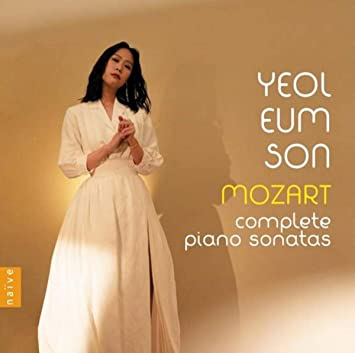
Mozart, Complete Piano Sonatas, Yeol Eum Son


To me the Mozart Piano Sonatas make for must-hear music no matter who or what you are. Nobody topped them for their special brilliance of invention, lyric and lively continualization, and sheer consistently plus wonderful thereness throughout all 18 of them. Part of that has to do with Mozart's love of his instrument of choice and too with the loving care with which the best performers approach the music. I cannot think of a better general exponent for this complete cycle than Ms.Yeol Eum Son and her recent release, who rings in just now with her beautiful played and recorded Complete Piano Sonatas  (Naive V8039 6 CD set).

Of course whenever listening through an entire cycle like this, it may gradually dawn on you like for me just how significant this slice of pianism was for then and so too for now. It is a vast treasure that may at first seem a fairly simple matter. But no, as you listen the simplicity semblance of a first blush grows deeper and you hear the depth in the rugged energy and articulate brilliance of the whole. And as you live with the chronology you begin to sense how early on Mozart's initial and life-long devotion to the piano keyboard allows him from the beginning to explore the wide band of possibilities inherent in the whole, how his inventive genius systematically develops the first real piano sound, of a consistently sympathetic reading of what the piano can do in Mozart's head and of course what he actually does at every step. This was music he thought people might like and he of course was so right!

And it is our reaction in part of course thanks very much to pianist Yeol Eum Son that we hear it all the way we do. She is ever a bundle of bright energy, of a subtle range of touch that brings all of it to life with poetic and eminently musical sureness that gives it all wonderous results, happily. She is in no hurry to impress but instead wisely lets the music unfold the way the composer intended, gradually maturing and becoming ever more brilliant. It is the music on a plane it deserves and demands to be on. Ms. Yeol Eum Son triumphs and we are all the better for it I think. Check this one out, do.

Listen to a stream if it. Please paste link in browser window: https://music.youtube.com/playlist?list=OLAK5uy_nIkSkWpO08_eS6Kr9u3-N_fui45zcKdFc 


Wednesday, May 17, 2023

William Bland, Sonata No. 9 "Spring," Nouveau Rag, Sonata No. 10, Kevin Gorman


William Bland, a New Music composer, walks among us (b 1947) and a recent album of his piano compositions gives us reasons to be happy about that. On this compilation, a second volume of the series, Kevin Gorman poetically performs the Sonata No. 9 "Spring," the Nouveau Rag and the Sonata No. 10 (Bridge CD 9580).

The music is substantial, lyrical and worth hearing. It has perhaps a residue of a Schumann, the further evolved expression of post-Lisztian voice, and perhaps, the ring of cascading Scriabin, only most times more thoroughly post-Romantic, a sometimes attractively strong shading of old Jazz and Ragtime especially in the Rag piece here, and a harmonic scaffolding that sometimes identifies it as very current I suppose you could say. As you listen repeatedly it all comes out as memorable and well invented, compositions with a full exposition of talented inventive pianisms and melodic-harmonic contentfulness. The final 10th Sonata gives us an especially exciting virtuosity that brims over with expression and sincerity. Give this your ears and see what you think.

Thursday, May 11, 2023

Symphonic Chronicles. Vol. 1, London Symphony Orchestra, Royal Scottish National Orchestra, Miran Vaupotic, David Watkin


What is on tap today is some six symphonic works by some six new, new music composers in a compendium dubbed Symphonic Chronicles, Volume One (Navona NV6519).   Through the duration conductors Miran Vaupotic and David Watkin alternately, ably and poetically direct the London Symphony Orchestra and Royal Scottish National Orchestra in a series of tonal works with a narrative and lucidly descriptive way about them. Like perhaps Vaughan Williams in early days you listen and not so much ask yourself if  this is Modern so much as whether it communicates some special musical contents to us, is the music creating a world we want to experience and how does it do that? 

I think it does do that throughout. The music holds its own in varied and vital ways, with a definite personal voice on the part of each composer. Perhaps the most weighty and pronoiunced part of the album is Steve Law's nicely poised Piano Concerto. The pianism of the work is most pronounced and contemporary without necessarily  being atonal or avant. It reflects the expressive places the piano has occupied in recent years, in our sometimes  vaguely postmodern era, The orchestra and piano interact in memorable ways that make you glad to get to know the work. It is as Jazzy on the edges as it is Modern Classical and all the better for that. It like much of these works is devoted to a kind of lyrical management of light, an  exploration of sonic personal contours. Each work sets its own agenda and proceeds to realize it on its own terms, So we get some real chestnuts with five more works by the likes of Deborah Kavasch, John Wineglass, Barbara Jazwinski, Nan Avant and Simon Andrews. These may be new names to me but their works show a maturity and originality of purpose that is most heartening to get to know.