Search This Blog

Monday, June 30, 2014

Jean-Louis Matinier and Marco Ambrosini, Inventio

There are those albums that have the "beyond category" feel to them. The one up today has that in very interesting ways. Jean-Louis Matinier and Marco Ambrosini and their Inventio (ECM B0020542-02) have a confidence born of prowess, a rapport and a commitment to a direction--two excellent musicians who know where they are going, and then proceed to go there.

Matinier plays the accordion; Ambrosini plays the nyckelharpa, a bowed string instrument related to the violin, ordinarily played in Swedish folk settings. Ambrosini has mastered the instrument for a different genre. We have a program of new settings of baroque classics and quasi-Eurofolk, quasi-classic modern compositions by Matinier and/or Ambrosini.

These are excellent players in duo since 2008. They have an uncanny togetherness. Tackling Bach inventions, a movement from Biber's "Rosary" Sonatas, and something by Pergolesi they manage to sound both baroque, pre-baroque, folkish and modern all at once. Their own compositions pull us to the present but bring along all those elements at the same time. Matinier has exceptional facility on the accordion that Ambrosini complements and magnifies in his own way.

Matinier and Ambrosini revel in and excel at producing a sensuously vibrant sound. They swell together in volume as expression demands, create uncanny blends and make music of a striking kind--something completely right for Manfred Eicher's sonic treatment. It all sounds just great.

The overall effect is one of a refreshing balm, a rejuvenation of a sense of discovery. Such imaginative virtuoso playing does not come by often, not on these very originally personal terms.

A delight for your ears! Something to hear when you are weary of the same old options. Recommended.

Friday, June 27, 2014

Per Nørgård, Symphonies 1 & 8, Vienna Philharmonic, Sakari Oramo

The present-day active symphonists? I mean composers who devote themselves to a symphonic output--who write real symphonies? Perhaps there are less of them than there used to be. I am not one at this point to do a systematic survey of the recorded output of living composers and statistically compare the number of symphonies per se with those getting a hearing in 1960. It is an impression only.

Then of course there is the issue of quality. The survey is a daunting task that breaks down once your own evaluation has to come into play--because you cannot hear everything! And then your evaluation has a subjective component. That is perhaps the subject of a book. There is no question that orchestral writing continues on as always, but there may be less of the formal symphony coming to us. No matter.

So never mind. One thing I can say this morning. Per Nørgård, living Danish composer, most certainly is a symphonist, one of real stature. You can hear it in the recording just out of his first and current last symphonies, Symphonies 1 & 8 (Da Capo 6.220574), as recorded by the Vienna Philharmonic under Sakari Oramo. Surprisingly enough this is the first recording of the Vienna Philharmonic doing Nordic new music. They picked music we should hear and they do a very good job with it.

The first symphony (1953-55 rev. 1956) is in a somewhat romantic vein, Sibelius-like in its orchestrational brilliance. The 8th (2010-11) is more modernistic, fractalized and abstracted. This is the premier recording of the latter work and it is good to hear.

I suppose you could say comparing the two symphonies has an apples and oranges feel to it. They are both Per Nørgård-like, certainly. But I have not gotten my mental musical senses around what that is, precisely. And some of that is deliberate. Per Nørgård devised each symphony as something with its own distinct personality, as he remarks in the liners to this disk. Indeed the first and eighth do not seem of the same exact family, cousins more than siblings. Of course they show a change and a growth in the composer's style. The 8th belongs to 2010 as the 1st does the early fifties I suppose. Surely the styles exhibited here felt right to Nørgård when he sat down and wrote the music. And they still sound right, just different.

In common is a sort of musical panorama that cannot be easily put into words but has something Nordic about it. That is, each has a descriptive non-verbal elegance, an eloquence, a set of musical colors combined and juxtaposed skillfully and even brilliantly into structures of sound.

All of this should indicate to you that Per Nørgård's music is something I am coming to know only gradually. These two symphonies continue me on that tone-voyage of discovery. Both the more romantic and the more modern examples set forth on on this disk convince me that he belongs among the important symphonists of our time. The music holds up under intensive scrutiny. As charming and dazzlingly dramatic as the first is, the eighth is more on the contrasting expressive-modern-cubistic whole-in-significant-parts side of possibilities. Just for the premier of the 8th alone this is an important disk. The inclusion of the 1st gives you a wide perspective on the composer. And the performances are committed and sonically grand.

Recommended!

Thursday, June 26, 2014

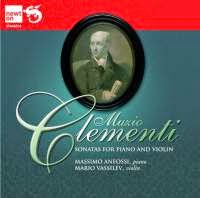
Muzio Clementi, Sonatas for Piano and Violin, Anfossi, Vassilev

If you took classical piano lessons for any length of time, like I did, you invariably came across one or more Sonatinas by Muzio Clementi (1752-1832). I certainly enjoyed the one I was assigned, and found to my delight that Satie had parodied it in a piece of his own, but at the time I wasn't aware of how prolific and worthwhile his more advanced work was--for the piano alone he wrote more than 100 sonatas. He was the pioneer for realizing in composition the complex sonorities available to the pianist. And if he was overshadowed in part by Mozart and later by Beethoven, it was more in terms of stylistic development than in the quality of the music itself, at least as far as the chamber works were concerned.

Today's disk gives us a picture of the breadth of Clementi's music via a nice selection of his Sonatas for Piano and Violin (Newton Classics 8802110), ably played by Massimo Anfossi at the piano and Mario Vassilev on the violin.

It's no mistake that these works list the piano before the violin in their titles. The piano part is by far the more brilliantly conceived. The violin takes a structurally important role, plays a fundamental part in the thematic unravelling of each movement. But the piano takes on a more virtuoso, elaborated function in these duets.

Once you get used to that there is much lyrical and brio presence to these works and the duo at hand. Clementi was a crown jewel of the classical movement, appreciated by both Mozart and Beethoven and a strong influence on their music.

Listening today you take in all the complexities and fundamental structural brilliance of the music. We perhaps now can appreciate more than ever how important his music was to the development of the centrality of the pianoforte in classical music. Of course perhaps most importantly the music itself is a joy to hear.

Definitely recommended.

Wednesday, June 25, 2014

Markus Reuter, Todmorden 513, Concerto for Orchestra, Thomas A. Blomster, Colorado Chamber Orchestra

There are some works that even if you only hear a couple of minutes of it at first, you know there is something special going on. That's how I felt when I watched the You Tube video of the first performance of Todmorden 513, Concerto for Orchestra (7D Media 1414).

It all started when progressive-avant-rock touch guitarist (The Crimson ProjeKct, etc.) Markus Reuter was fooling around with algorithms on his laptop one day. He hit on one where he was able to generate 513 different three-note chords (if I am not mistaken). From this he tried to work out an arrangement and sequence for a small electric instrument configuration but the music was too complex to sound properly with this combination.

In the end he and Thomas A. Blomster consulted together, the result of which was a full orchestration of the musical sequence where for sound color purposes a medium-sized orchestra was divided not into the usual sections but by a number of smaller cells, a string quartet, trio, etc. The seating arrangement of the orchestra was changed to reflect these groupings. The Colorado Chamber Orchestra was assembled to run through an initial reading of the piece. After several revisions to the score and intensive rehearsals the orchestra performed the premiere last year. A recording session followed and now Todmorden 513 can be heard in all its subtle glory on a CD and DVD, the latter providing a 5:1 surround mix and a video documentary on the realization of the work.

It is a work like none other--though it sounds like what Morton Feldman might have written had he advanced to a new stage. In a way it sounds like everything a minimalist composition leaves out! There are endless modulations in harmony stated in sustained chords as well as arpeggiations. The long piece has a hypnotic quality, a ritual meditation on the possibilities of orchestral sound as an endlessly unwinding sky with light winds, with every cloud floating by different yet built of the same substance.

Reuter's conception and realization is brilliant; Thomas A. Blomster's orchestration is equally so, and the performance is dazzling. This, I am confident, is one of the most important orchestral works of our era. It is neither backward looking to the choppy sea of classical modernism nor is it contemporary in the usual ways we might find today. It is one-of-a-kind, like Terry Riley's "In C" but in its very own way.

You must surrender yourself to the sounds and give up expectations of thematic entertainment. This is in real-time like other musics but has more of a feel of the universe in perpetual motion than a local narrative event. It is exceedingly beautiful in a way that may exasperate the impatient, but then classical modern music is not generally fabricated for those looking for quick and easy thrills. The thrill will be there when you open yourself up, but you must allow the music to enter your mental world on its own terms.

This is a triumph. More than that it is brilliant, a breakthrough in form and sound. It belongs in the collection of anybody serious about understanding the most modern modern music. I tell you true. My wife liked it, also, which tells me it's not just a specialized sort of thing for the egghead weirdos out there like me! So do not hesitate!

Tuesday, June 24, 2014

Ben Moore, Dear Theo, Three Song Cycles

As said the other day, modern song cycles aren't exactly a lost art, but the number of new releases in the realm are somewhat less than those for the more consistent output of symphonic and chamber works. Nonetheless there is good music to be had in the song realm if one looks out for it.

Today, three cycles by Ben Moore, Dear Theo (Delos 3437). Moore (b. 1960) is an American composer of today who excels in the song form. The three cycles represented in this disk show his talent for dramatic musical settings of interesting texts. As the composer remarks in the liners, all three have as underlying theme the wish for freedom.

"Dear Theo" centers around Vincent Van Gogh's many letters to his brother Theo. For his most important creative periods, Theo was his benefactor and confidant, a sounding board in a world where Vincent was often in extraordinary isolation, his art being the sole purpose of his existence but he needing urgently someone to listen to his hopes, fears and ruminating on artistic visions. That was most often, in fact almost exclusively at times satisfied via his letters to Theo. "Dear Theo" crafts a moving cycle around excerpts from the letters.

"So Free Am I" has as its basis selected poetic texts widely separated by time, written by women and expressing their need for free self-expression.

"Ode To A Nightingale" is based on the poem by John Keats, each stanza essentially handled by a different song.

As a bonus we get Moore's setting of Yeats' "The Lake Isle of Innisfree".

From a musical standpoint the harmonic progressions of each song have great interest. They aren't typical, they work quite well as a constantly evolving through-composed movement against the expressive vocal parts, and they conjoin with text and vocal to create an expressive whole. It's a well-thought out tonality Ben Moore creates in these songs, neo-romantic in their own way, with an excellently integrated vocal and piano nexus, a sophisticated, ultra-musical approach that wears well over many listenings.

All the performers do well expressing Moore's intentions. Brian Zeger has a poetic touch and a flowing way with the piano parts. The vocalists approach the songs mostly in a very declamatory, operatic style--Paul Appleby as tenor for "Dear Theo", Susanna Phillips, the soprano featured on "So Free Am I", and Brett Polegato, whose baritone seems especially suited to "Ode to a Nightingale". All cover their parts well and allow the music to bloom forth for us to enjoy and enter into.

Moore has a true affinity with and talent for the song cycle. Anyone who appreciates the form and looks for something modern and contemporary-tonal will respond readily to these cycles. Moore and his music have conviction and a beautiful sense of line. Recommended.

Monday, June 23, 2014

Villa-Lobos, The Guitar Manuscripts: Masterpieces and Lost Works 2, Andrea Bissoli, Minas Gerais Philharmonic Orchestra, etc.

What Heitor Villa-Lobos (1887-1959) did was create a vibrant modern Brazilian classical music virtually single-handedly. There were others, surely, composing there in his lifetime but he was the first to leave us a body of work that epitomized what is possible and left an original stamp that was both wholly original and very Brazilian.

You can hear this on many recordings, today's being a very good one. The Guitar Manuscripts 2 (Naxos 8.573116) takes up where Volume 1 leaves off, with more obscurities and classics. Once again Andrea Bissoli, guitarist of communicative warmth, plays the role of principal soloist here.

We begin with Bissoli's guitar arrangement of Villa-Lobos first extant composition, "Dime perche" from 1901. You can hear the composer already moving forward. "Valsa Concerto No. 2" from 1904, was apparently inspired by an overheard remark Segovia made about the unidiomatic qualities of V-L's guitar compositions. It remained unfinished until Andrea Bissoli did the honors.

From there we have four works that reflect on Villa-Lobos's transformation of Brazilian street band music, the first, "Sexteto mistico" (1917), and then the later series of direct adaptations of the popular Choros style to the musical modern-classical personality of early Villa-Lobos: "Introducao aos Choros" (1929) and "Chorus No. 6" (1926) for symphony orchestra, and "Choros No. 1" (1920) for solo guitar.

Finally we have a lovely "Cancao do Amor" (1958) for soprano and orchestra, a movement from "Forest of the Amazon", which was used (in part) as the soundtrack for the film version of Green Mansions.

The music is generally enthralling, the performances very good to excellent. Bissoli, Ensemble Musagete, the Minas Gerais Philharmonic Orchestra under Fabio Mechetti and soprano Gabriella Pace offer up to us the music in all its idiomatic splendor and charm.

Some of this is indeed obscure; all of it is very worthwhile Villa-Lobos that no doubt will give you many hours of enjoyment whether you are a confirmed Villa-Lobos appreciator (such as I am) or new to him. Very much recommended!

Friday, June 20, 2014

David Macbride, A Special Light

Some composers' music you might call DIY, or home-made. At the extreme is someone like Harry Partch who invented all the instruments and wrote the music for them with his own intuitive sense. I suppose Moondog would be in that category. Of course Charles Ives remains the most effectual and dramatic in what he did in defiance of his teachers--and the world as it existed at the time.

David Macbride seems to me in the home-made category too, judging from his music on A Special Light (Innova 886), a collection of 12 modern chamber works with varying configurations, all done Macbride-style. His own identity--with a Chinese mother and Scottish-rooted father--has given him a kind of flowing persona that helps him make his music singular. These are recent works of the past decade, works that reflect one way or another Chinese "musical and cultural traditions", in his own words.

Back to the "home-made" for a minute. It's not that the music sounds unschooled or naive, just that Macbride resolutely goes down his own path. There are aspects of his music that have ambiance in a radical tonality kind of way, such as the opening title work for piano and glockenspiel. There is not enough repetition to qualify as minimalist, and that more certainly gives his music its own thrust. The music has an almost folk quality, yet, no, it's rooted but also a bit wayward.

"1X4" and "1X8" are for cello and three or seven prerecorded cello tracks, respectively. They encapsulate an individual melodic linear sense, a modern counterpoint and spatial sensibility. There are three excerpts from "Percussion Park", what he calls his "communal music", a situation where the audience has some say as to the outcome of the work in performance. Beyond that there are additional percussion pieces, "Kelet" for violin and piano which recalls Chinese erhu music on the violin and also features pentatonic passage on the piano reminiscent of music for the guqin (a kind of Chinese zither). Then there is "Ave Maris Stella" utilizing 1/4 tones and other advanced techniques for the oboe and accompanied by an improvised percussion part. The latter work sounds more typically avant garde than many of the pieces here. All this shows you that he is more intent on expressing himself than in following the well-trodden, absolutist stylistic routes others may choose these days.

In all this there is a refreshing, plastic notion of "home". David Macbride has multiple "homes" in the origin sense and freely opens himself up to the possibilities of his multiple-heritage. But perhaps more importantly the music is all his. It is as unpredictable as it is fascinating.

A Special Light opens us to a spectrum of creative insights and achievements that are what David Macbride's music is all about. Recommended!