Search This Blog

Thursday, January 27, 2022

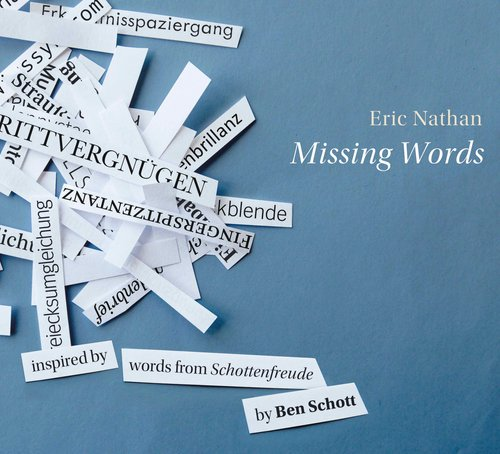
Eric Nathan, Missing Words


Based on the volume I have been listening to with some joy, composer Eric Nathan shows himself to be a Neo-High Modernist of true inventive thrust. The album at hand is the chamber series contained on two CDs and entitled `Missing Words (New Focus Recordings FCR 314 2-CDs).

The idea of the music is that when English fails, one might switch to German, and if that fails, music should step in to give us in poetic clarity the complete thought message. As you listen, or as I did anyway, the programmatic idea lives on in the main as an inspiration for the series of six works. And as you listen you feel a musical narrative that you understand apart from any words.

The six works cover a full gamut of instrumental possibility from cello and piano (Parry and Christopher Karp, respectively) to the Boston Modern Orchestra Project as conducted and directed by Gil Rose. I do not think a blow-by-blow description will substitute for the experience of lingering  within this cornucopia of music--and that is fitting since the idea is that music says what words cannot. In general though keep in mind this is a Modern sort of vocabulary, at times rooted in a sophisticated tonality and then expanding to a more spacious plethora of note relation choices.

What most strikes me about this series of Nathan's works is indeed how fluid, eloquent and assured is each of these works. This to my mind presents a series of works whose importance I suspect will in the years to come be a very memorable part of the music of our time. And it obtains that rather lofty spot in my ears in the most natural of ways. I do recommend this album highly.  It is most original fare, played with poetic assurance. Anyone who values the "new" in New Music should experience delight in hearing these works. By all means check this one out!

Tuesday, January 25, 2022

Sarah Hennies, Spectral Malsconcities, Bearthoven, Bent Duo


Things that are called Experimental Music could be anything these days. So when I saw that as applied to the album Spectral Malsconcities (New World 80824-2) featuring two compositions by Sarah Hennies, I had no definite idea what to expect.

Turns out it is a chamber Minimalism where each work sets out a multi-layered cycle of repetition and development. The title work, Spectral Malsconcities (2018) is scored for piano (Karl Larson), contrabass (Pat Swoboda), and percussion (Matt Evans), the three musicians collectively known as Bearthoven. 

The work has various episodes and densities, but the multiple velocity parts seem especially interesting to me, partly because I myself have worked in this mode. What is fascinating is the way three different rhythmic velocities group together and then lag apart over time. Other sections are deliberately sparse.

So also the second work, Unsettle (2017) scored for  piano (David Friend) and percussion (Bill Soloman). These two artists are known together as Bent Duo. This second piece is even more stark and may be something requiring a bit of patience if you are not accustomed to the more thorough kinds of Minimalism.

And I suspect how you will react to this two-work program will depend upon whether the edgy side of Minimalism appeals to you, interests you and/or stimulates you. If you give "Unsettle" some time it starts to build and sends you to a mesmerized place.

So do not hesitate if the sparse kind of atmosphere appeals to you. This has a kind of conviction to it, born of a kind of good faith phrasing gesture set. It is deeply concentric, quite serious about the musical world it seeks to convey. Listen to the first work and that should tell you what your reaction will be. It is all pretty fascinating as far as I am concerned.


Monday, January 24, 2022

George Walker, Five Piano Sonatas (1953-2003), Steven Beck


I've been listening to New Music for a very long time now and if you mention the name George Walker I remember a few LPs that featured one or more of his compositions. He has or had (1922-2018) his own very expressive way, Modern but his own dynamic choice of notes and space. If you did not know he was African-American would you have guessed from his works?  I do not know about your ears but surely he stands out in general and as somebody worthwhile with or without categories.

There is a new album out and it re-affirms his special musical way. It is his Five Piano Sonatas (1953-2003) (Bridge 9554) with Steven Beck doing a fine job playing all five relatively short works.

Each one is a sort of pithy gem. Each has a nicely chromatic density, and a spatial-aural, articulate and dense tumbling quality that sounds ever fresh and inventive. They spin out of the program in chronological order and at the same time they unfold as a definite relation of continual self-development, all with a special virtuoso quality that comes out of the music rather than causes the outcome, so to speak.

So there we go. This is beautifully involved, strikingly expressive piano music that you who have good ears will understand and love, I hope.


Monday, January 17, 2022

Robert Schumann, The Roots and the Flower, Counterpoint in Bloom, Opus 56 & 60 Organ Music, Jens E. Christensen


The Classical label Our Recordings celebrated its 15th anniversary recently, and I must say they have done some wonderful things in the years I have been reviewing Classical and Modern music (type their name in the index to see my reviews). A recent album of theirs that gives me another reason to rejoice  is called The Roots & The Flower: Counterpoint in Bloom (Our Recordings 6.220675), which in fact is Schumann's organ music Op. 56 & 60 as played with gravitas and heroic liveliness by Jens E. Christensen.

We may sometimes forget that 19th Century composers ordinarily had a good deal of Counterpoint as part of a well-rounded education. No surprise then when we remember Beethoven's Scherzo as the second movement of his 9th. Then of course there was his Grosse Fugue, which is also an amazing achievement regardless of what era we might compare with it.

If these examples readily come to mind, it is less known that Robert Schumann's organ music opus 56 & 60 are master examples of counterpoint as Schumann addressed it. So the 12 deeply ornate examples as we can hear them on this album will no doubt please you who appreciate masterful counterpoint as it sometimes existed happily in the Romantic period.

After a fair number of listens you feel (if you are like me) that Schumann gave us his best here, even if not in any typical way for him. It is the closest thing you'll come to imagine Schumann had he composed in the Baroque era! It is a fascinating and a very rewarding listen, Strongly recommended.


Monday, January 3, 2022

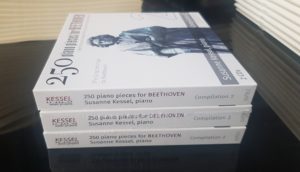
Susanne Kessel, 250 Piano Pieces for Beethoven, Compilation 2


Pianist Susanne Kessel has come up with a wonderful idea to mark Beethoven's 250th birthday. She has sent out the call for living composers of a like mind each to write a short piece for solo piano to celebrate and commemorate this milestone date and in appreciation of the Master. The result is the multi-CD offering 250 Piano Pieces for Beethoven. I covered the first compilation on my March 28, 2017 review post here. It got my attention in all the good ways to do so--lots of interesting homage pieces brilliantly played.

So happily I've been hearing the Compilation 2 (Kessel Sonic Projects ppfB2 2-cds) and also Compilation 3 (review forthcoming).

Compilation 2 is a treasure  trove of some 44 miniatures spanning a hearty 2 hours and 39 minutes. The 44 composers involved in this volume may not be familiar to you. What matters us that each of them give us a Modern creative response to the place of Beethoven in our musical world. 

Some pieces rework and re-situate some well known Beethoven piano works, others paraphrase or resituate an orchestral moment or two. And so in this way each strikes out into its own territory. Some others do so without directly referencing Beethoven but quite positively following Beethoven's expressive muse. There is a wide range of Modern genre affiliations--so a prepared piano work for example, or extended techniques beyond the hands-on-keys standard--some work inside the piano, etc. There is also a Minimalist cast to the odd piece or two, with hypnotic fanfares. They spice up the program and expand its grasp to the virtual whole of our current musical world. Much of the music retains the general tonal framework that of course Beethoven worked within over his composing life. But even s there is no mistaking this music for anything but current-day.

All have in common a very pianistic demeanor and a Beethoven-meets-the-modern world outlook It is a testament to Susanne Kessel's musical-poetic pianism, an extraordinary thing and no doubt something that will very much appeal to the piano centric listener, the Beethoven aficionado and the new music enthusiast. It is a most absorbing program, a great listen, and a real piano tour de force! Bravo!


Thursday, December 23, 2021

Benedict Sheehan, Vespers, Eastern Orthodox Choral Music, The St. Tikhon Choir


This time of year always seems right for choral music--for obvious reasons. And so I am listening to something nicely turned and somewhat unexpected. That is Eastern Orthodox a cappella music for Vespers (Cappella Records CR423SACD) sung quite nicely by the Saint Tikhon Choir. It is the World Premiere recording of the 2021 full settings of Psalms composed by Benedict Sheehan. They are in the tradition of Rachmaninoff's All Night Vigil.

What that means is that Eastern Orthodox chant elements are adapted to a melodic-harmonic later day earful. It is in the tradition and nice to hear.

If you like Eastern Orthodox liturgical vocals you will find this a nice addition. Or even if you do not! Recommended.

Monday, December 20, 2021

Dave Flynn, Irish Minimalism


On some level the Minimalist turn at times has been consonant with hypnotic repetitions in Folk music the world round. With composer Dave Flynn's recent release Irish Minimalism (FHR FHR116) we experience a chamber music that explicitly ties with traditional Irish Folk music and thereby injects a feel and form that both embraces and transcends conventional Minimalism. Of course Irish dance music and song have created a music universe that continues to thrive and was a wide-world influence way long before Minimalism came into the New Music scene.

Dave Flynn manages in this lively CD program to capture the energy, lyrical heft and compelling presence of traditional Irish music at the same time as he injects classical instrumentation and Minimalist flow into the sequencing. There can be a bagpipe like drone and phrasing that straddles folk and classical at times in ways that grab your attention and draw you into its orbit. Some sections are more firmly in Folk territory, some more solidly into a Minimalist sound, but it is nicely shifting, ever shifting.

The music makes use of Classical chamber ensembles (ConTempo Quartet, IMO Quartet, the uilleann pipes of Mick O'Brien and the folk-like vocals of Breanndan Begley. There is variety, variation and freshenings in the four works, variously titled "The Cranning" (String Quartet No. 1) "The Cutting" (Quintet No. 1 for Uilleann Pipes and String Quartet),  "The Keening" (String Quartet No. 3), and "Stories from the Old World" (for Voice, Pipes and Quartet).

In the end if you are like me you welcome the rightness and musicality of the hybrid and are glad for Dave Flynn's imaginative music. Recommended if the title intrigues you, for that is exactly what you get in nice ways. It all works together happily. Bravo!