With all the world of music unfolding today we are sometimes as in a maelstrom, a storm of creative effort amidst a sea of unprecedented developments. If trying circumstances can lead to great music, as is the case for example with some gem symphonies that came out of World War II, should we expect the same today? Things seem promising and a fruit of that we hear in the recent music of John Williams, known by many for his expressive and effective film scores, but showing a somewhat more adventuresome and wayward inventive and orchestrational singularity in his concerted works. We can hear that nicely in the recent recording of his Violin Concerto No. 2 (DGG 80035442-02) as played so beautifully by violin titan Anne-Sophie Mutter and the Boston Symphony Orchestra under the composer.
Modern classical and avant garde concert music of the 20th and 21st centuries forms the primary focus of this blog. It is hoped that through the discussions a picture will emerge of modern music, its heritage, and what it means for us.
Search This Blog
Tuesday, August 23, 2022
John Williams, Violin Concerto No. 2, Anne-Sophie Mutter, Boston Symphony Orchestra
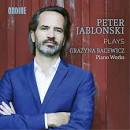
Grazyna Bacewicz, Peter Jablonski Plays Bacewicz Piano Works
The gradually unfolding appreciation of Polish composer Grazyna Bacewicz (1909-1969) continues apace, at least here in the States. There is another enlightening release I have been catching up with lately with no small amount of...delight I guess the word is. It is an album masterfully navigated by Peter Jablonski, entitled Peter Jablonski Plays Grazyna Bacewicz Piano Works (Ondine ODE 1899).
It affirms further that Bacewicz is a genuine voice of last century Polish Modernism in some compelling, advanced harmonic and melodic ways, another way to get beyond the late Romantic gush of pianism to be heard in somebody like Scriabin. I don't mean to over simplify but she manages to sound a clarion call to Eastern European musicways, a bidding to express the present in her very own way, not to lose sight of folk roots and necessarily then to open to the alternation and conjoining of the complex with the simple. But in ever inventive flow with a remarkable ease and fluidity.
So as we gradually absorb and appreciate it all, we get to hear her "Concert Krakowiak" (1949), "Ten Concert Etudes" (1956-57), "Two Etudes On Double Notes" (1955), "Piano Sonata No. 1" (1949) and "Piano Sonata No. 2" (1953).
All these works have undiluted presence and Peter Jablonski brings each one to life with care, enthusiasm, feeling, and formfulness.
I heartily recommend this one for reasons that I hope are clear. Jablonski triumphs and helps us appreciate the ultra-musical pianism of Bacewicz at her best.
Thursday, August 18, 2022
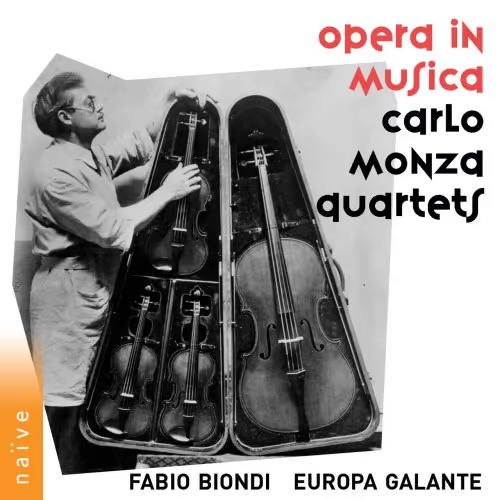
Carlo Monza Quartets, Opera in Musica, Fabio Biondi, Europa Galante
What we still can know anew can startle. So it turns out composer Carlo Monza (1735-1801) is something rewarding to hear, certainly as played so well by Fabio Biondi and the quartet Europa Galante doing a fine thing on the release Opera in Musica: Carlo Monza Quartets (naive CP SPPF V7541).
These quartets, some six in all, are bright, sparkling with brio and depth as realized by these talented players. It is an early Classical kind of confection, not stickily sweet but sincerely, pointedly bristling and bubbling. Violinist Bondi puts it plainly in the liners, "Monza's music is characteristic of the late eighteenth century, with delightful themes, varied moods and a gallant tone."
Doubtless when you awoke this morning you had no idea you'd wonder about this Carlo Monza, But seriously if you want something unexpectedly charming, beautifully played, you will no doubt find this most appealing as I did. Get it, hear it, let it grow on you.
Wednesday, August 17, 2022
Carolin Widmann, L'Aurore, Music for Solo Violin, Music by Ysay, Benjamin, Hildegard of Bingen, Enesu, Bach
Music for solo string instruments seems to be surging in popularity and frequency of performance like perhaps never before. In the past few weeks I have covered several albums partly or solely devoted to such things. So today once more. This time it is an all-solo album put across with wonderful spirit and microscopic nuance by Carolin Widmann, whose excellent playing we have appreciated several times before on here--type her name in the search box above for those review articles.
The album at hand is evocatively entitled L'Aurore (ECM New Series 2709). In it we are treated to some six nicely contrasting, skyfully filled works. The program begins with a short, tenderly meditative working of a piece by the pioneering early music composer Hildegard of Bingen, as realized for solo violin. It is later reprised to dramatic effect. The Ysaye Sonata No. 5 is playful and intimate, thanks especially to Carolin's ecstatic and virtuoso reading. George Benjamin (b. 1960) and his "Three Miniatures" gives us an Expessionistic clangorousness that is a delight to hear in Ms. Widmann's hands. Equally essential is Georges Enescu's "Fantasie Concertante" with its characteristic verve and concentrated line spelling artfulness.
The finale is the spectacularly singing and heartful lyricism of Widmann's triumphant performance of Bach's Partita No. 2, one of the most interesting and satisfying versions I have had the pleasure to hear.
And that is the sum of it, a wonderful offering that affirms Carolin Widmann's place as one of the most singular and accomplished violin soloist alive. I recommend this with no reservations. It is a delight from start to finish.,
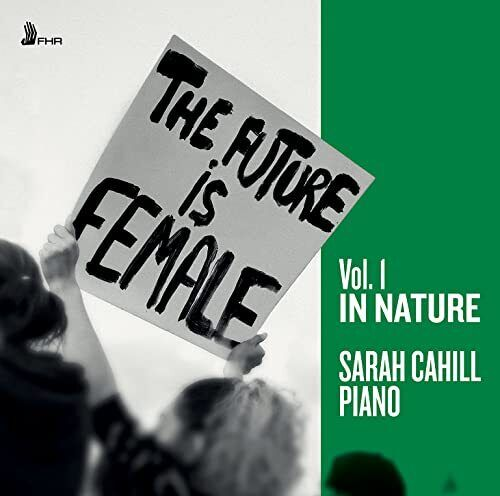
Sarah Cahill, The Future is Female, Vol. 1 In Nature, Piano Music by Women Composers
Of all the music I have listened to over the years, there were at first few female composers recorded who wrote for the solo piano. In years gone by, the emphasis of course originally was of the dominant male composers over time, and of course there was plenty to appreciate as there still is. On the other hand the musical lifeways as expressed in recordings and performances has gradually turned as the world view changed to consider women and their contributions, to resurrect or uncover the talent and achievements of women, even if many were not given the attention of their male counterparts when they lived or until recently.
All that of course has changed and we now have many worthy woman composers to appreciate in the contemporary world but also historically. As a welcome aspect of such things pianist Sarah Cahill has embarked on an ambitious multi-volume set of relevant piano works which are apparently available as a set but now also coming out on individual CDs as well. The project as a whole is entitled The Future is Female and the first installment I have been listening to and I consider here is entitled Volume 1: In Nature (FHR 131).
On this initial volume we are treated to some 16 compositions by women hailing back as early as the 18th century through to today. Ms. Cahill approaches each work with care and sympathy, and not some little amount of flair.
The list of composers is largely unknown or little known to me, but the works themselves bear intense scrutiny, opening up new worlds for those eager for more of such fare. The composers included bears presenting, to give you an idea of the persons involved and when they lived. So we have the music of Anna Bon (1739/40-after 1767), Fanny Mendelssohn-Hensel (1805-1847), Teresa Carreno (1853-1917), Lookadiya Kashperova (1872-1940), Fannie Charles Dillon (1891-1947), Vitezslava Kapralova (1915-1940), Agi Jambor (1909-1997), Evo Beglarian (1958- ), Deirdre Gribbin (1967- ), Mary D. Watkins (1939- ).
So all that as you give it some good listens stands out as well worth hearing and having. The music runs the gamut from early Classical through Modern and beyond. Very good music, very well performed. I thoroughly recommend it for those who find the idea interesting. It is all one could hope for and more besides.
Tuesday, August 16, 2022
Martin Matalon, Formas del Tiempo, Elena Klionsky, Piano
Free Jazz master Ornette Coleman once quipped that "there is no bad music, just bad musicians." If you know his music and the whole idea of a Jazz freedom, you can understand where he was coming from, but is it true of other musics, too? Well there is much to be said about the virtues of a great performance, but then the music still lurks in its repository on music paper or for folk etc. in folk memory, and of course there is a long tradition of individual rankings of works, for better or ill.
Today's music offering does not stand or fall on the performances, but they are absolutely key nonetheless. It is an album of compositions by Martin Matalon (b 1958), featuring the pianism of Elena Klionsky. It is a compendium of some four piano-centered compositions, the program as a whole given the title Formas del Tiempo (MSR Classics MS 1789).
The instrumentation goes between solo piano and more, for example "Artificios" for solo piano (2014), "Dos Formas del Tiempo" for solo piano (2000), "La Makina" for two pianos, two percussionists and electronics (2007), and finally "Trame IV - Concerto for Piano and Eleven Instruments" (2001).
All performers and performances are top notch, with Ms. Klionsky holding forth heroically and magically, with Salome Jordania taking the second piano part with a real flair as needed, with the New Juilliard Ensemble under Joel Sachs doing a great job in the chamber orchestral mode as needed, and finally with strong percussion appearances by Eve Payeur and Julien Macedo as called for, and intelligent electronics by David Adamcyck.
The piano parts are virtuostic and High Modern in the most thoroughgoing ways, with clusters, momentum, space travelling and full throttled expresson. All four works bring to us very effective and atmospheric cosmic projecting in ways that make us want to hear it all again and again. I will not try and describe in detail the sequence of each work as it is probably more rewarding just to listen. All four pieces have an original yet admirably Modernist thrust that triumphs thanks to the excellent performances by Elena Klionsky and company. Bravo!
Thursday, August 11, 2022
Gity Razaz, The Strange Highway
For today's music post we have a very moving and dynamic Gity Razaz (b 1986) and her album of compositions entitled The Strange Highway (BIS 2634 CD). She was born in Tehran and came west to pursue her classical compositional aspirations.
The results are this very personal, Expressionist-Modern compendium of some five varied but consistently compelling works. It is a sort of program that rewards when you open up to it. And by its very special waywardness its ability not to conform but to reaffirm the newness of the new, we all might gain something worthwhile by letting it play!
"The Strange Highway" (2011) begins the program by giving us a deeply dramatic minor-chromatic journey for cello octet that is of a kind of soundscaped expansiveness that marks it of today yet also calls the ancient muses in its dramatic sweep. The musico-logical and chronological bookend to the opener is the closer, the dramatically extended reverie "Metamorphosis of Narcissus" (2011) for chamber orchestra and fixed electronics. It has a truly expressive chromatic depth that beautifully closes the entire sequence.
In between the bookends is a series of some three works featuring a Modern rhapsodic take on string instruments--the 2007 "Duo" for cello and piano, the 2015 "Legend of Sigh" for cello, pre-recorded cello and electronics, and then the 2020 soliloquy "Spellbound" for solo viola.
There is a good deal of dramatic flourish and thoughtful line weaving throughout. There is a special originality from start to finish, a markedly idiomatic set of parts, and thanks to the well hewn performances we get to hear this music with admirable fidelity it would seem to the composer's vision. In the end I for one look forward to hearing more of Razaz's music. This one has a real presence that reminds us how far we have come but then how much more music is possible going forward. Good things here and I heartily recommend it all to you.