Search This Blog

Monday, January 30, 2017

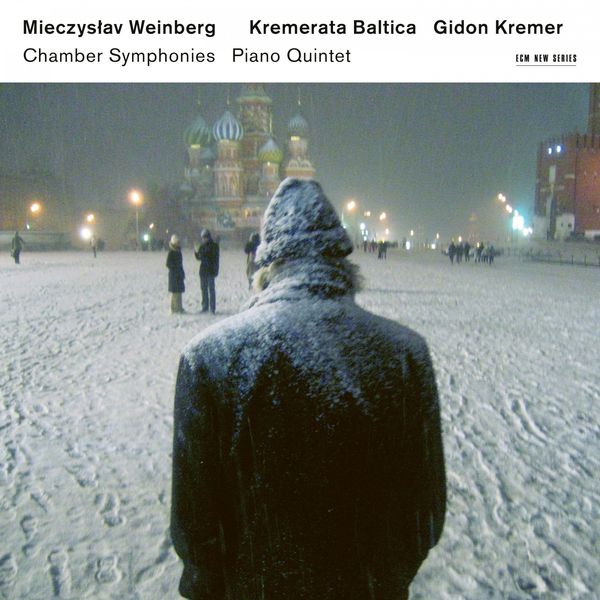
Mieczyslav Weinberg, Chamber Symphonies, Kremerata Baltica, Gidon Kremer

The remarkable surgency of the music of Mieczyslav Weinberg (1919-1996) continues very encouragingly. Today we have an exceptional 2-CD set by Gidon Kremer and Kremerata Baltica (ECM New Series 2538/39) that includes the later period Chamber Symphonies and an orchestration of the 1944 Piano Quintet.

This is a set of great beauty, thanks to the assured helmsmanship of Kremer, the finely contoured string parts by Kremerata Baltica and the soloists and their obvious sympathy and enthusiasm, and the exceptionally detailed soundstaging of Manfred Eicher.

The four Chamber Symphonies are some of Weinberg's most compelling forays into an unending flow of melodic-harmonic originality. They were written between 1986 and 1992, a time when he was able to compose without the threat of being labeled anti-realist and elitist that the Stalin era often enough hurled at Russia's greatest composers, to the peril of the music and their lives. Yet too the 1944 Piano Quintet, heard here in the aptly orchestrated version by Kremer and Andrei Pushkarev, manages to ring out in characteristic Weinberg fashion.

If you seek a single release to introduce yourself to Weinberg's music, I would recommend this one without hesitation. For those already initiated this is nevertheless primo Weinberg in the excellence of performances, the brilliance of  the works themselves and the superlative sound. A landmark release!

Kremerata Baltica is touring the US and Canada through February 10 in a program that includes Weinberg's "Chamber Symphony No. 4." Google Kremerata for details on dates and locations.

Friday, January 27, 2017

C.P.E. Bach, Organ Sonatas, Iain Quinn


If Johann Sebastian Bach's organ music was the sound of God, C.P.E.Bach's was more properly the sound of humanity. The fugues and toccatas of father Johann exuded a heavenly mystery; son C.P.E kept closer to earth; Johann's organ swells were a mighty roar, some of the loudest music on earth at the time; C.P.E.'s Organ Sonatas (Naxos 8.573424) had a chamber intimacy.

I've lived with these sonatas since young adulthood, on an old Arion LP by I do not remember whom. The perfomances had a classical balance and sprightly quality that I hear again happily in the new Naxos recording by Iain Quinn. We get the Sonatas H. 135, H. 85-87, and H. 134. These were written for Frederick the Great's sister Princess Anna Amalia during Bach's tenure as court composer and instrumentalist for the music-loving king.

They reflect a less-than-virtuoso ability that C.P.E. had on the organ as compared with his father (C.P.E. was more a master of the clavichord). But then again they have a beautifully ornate, lyrically robust approach that mark them as charming and uniquely memorable.

Iain Quinn gives us performances that do full justice to the music's fine architecture and lyricism.

Worth every penny at the Naxos price and a significant addition to your library.

Thursday, January 26, 2017

Adam Schoenberg, American Symphony, Kansas City Symphony, Michael Stern


Is Adam Schoenberg the American Sibelius? Maybe. I haven't heard such ravishingly beautiful, unabashed orchestral lyricism since the Finnish master put notes to paper. That is, on Adam's new album of works American Symphony - Finding Rothko - Picture Studies (Reference RR-139 SACD).

The Kansas City Orchestra under Michael Stern gives us its fully concentrated, fully idiomatic readings of the program. They seem ideally dedicated to bringing out the music's broadly bright sonarities and subtly powerful climaxes.

There is more modernism to be heard in this music, some spicy dissonances and rhythmically exotic moments well placed amidst the poetic shimmer. And surely Schoenberg is not in any way out to copy Sibelius's unique style. But it all comes out with such a gloriously gentle and alternatingly uproarish rapture, that we experience after a few listens something akin to what we feel after hearing a mature Sibelius symphony, or perhaps Copland's glowing "Appalachian Spring."

And each work does have programmatic elements: the pastoral Americana of the symphony, the color affinities of "Finding Rothko," the art and pictorial references of the movements in "Picture Studies."

Here is a modern music that anybody might find beautiful. It has the ability to remain very approachable for almost anyone's ears. And yet there is a great deal of innovative brilliance of substance in every bar. That is rare and I might go as far to say that Adam Schoenberg is headed for a career of wide acclaim.

Hear this music by all means. It is sorely needed in our troubled times!

Wednesday, January 25, 2017

Shostakovich, Violin Concertos 1 & 2, Frank Peter Zimmermann, NDR Elbphilharmonic Orchester, Alan Gilbert

Some or many of the greatest composers, modern or otherwise, have left us a legacy via a significant body of works, numerous enough that it takes considerable time to absorb and digest the sum total of their creative career. With others there may be less  for whatever reason. Dmitri Shostakovich is a composer of the former type. He left for us a daunting corpus of symphonies, operas, string quartets and other chamber works, solo piano works and concertos. Getting to know well the salient features of his output can take a lifetime.

His Violin Concertos 1 & 2 (BIS 2247), now in a new recording by violin master Frank Peter Zimmermann along with the NDR Elbphilharmonie Orchester under Alan Gilbert, are some of the must-know works.  The moodiness of the first contrasts with the section devoted to a frenzied Jewish folk dance. Zimmermann gives us an appropriately striking contrast between the two moods which are seconded in the orchestral parts, played with a zeal that matches the solo line. This version gives us an especially good bead on the frenzy, the best I've heard.

The second concerto is filled with adagios of great beauty and a less frenetic Allegro finale. And once again Zimmermann and company are up to the challenge.

In both concertos the cadenzas are spectacular in Zimmermann's hands.

All in all great works in high definition sound, played with definitive gusto and depth of feeling. If you don't have these concertos this is a version I'd definitely recommend. Those who are devoted to these concertos will also benefit much from these ultra-contemporary readings. Zimmermann has an unsentimental and very kinetic approach that Gilbert reinforces for some pretty extraordinarily moving and exciting fare.

Strongly recommended.

Tuesday, January 24, 2017

Steve Reich, Double Sextet / Radio Rewrite, Ensemble Signal, Brad Lubman

Here we have another nice one to celebrate Steve Reich's 80th birthday year, namely Ensemble Signal's personal take on two Reich perennials, Double Sextet / Radio Rewrite (Harmonia Mundi 907671). The "Double Sextet" dates from 2007, "Radio" from 2012.  Both works reassert Reich's rhythmic centrality while giving the harmonic-melodic subtleties of his later period a somewhat more secondary role.

Ensemble Signal and conductor Brad Lubman are very much in their element for both works. They relish the driving pulsations and pronounced accentuations of the works to give us a fully satisfying take on these gems.

As usual Reich never allows himself a banal phrase in these, and at the same time every phrase bears the stamp of his original musical identity. As always, a superior inventive brilliance distinguishes Reich from some of his colleagues and imitators. These infectiously joyful performances are a timely reminder of just why he is the most important of the so-called minimalists. Happy birthday Maestro Reich!

Monday, January 23, 2017

Debussy, Four-Hand Piano Music 2, Jean-Pierre Armengaud, Olivier Chauzu

The world is still reeling thanks to the brilliance of Debussy (1862-1918) (and for that matter, Ravel). He (they) made a decisive step away from romanticism to create a modern music that presented sophisticated, evolved harmonic directions that are still with us as an assumption whenever tonality is addressed. But Debussy also had a vision of melodic form that was embedded in the richly expanded harmonic images and subjected to a pristine poeticism. Finally he took his cue from the French composers of his time to make orchestra color something ever more evolved. His orchestrations were glorious realizations of the timbral possibilities of the instruments of the modern symphony orchestra in all their various combinations, making a clean break from the strings versus other instruments that was generally so much a part of the orchestral aportionment from at least as far back as Haydn's time.

The music was dubbed "impressionism" and indeed there was some relation between the music and the way painters like Monet handled paint color and texture. And like the impressionists in the visual arts the way was paved for a world where the materials were freed from accepted conventions of a literal depiction to a new reality, a new combination and conversation between color and timbre, which of course the modern musical world drew upon, Varese through Messiaen and many others, to create the music of today.

But Debussy was more than just an important pioneer in the creation of modernity, he was also of course the creator of a body of works that gained the enthusiasm and love of listeners from his lifetime onwards.

This perhaps is a long digression from the CD at hand today, but it is critical as a background for why the current CD is revelatory. OK, so we have a second volume of Debussy's Four-Handed Piano Music (Naxos 8.573463), as played with strength and grace by pianists Jean-Pierre Armengaud and Olivier Chauzu. I have not heard the first volume but I assume what I say is true of that volume as well.

The four-hand piano versions of the works presented here in Volume Two are arrangements of some of the seminal orchestral works, "Prelude a l'Apres-midi d'un faune" as arranged by Ravel, "La Mer," as arranged by Debussy, and "Images" as arranged by Caplet. All  three are justly celebrated in their orchestral versions for the brilliance of their orchestrations, and the sound is so vivid in the original versions that we may pay less attention to the strictly musical--harmonic, melodic, rhythmic--qualities of the works.

The four-hand versions of course strip away all orchestral color and substitute it with pure pianism, in the process allowing us to hear clearly the very progressive harmonic-melodic substance of the works, which was quite radical for the period and comes to us in a concentrated form so we can hear it all as if for the first time. "Afternoon of a Faun" (1894) begins the program, and it certainly sounds more daring in this version today than we perhaps have heard so many times in its fully orchestrated version, where the sensuous properties of the orchestration distract us or more properly direct us to the dazzling color of the timbres.

And so it goes for the rest of the music heard here. In the end, I feel as if I have entered another musical world, where I can contemplate the advanced fundamentals of the notes themselves.

The duo plays all with a gracious poetic sense.

So for all the reasons given I do not hesitate to recommend this volume highly. It will give you a new look at the brilliance of Debussy.
Friday, January 20, 2017

Garrido-Lecca, Peruvian Suite, Norwegian Radio Sym, Ft Worth Sym Orch, Miguel Harth-Bedoya

Living Peruvian composers are not well-known to me, so when a volume of orchestral music by Celso Garrido-Lecca (b. 1926) came out lately, I jumped at the chance to hear it. Peruvian Suite (Naxos 8.573759)  includes the title suite and three others, written between 1980 and 1994.  The Forth Worth Symphony does the performance honors for one of the suites, the Norwegian Radio Orchestra for the rest, all  under the capable hands of conductor Miguel Harth-Bedoya. He and the orchestras provide colorful, energized readings that seem right for the scores.

Garrido-Lecca as heard in these works is vividly depictive and often Peruvian folk oriented more so than he is always modernistic. He is a good orchestrator and a master of contrasting sections that can be balladic or dance-like according to the needs of the moment. "Andean Folk Dances" begins the program with kinetically moving sections contrasting with more introspective ones. "Symphonic Tableaux" continues the mood with more ambitiously complex rhythmic movement.

"Peruvian Suite" is meant to explore the diversity of Peruvian folk elements. It does so succinctly, skillfully and rather delightfully..

The final suite "Laudes II" musically represents the thinking of Chinese Taoist Lao-Tzu. The work expresses the idea that "the Tao that can be spoken is not the eternal Tao, the name that can be named is not the eternal name."  The music is accordingly somewhat ineffable but remains filled with vibrant color in the later Garrido-Lecca manner. The final movement with its extroverted reed, horn and trumpet passages is exciting, while the other movements are abstracted and mysterious or questioning. It is a more strictly modernistic version of the composer and the most satisfyingly original of the program for me.

Is Garrido-Lecca the Peruvian Copland? It is not entirely out of the question. We have four world premiere recordings that give us a good idea of his inventive skills. Anyone with an interest in what is going on in South America in the present day will be rewarded with one good answer. It supplies some fine listening in any case.