Search This Blog

Tuesday, November 8, 2011

Azerbaijani Piano Concertos, Royal Philharmonic Orchestra and Soloists


The modern concert music of Azerbaijan does not often find its way to the west. There was a recent Naxos disk of the music of Amirov (see my review posting of April 9, 2010 at gapplegatemusicreview.
blogspot.com) and a few others, but not much else that I know of.

So the present release Azerbaijani Piano Concertos (Naxos 8.572666) is most welcome. It's the Royal Philharmonic Orchestra under Dmitry Yablonsky, with alternating piano soloists F. Badalbeyli and M. Adigezalzade, working their way through two full concertos and three shorter pieces.

The music reflects the cultural influences to be felt in the region in the 20th and 21st centuries. Much of it has an appealing minor tonality that is part of the heritage of eastern/mideastern traditional music, but there is also a Tchaikovskian-Rachmaninovian strain to be heard and in some pieces the influences of early modernity. Amirov and Nazirova's "Concerto After Arabian Themes" (1957) has much of the romantic-meets-mid-eastern flavor alluded to above. Adigezalov's Concerto No. 4 (1994) continues in that vein with a bit more modern elements. The three shorter, single-movement works are pleasing, with Guliyev's "Gaytagi" (1958/1980) generating the most excitement.

It is a collection of music that doesn't hit home as world-class singularity. It does give you an interesting view of what some Azerbaijani composers have been doing. And the performances are good. Those who like a little exoticism will find it here.

Friday, November 4, 2011

Andras Schiff Plays Robert Schumann's Piano Music on "Geistervariationen"


Robert Schumann is not a modern composer, obviously. But I include this recording on the blog today because it involves high-romantic pianism played with the sort of renewed attention to the notes and phrasing that sounds modern. Pianist Andras Schiff plays some of Schumann's most ambitious and moving solo piano works on Geistervariationen (ECM New Series 2-CDs B0016115-02) in such a way that you hear clearly the phrasing and fully realized note values that Schumann intended. Truth be told, I have heard many performances of these works where the sustain pedal and an overarching dash of passion make up for lack of precision. Andras Schiff brings the MUSIC to our ears minus the overwrought expression, though his playing does not lack warmth and drive, and with the keen architectural attention to detail that allows us to hear the melodic-harmonic brilliance of the music.

It's a double CD with plenty of room for many of Schumann's best works, "Papillons," the C Major Fantasy, the Opus 11 Piano Sonata, Kinderszenen, Waldszenen and his final work, the Geistervariationem.

Andras Schiff is a remarkable pianist. Listening to this set, it is as if you are hearing these pieces for the first time. Highly recommended--even for those who are not confirmed Schumann-lovers.

Thursday, November 3, 2011

Toshio Hosokawa, "Landscapes," for Chamber Orchestra and Sho


The Munich Chamber Orchestra under Alexander Liebreich and Mayumi Miyata on the Japanese mouth organ, the sho, tackle four compelling Toshio Hosokawa compositions spanning the last two decades on Landscapes (ECM New Series B0016073-02). "Cloud and Light" (2008), "Sakura fur Otto Tomek" (2008) "Ceremonial Dance" (2000), and "Landscape V" (1993), are given lingeringly detailed interpretations.

Hosokawa's music combines the long sounds of Japanese ancient ceremonial Gagaku music and other traditional forms with the modern sound-coloristic, soundscape approaches that are an important aspect of contemporary concert music. It all works convincingly and movingly on Landscapes. Based on this program Hosokowa stands alongside Takemitsu, Mayuzumi and Ishii as an important modern Japanese composer who works with tradition in innovative ways.

It is music to contemplate, linger over, revel in. It is a very excellent example of the vital compatibility of tradition and modernism in the contemporary music world. Hosokawa shows us as he puts forward this series of tone-essays that, under the masterfully sensitive baton of Alexander Liebreich, his music is one of the most convincing new developments in modern concert music in this decade. By all means give it a listen!

Monday, October 31, 2011

The Pacifica Quartet: String Quartets by Dimitri Shostakovitch and His Contemporaries (The Soviet Experience, Volume 1)


Bela Bartok and Dmitri Shostakovitch created a series of string quartets that hold their own today as singular masterpieces of that genre in the 20th Century. There are others too, of course. But nowhere else is the sublimity of the late Beethoven quartets so rivaled.

There is a new recording of the middle-period Shostakovitch quartets (nos. 6-8 of the 15 total) The Soviet Experience, Volume One (Cedille, 2-CDs 90000 127). The Pacifica Quartet play these and, for good measure, Miaskovsky's Quartet No. 13. The title of this set is understandable, yet perhaps a bit ironic. Stalin and his Social Realist minions hounded Shostakovitch through the bulk of his career for his modernism, which they deemed bourgeois and "formalist". Time and again in his more publicly visible symphonic and operatic premiers he was taken to task. Seemingly with the Quartets he defiantly proceeded to develop the music as he saw fit. And perhaps because the quartet premiers were less a public occasion the apparachniks had less to say about who could play them and when. In any case this music exists almost in spite of the "Soviet Experience," so the title is not a straightforward one.

What counts however is the music and its performance. The Pacifica Quartet do a marvelous job to bring out the excitement of the brio passages and the contemplative, tender sadness of the slower movements. This is a very fine performance of these quartets, one of the best I've heard, if not THE best. The Miaskovsky No. 13 is well played too. It may not be quite at the level of the Shostavovitch works but it sets them off well and provides an interesting contrast.

I hope the Pacifica Quartet go on to record the rest of the Shostakovitch cycle. For now we can be thankful that this recording of the middle works is with us. It is a must-hear!

Friday, October 28, 2011

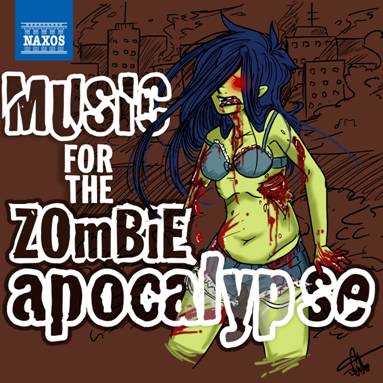
Music For The Zombie Apocalypse: Naxos' Gothic, Macabre and Chilling Anthology for Halloween and After


I generally shy away from anthologies with a particular theme. If it has an interesting mix that sets a theme off well, however, I take notice. Such an item is Naxos of America's Music For The Zombie Apocalypse, a rather bizarre mix of gothic dark side medieval-to-romantic classic gems and modern avant-eerieness, well suited to a zombie inferno and so a great choice for scaring the heck out of trick-or-treaters or putting the psycho-frosting on your Halloween party cake.

What's interesting and fun about this particular set (which runs almost two-hours time) is that it avoids the classical cliches of the season to dig deeper into the death-in-life zombie horror possibilities in the repertoire. Fune-orial requiem excerpts from Faure, Berlioz & Mozart, chant, minor-mode glass harmonica other-worldly-ness and haunted early-music counterpoint mix with the avant horror latent in works by Penderecki, Part, Schnittke, Gorecki, Varese and Lutoslawski.

Right now you can grab this one as a fine-sounding download at a great price. This Spring it will be out as a CD. Check the Naxos link for more info. I whole-heartedly. . . but wait, I am missing my internal organs, arghghghghg!!! ....I most certainly recommend you give yourself a fine set of nitemares with this set!! It's different enough that you can raise the hair on the back of many necks with it. Happy Halloween!

Thursday, October 27, 2011

Johann Wolfgang von Goethe, Faust (Abridged), Naxos Audiobook


Goethe's Faust has had a huge impact on both musical culture and the Western legacy at large. So it seems fitting that we mention a rather wonderful dramatic enactment of the work on a new Naxos Audiobook (0068). It's abridged, which is a fine thing since a full version would last a veritable eternity. In effect Naxos Audiobooks has done for Faust what some of the classic London recordings of the '60s did for opera. It conceives of the soundstage and special potential of the modern recorded medium and how they can heighten appreciation for the work in ways that the stage or the book format cannot.

So this production has very well conceived sound effects, music, voice alteration and excellent dramatic recitation by the actor-reciters. Listen straight through and you get a vivid experience of the Faust drama in ways you would not get in any other form. The English translation is melifluous and not stilted, and the recitation is terrific.

Anyone who has appreciated the various settings of Faust by Gounod, Berlioz, Schumann, etc., will revel in the full drama enacted in the spirit Goethe intended.

Of course this is a long work even in its abridged form. The ideal way to experience it first hand is in this audiobook. It makes what could easily be a bit of an ordeal an exciting and sonorously delightful experience, if you are a person of some patience.

Highly recommended. Paste this URL in your browser window to find out more or order a copy for yourself: http://www.naxosaudiobooks.com/0068.htm

Wednesday, October 26, 2011

Busoni, Doktor Faust: Sir Adrian Boult and a Stellar Cast Do A Bang-Up Job in This Historic Recording


Ferruccio Busoni (1866-1924) was a key transitional composer who bridged the gulf that opened between the romantic and modern-expressionist schools. His piano pieces are revered by connoisseurs. Then there is a major opera, Doktor Faust, left nearly finished at his death in 1924.

Noted conductor Sir Adrian Boult put together an abridged concert version of the work for BBC and recorded it in 1959 with the London Philharmonic Orchestra/Choir and an impressive cast of Dietrich Fischer-Dieskau, Richard Lewis, Ian Wallace, Heather Harper and John Cameron. The recording, fitting one disk at 74 minutes length, has been issued recently (LPO 0056).

It's a work of definite merit, with plenty of dramatic scoring and vocal presence. Boult and cast do a great job building the case for the opera as a fully worthy modern masterwork. The performance here is surely one of the very best on disk. One quibble: there is no libretto included. Of course nowadays one can readily find such things on the internet. Nonetheless it is a shame that it was omitted. Aside from this, though, Boult's version is a real winner!