John A. Carollo. His time has come it seems to me. Nowhere more do you get that feeling than when listening to the fine recording of his Symphony No. 3 (Navona 6250). The London Symphony Orchestra under Miram Vaupotic do an excellent job bringing to us the specifics, the poetics of this work. It is a 30-minute opus in four movements, completed in 2017.
And it shows Carollo once again in a fine light--places him as undoubtedly one of the US composers who is making the present a time to remember musically. The final movement "Let the Evening Stillness Arouse" reminds us that all along there has been present in the music John's gift of creating a beautifully evocative world, not as Copland but as Corollo, very local in the best ways, yet Modern in the tradition without necessarily self-consciously seeking beyond what falls naturally out of his pen, if I intuit the inventions properly. The first movement "To Morning" begins with an equally natural dedicative lyricism, giving the work proverbial bookends, while the middle movements are posied and poised, slightly playful yet serious at the same time. A great thing that is, surely.
This is tonal yet tough and edgy enough to identify it all as post-what is gone and pre-what is to come. And original it is. Very.
The four movements speak in contrasting and heartfelt ways. It is an important work, I think. I have been listening and covering happily his music on these pages nearly from the very beginning of the blog. And if there is one work that tells us what we need to hear if one could only put our ears initially to one, this one is it.
Recommended strongly for those wishing to understand the US present day Modernism, for those wishing to know Carollo the composer, for anyone looking for new music of noteful valor and lyricism!
.
Modern classical and avant garde concert music of the 20th and 21st centuries forms the primary focus of this blog. It is hoped that through the discussions a picture will emerge of modern music, its heritage, and what it means for us.
Search This Blog
Monday, October 7, 2019
Friday, October 4, 2019
George Perle, Serenades, Boston Modern Orchestral Project, Gil Rose
The more time and releases go by the more impressive to me becomes the Boston Modern Orchestra Project (BMOP), an American composer-New Music oriented series of great excellence and good sense of need to fill out the recent history of the genre and give us much worthy to appreciate.
Director-conductor Gil Rose and the orchestra keep coming up with very timely and impeccably created releases, no less so today with composer George Perle (1915-2009) and his Serenades (BMOP 1067).
My first exposure to the music of Perle came back in a New Music concert in Manhattan in 1972. I have been glad to hear his music ever since. The three Serenades presented on this CD were written between 1962 and 1968 and form a prime Perle for sure.
The first is for viola and chamber orchestra with Wenting Kang doing wonderful things with the solo part. No 3 is for piano and chamber orchestra and Donald Berman gives us power and poetics at the piano helm. No 2 is for eleven players equally.
All have a beautiful unraveling about them, thoroughly High Modern in their attention to advanced harmonic-melodic tonality at the edge and the inventive levels are as high as the wonder of the orchestration sureness. This was a Master.
In the liners there is a poignant passage where Perle expresses his need for authenticity, as part of a tradition, and that is of the legacy of Modernism and all that has led to it I suppose. You listen to this music and the fine performances and there is no doubt that he is of his world, but originally so as well as anyone. Listen to the long and winding piano run in the penultimate movement of the Third Serenade and you will have no doubt of Perle's centrality to things now. He embodies tradition but he is also a tradition now, someone to respect, emulate, listen to closely.
I do recommend this highly to all Moderns and those who wonder about Modern folks as well. Perle is essential on this one and BMOP give us exemplary performances. Bravo!
Director-conductor Gil Rose and the orchestra keep coming up with very timely and impeccably created releases, no less so today with composer George Perle (1915-2009) and his Serenades (BMOP 1067).
My first exposure to the music of Perle came back in a New Music concert in Manhattan in 1972. I have been glad to hear his music ever since. The three Serenades presented on this CD were written between 1962 and 1968 and form a prime Perle for sure.
The first is for viola and chamber orchestra with Wenting Kang doing wonderful things with the solo part. No 3 is for piano and chamber orchestra and Donald Berman gives us power and poetics at the piano helm. No 2 is for eleven players equally.
All have a beautiful unraveling about them, thoroughly High Modern in their attention to advanced harmonic-melodic tonality at the edge and the inventive levels are as high as the wonder of the orchestration sureness. This was a Master.
In the liners there is a poignant passage where Perle expresses his need for authenticity, as part of a tradition, and that is of the legacy of Modernism and all that has led to it I suppose. You listen to this music and the fine performances and there is no doubt that he is of his world, but originally so as well as anyone. Listen to the long and winding piano run in the penultimate movement of the Third Serenade and you will have no doubt of Perle's centrality to things now. He embodies tradition but he is also a tradition now, someone to respect, emulate, listen to closely.
I do recommend this highly to all Moderns and those who wonder about Modern folks as well. Perle is essential on this one and BMOP give us exemplary performances. Bravo!
Thursday, October 3, 2019
Bach In Transcription, Jean Alexis Smith
The phenomena of the Bach transcription for piano rose up brightly and prominently in the 1800s with Liszt and has been a factor, a happy thing ever since. Now pianist Jean Alexis Smith brings to us some of the most worthy of such endeavors on Bach in Transcription (MSR Classics 1720). That Bach himself was an avid transcriber reminds us that the practice goes far back, but the Bach craze in many ways started in the late classical-early romantic era and hence we gauge from there.
There are all kinds of goodies on this collection, and it is a definite plus to have all ten works as played quite respectfully well by Ms. Smith. We get Busoni's celebrated transcription of "Toccata in C Major," Ignaz Friedman's "My Heart Ever Faithful," Harold Bauer's "The Soul Rests in Jesus' Hands," Busoni's "Adagio in A minor," Liszt's "Prelude and Fugue in A minor," Alexander Siloti's "Prelude in B minor," Leopold Godowsky's "Adagio in C Major," Busoni's "I Call Unto Thee Oh Lord," and finally Grainger's "Blithe Bells (Sheep May Safely Graze)."
The effect of so much "additional" piano Bach is like a surprise present on a day when you did not expect anything. There is much that will be familiar no doubt, some less so, but all extraordinary to hear on piano played with care and concern. The heroic piano idea of the 19th century and beyond lives in these transcriptions, not all of which are verbatim and all take the wonders of the grand piano in hand to bring out a later-day addition to the Master's already brilliant doings. All the better in that we do not lose the original in the process, surely.
I recommend this for all piano fans and all who want more Bach, nicely redone at the dawn of Modernity. Kudos! Happy me.
There are all kinds of goodies on this collection, and it is a definite plus to have all ten works as played quite respectfully well by Ms. Smith. We get Busoni's celebrated transcription of "Toccata in C Major," Ignaz Friedman's "My Heart Ever Faithful," Harold Bauer's "The Soul Rests in Jesus' Hands," Busoni's "Adagio in A minor," Liszt's "Prelude and Fugue in A minor," Alexander Siloti's "Prelude in B minor," Leopold Godowsky's "Adagio in C Major," Busoni's "I Call Unto Thee Oh Lord," and finally Grainger's "Blithe Bells (Sheep May Safely Graze)."
The effect of so much "additional" piano Bach is like a surprise present on a day when you did not expect anything. There is much that will be familiar no doubt, some less so, but all extraordinary to hear on piano played with care and concern. The heroic piano idea of the 19th century and beyond lives in these transcriptions, not all of which are verbatim and all take the wonders of the grand piano in hand to bring out a later-day addition to the Master's already brilliant doings. All the better in that we do not lose the original in the process, surely.
I recommend this for all piano fans and all who want more Bach, nicely redone at the dawn of Modernity. Kudos! Happy me.
Wednesday, October 2, 2019
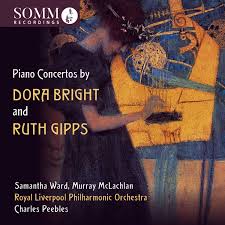
Piano Concertos by Dora Bright and Ruth Gipps
English folk and song-like strains mingle with Classical-Romantic-Impressionist piano concerto forms in the interesting new CD Piano Concertos by Dora Bright and Ruth Gipps (SOMM Recordings CD273).
In the process of listening to this volume we gain an understanding of the charms and expressive clout of Bright (1862-1951) and Gipps (1921-99).
The performances of pianists Samantha Ward (for Bright) and Murray McLachlan (for Gipps) plus the Royal Liverpool Philharmonic Orchestra under Charles Peebles leave nothing to be desired. They are fine in detail and in the performative whole. There is both tenderness and spirit as needed.
Bright's peak formative period (according to the liners) was in the 1880s, Gipps' in the 1940s, so of course they belong to different eras, and so too the post-Brahmsian Englishness of Bright and the expressive clarity of Gipps tie in important ways to the periods in which they lived.
Bight's inventive line-weaving ability is apparent in the "Piano Concerto No. 1" and the "Variations for Piano and Orchestra," which make their recording debut on this CD. They have a flair and stay in the mind as worthwhile. The Variations have depth, the Concerto has heart.
Gipps' "Piano Concerto in G minor" has gravitas and an almost English-Rachmaninovian weightiness.in the first movement, then a puckish sprightliness and a touching lyricism that charms most certainly. The piano parts can be ravishing at times, happily. Her short orchestral "Ambarvalia" is a fittingly songful end to a fascinating program.
A nice surprise, this. Modern it is not, any of it, not exactly, not typically though Gipps sometimes sounds a bit adventuresome, stepping away from a strict Romanticism into an Impressionism of an individual sort, and there is a nice local quality to the outlook in both cases. Hear it and experience some new voices among women historically. Both were talented.
In the process of listening to this volume we gain an understanding of the charms and expressive clout of Bright (1862-1951) and Gipps (1921-99).
The performances of pianists Samantha Ward (for Bright) and Murray McLachlan (for Gipps) plus the Royal Liverpool Philharmonic Orchestra under Charles Peebles leave nothing to be desired. They are fine in detail and in the performative whole. There is both tenderness and spirit as needed.
Bright's peak formative period (according to the liners) was in the 1880s, Gipps' in the 1940s, so of course they belong to different eras, and so too the post-Brahmsian Englishness of Bright and the expressive clarity of Gipps tie in important ways to the periods in which they lived.
Bight's inventive line-weaving ability is apparent in the "Piano Concerto No. 1" and the "Variations for Piano and Orchestra," which make their recording debut on this CD. They have a flair and stay in the mind as worthwhile. The Variations have depth, the Concerto has heart.
Gipps' "Piano Concerto in G minor" has gravitas and an almost English-Rachmaninovian weightiness.in the first movement, then a puckish sprightliness and a touching lyricism that charms most certainly. The piano parts can be ravishing at times, happily. Her short orchestral "Ambarvalia" is a fittingly songful end to a fascinating program.
A nice surprise, this. Modern it is not, any of it, not exactly, not typically though Gipps sometimes sounds a bit adventuresome, stepping away from a strict Romanticism into an Impressionism of an individual sort, and there is a nice local quality to the outlook in both cases. Hear it and experience some new voices among women historically. Both were talented.
Hans Werner Henze, Das Floss der Medusa, Peter Eotvos, WDR Symphonie Orchester, WDR Rundfunkchor, etc.
This newly released recording of Hanz Werner Henze's oratorio Das Floss der Medusa (SWR Classic 19082CD) is only the second to become available as I understand it, the first being of a rehearsal. This one is a live concert performance. It features the SWR Symphonyorchester and SWR Vokalensemble, the SWR Rundfunkchor, the Freiburger Dominsingknaben along with soloists Camilla Nylund, Peter Schone and narration by Peter Stein. Peter Eotvos directs and conducts. The results are excellent.
And in listening I could not help but draw comparisons with Berg's Wozzeck--in the sense that the work feels like a kind of descendant in mode, sound and mood of pathos, a familiar in its own right, with likenesses and differences that perhaps a grandson might exhibit.
It is the choral-soloist-orchestral opus that Henze did so well. If you do not understand German the somewhat lengthy parts narrated/recited in that language may be less interesting than more, but then there is a great deal of wonderful moments in the music, ultra-High Modern in ways unique to Henze, a titan in the world he walked tall within. We hear why in this recording.
There are other works something like this to audition but I must say I am quite happy with the performance/work at hand as a whole after listening heavily to it. Anyone who wants to know Henze or know him better would be well-served and enlivened by this one. And it would be a valuable addition to the confirmed Henze fan's library. Recommended.
And in listening I could not help but draw comparisons with Berg's Wozzeck--in the sense that the work feels like a kind of descendant in mode, sound and mood of pathos, a familiar in its own right, with likenesses and differences that perhaps a grandson might exhibit.
It is the choral-soloist-orchestral opus that Henze did so well. If you do not understand German the somewhat lengthy parts narrated/recited in that language may be less interesting than more, but then there is a great deal of wonderful moments in the music, ultra-High Modern in ways unique to Henze, a titan in the world he walked tall within. We hear why in this recording.
There are other works something like this to audition but I must say I am quite happy with the performance/work at hand as a whole after listening heavily to it. Anyone who wants to know Henze or know him better would be well-served and enlivened by this one. And it would be a valuable addition to the confirmed Henze fan's library. Recommended.
Tuesday, October 1, 2019
Dimensions, Works for Orchestra, Vol.2, Stem, Whitley, Field, Francis, Jarvlepp
New Music continues to flourish. Today, a new volume of an anthology of up-to-the-minute Modern orchestra music entitled Dimensions, Works for Orchestra, Vol. 2 (Navona 6251). The music all has some definite excitement rhythmically and a kind of rootedness in one way or another that gives us Modernity but also a kind of music of place, a locality if you will.
The performances are very good and recording quality fine. So we can hear and appreciate some interesting music that excites by an anything-goes eclecticism as much as originality combined with stylistic largesse, all in a memorably tonal realm.
So we hear the fine drumming inherent in Eric Stem's "Portland," the almost Indonesian stepped meters and layering of Whitley's "Bonzai Down," a sort of pastoral Barber Knoxvilleness set against martial rhythms of Field's Whitman lyric-ed "A Letter from Camp," the rich lyricism and polyrhythmic aspects of Francis' "Concerto #2 for Guitar and Orchestra 'In Somnis Veritas'" and a Latin rhythmic cha-cha feel with Jarvlepp's "Street Music."
It is music that stays with you, that impresses with its together quality and melodic-orchestrational-rhythmic heft. Strongly recommended for all modernists.looking for rhythmic spice.
The performances are very good and recording quality fine. So we can hear and appreciate some interesting music that excites by an anything-goes eclecticism as much as originality combined with stylistic largesse, all in a memorably tonal realm.
So we hear the fine drumming inherent in Eric Stem's "Portland," the almost Indonesian stepped meters and layering of Whitley's "Bonzai Down," a sort of pastoral Barber Knoxvilleness set against martial rhythms of Field's Whitman lyric-ed "A Letter from Camp," the rich lyricism and polyrhythmic aspects of Francis' "Concerto #2 for Guitar and Orchestra 'In Somnis Veritas'" and a Latin rhythmic cha-cha feel with Jarvlepp's "Street Music."
It is music that stays with you, that impresses with its together quality and melodic-orchestrational-rhythmic heft. Strongly recommended for all modernists.looking for rhythmic spice.
Gillian Smith, Into the Stone, Music for Solo Violin by Canadian Women, Ho, Sokolovic, Krausas, Agocs, Laplante
Ms. Smith's fine playing allows us to hear in full virtuoso dimension Alice Ping Le Ho's "Caprice," Ana Sokolovic's "Cinque Danze per violino solo," Veronika Krausas' "Inside the Stone," Kati Agocs' "Versprechen (Promise)," and Chantale Laplante's "Le ciel doit entre proche."
The music has high intensity and Expressionist energy more than Romantic passion, and so fits well into the Modernity we occupy today. Gillian Smith puts a concentrated focus on it all and makes us arise to the music actively with dynamic appreciation. The music references subtly the fiddle-folksy elemental at times (in a way as a novelist might use local forms in a dialog?) and at the same time follows its way into the adventuristically edgy melodic-harmonic, generally with a key center but abstracted as open and forward leaning. All is in the service of a timbrally vibrant violin expression that rings true at all points. And yet somehow the spirit of solo Bach is never entirely distant, happily. It is within a tradition; it is learned in violinistic means yet completely of our time.
Every work shows a true connoisseurship of the violin and its capabilities and in many ways composer and instrumental artist conjoin in perfect mutuality, in continuous performativity. That sets this CD apart as something special.
Fine playing, captivating compositions. Dial MV for Modern Violin, by all means. Do listen if you have time. It is in important ways a solo concert triumph, well worth your time.
Subscribe to:
Posts (Atom)